Loading
Form preview
  • US Legal Forms
  • Other Templates
  • More Forms
  • More Uncategorized Forms
  • Describing Motion Verbally With Distance And Displacement

Get Describing Motion Verbally With Distance And Displacement

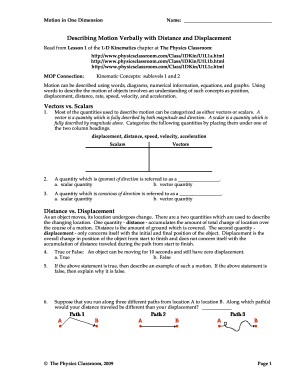
Motion in One Dimension Name: Describing Motion Verbally with Distance and Displacement Read from Lesson 1 of the 1D Kinematics chapter at The Physics Classroom: http://www.physicsclassroom.com/Class/1DKin/U1L1a.html.

How it works

  1. Open form

    Open form follow the instructions

  2. Easily sign form

    Easily sign the form with your finger

  3. Share form

    Send filled & signed form or save

How to fill out the Describing Motion Verbally with Distance and Displacement online

This guide provides clear, step-by-step instructions on how to complete the Describing Motion Verbally with Distance and Displacement form online. By following these steps, users can effectively fill out the form while ensuring that all necessary information is accurately submitted.

Follow the steps to complete the form effectively.

  1. Click the ‘Get Form’ button to obtain the form and open it in your preferred editor.
  2. Identify the sections of the form. Ensure you understand what information each section requires before proceeding.
  3. Begin by entering your name in the designated field, ensuring it is spelled correctly.
  4. Read the introductory instructions carefully to understand how to describe motion using distance and displacement. This will help you fill out the related sections more accurately.
  5. For the section concerning the categorization of distances and displacements, accurately fill in the quantities under vectors or scalars, based on your understanding of these concepts.
  6. Answer any questions presented in the form (e.g., true/false statements) based on your knowledge acquired from the related lessons.
  7. Provide examples or explanations wherever prompted, ensuring they are clear and directly address the questions.
  8. Double-check all entries for accuracy and completeness before proceeding to finish.
  9. Once you have filled out all sections, you can save changes, download, print, or share the completed form.

Start completing the Describing Motion Verbally with Distance and Displacement form online today!

Get form

Experience a faster way to fill out and sign forms on the web. Access the most extensive library of templates available.
Get form

Related content

The Severity of an Earthquake - USGS Publications...
Nov 30, 2016 — ... greatly magnify these ground motions, can detect strong earthquakes...
Learn more
(PDF) Motion in One Dimension Describing Motion...
Motion in One Dimension Name: Describing Motion Verbally with Distance and Displacement...
Learn more
Language - Wikipedia
A language is a structured system of communication used by humans. Languages consist of...
Learn more

Related links form

Expert Opinion Letter Template Peer Review Sample Qualtrust Form Child Support Paid Verification Group - Montreat

Questions & Answers

Get answers to your most pressing questions about US Legal Forms API.

Contact support

Answer Expert VerifiedDisplacement of the body per unit time is called velocity. Velocity is the vector which showcases the direction and the rate of motion.

Distance is a scalar quantity as it only depends upon the magnitude and not the direction. Displacement is a vector quantity as it depends upon both magnitude and direction. ... The distance can only have positive values. Displacement can be positive, negative, and even zero.

Distance is a scalar quantity as it only depends upon the magnitude and not the direction. Displacement is a vector quantity as it depends upon both magnitude and direction. ... The distance can only have positive values. Displacement can be positive, negative, and even zero.

In physics, equations of motion are equations that describe the behavior of a physical system in terms of its motion as a function of time. More specifically, the equations of motion describe the behaviour of a physical system as a set of mathematical functions in terms of dynamic variables.

You can describe the motion of an object by its position, speed, direction, and acceleration. An object is moving if its position relative to a fixed point is changing. Even things that appear to be at rest move.

Use distance to describe the shortest path between starting and ending points, and use displacement to describe the total path between starting and ending points.

The word displacement implies that an object has moved, or has been displaced. Displacement is defined to be the change in position of an object.

Distance is a scalar quantity that refers to "how much ground an object has covered" during its motion. Displacement is a vector quantity that refers to "how far out of place an object is"; it is the object's overall change in position.

Answer: In physics, motion is a change in position of an object with respect to time. Motion is typically described in terms of displacement, distance (scalar), velocity, acceleration, time and speed.

You can describe the motion of an object by its position, speed, direction, and acceleration. An object is moving if its position relative to a fixed point is changing. Even things that appear to be at rest move.

Get This Form Now!

Use professional pre-built templates to fill in and sign documents online faster. Get access to thousands of forms.
Get form
If you believe that this page should be taken down, please follow our DMCA take down processhere.
Get Describing Motion Verbally With Distance And Displacement
Get form
  • Adoption
  • Bankruptcy
  • Contractors
  • Divorce
  • Home Sales
  • Employment
  • Identity Theft
  • Incorporation
  • Landlord Tenant
  • Living Trust
  • Name Change
  • Personal Planning
  • Small Business
  • Wills & Estates
  • Packages A-Z
  • Affidavits
  • Bankruptcy
  • Bill of Sale
  • Corporate - LLC
  • Divorce
  • Employment
  • Identity Theft
  • Internet Technology
  • Landlord Tenant
  • Living Wills
  • Name Change
  • Power of Attorney
  • Real Estate
  • Small Estates
  • Wills
  • All Forms
  • Forms A-Z
  • Other Templates
  • Legal Hub
  • About Us
  • Help Portal
  • Legal Resources
  • Blog
  • Affiliates
  • Contact Us
  • Delete My Account
  • Site Map
  • Industries
  • Forms in Spanish
  • Localized Forms
  • State-specific Forms
  • Forms Kit
  • Real Estate Handbook
  • All Guides
  • Notarize
  • Incorporation services
  • For Consumers
  • For Small Business
  • For Attorneys
  • USLegal
  • FormsPass
  • pdfFiller
  • signNow
  • altaFlow
  • DocHub
  • Instapage
Form Packages
  • Adoption
  • Bankruptcy
  • Contractors
  • Divorce
  • Home Sales
  • Employment
  • Identity Theft
  • Incorporation
  • Landlord Tenant
  • Living Trust
  • Name Change
  • Personal Planning
  • Small Business
  • Wills & Estates
  • Packages A-Z
Form Categories
  • Affidavits
  • Bankruptcy
  • Bill of Sale
  • Corporate - LLC
  • Divorce
  • Employment
  • Identity Theft
  • Internet Technology
  • Landlord Tenant
  • Living Wills
  • Name Change
  • Power of Attorney
  • Real Estate
  • Small Estates
  • Wills
  • All Forms
  • Forms A-Z
  • Other Templates
Customer Service
  • Legal Hub
  • About Us
  • Help Portal
  • Legal Resources
  • Blog
  • Affiliates
  • Contact Us
  • Delete My Account
  • Site Map
  • Industries
  • Forms in Spanish
  • Localized Forms
  • State-specific Forms
  • Forms Kit
Legal Guides
  • Real Estate Handbook
  • All Guides
Prepared for you
  • Notarize
  • Incorporation services
Our Customers
  • For Consumers
  • For Small Business
  • For Attorneys
Our Sites
  • USLegal
  • FormsPass
  • pdfFiller
  • signNow
  • altaFlow
  • DocHub
  • Instapage
Social Media
Call us now toll free:
+1 833 426 79 33
As seen in:
© Copyright 1999-2026 airSlate Legal Forms, Inc. 17 Station Street, Ste. 203, Brookline, MA 02445
  • Your Privacy Choices
  • Terms of Service
  • Privacy Notice
  • Content Takedown Policy
  • Bug Bounty Program