Nd conversations appropriately 2.3 Flexibility 1. Accepts making mistakes without becoming upset/angry 2. Accepts consequences of his/her behavior 3. Accepts unexpected changes 4. Continues to try when something is difficult 5. Ignores others or situations when it is desirable to do so 2.4 Problem Solving 1. Identifies/defines problems 2. Generates solutions to problems 3. Carries out solutions by negotiating or compromising 4. Understands impact his/her behavior has on peers Social Skills Chec.
Loading

Open form follow the instructions

Easily sign the form with your finger

Send filled & signed form or save
How to fill out the Social Skills Checklist online
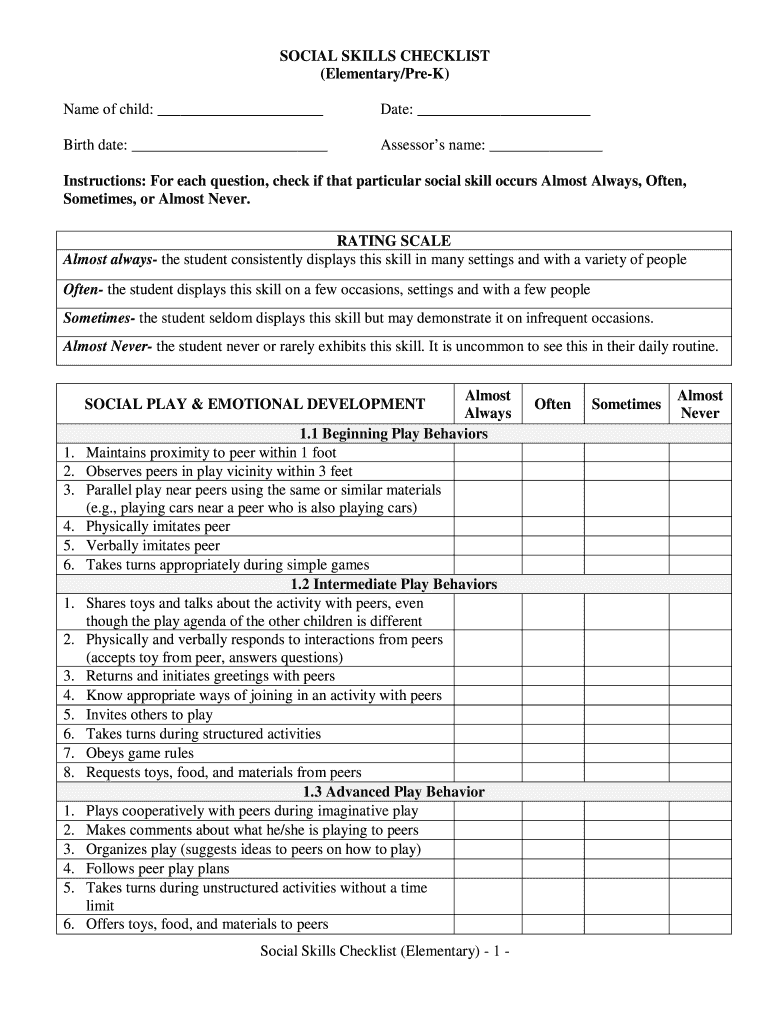
The Social Skills Checklist is a valuable tool designed to assess a child's social skills across various dimensions. This guide provides step-by-step instructions on how to effectively fill out the checklist online, ensuring that all relevant skills and behaviors are accurately assessed.
Follow the steps to complete the Social Skills Checklist online.
- Press the ‘Get Form’ button to access the Social Skills Checklist. Ensure the form opens in your preferred online editor.
- Begin by entering the child's name in the designated field at the top of the form.
- Fill in the date and the child's birth date in the respective fields to establish a clear record.
- Enter the assessor's name in the appropriate section to identify who is completing the checklist.
- Review each question carefully within the checklist. For each social skill, select one of the options: Almost Always, Often, Sometimes, or Almost Never, based on your observations of the child's behavior.
- Proceed through the sections: Beginning Play Behaviors, Intermediate Play Behaviors, Advanced Play Behaviors, Understanding Emotions, Self Regulation, Flexibility, Problem Solving, Conversational Skills, Nonverbal Conversational Skills, and Compliments.
- In each section, ensure that you check the appropriate box that reflects the child's skill level for each specified behavior.
- Once you have completed all sections, calculate the total percentage for each rating category as outlined in the summary section of the checklist.
- After completing the form, review all entries for accuracy and completeness.
- Save any changes, and download or print the completed Social Skills Checklist for your records or to share as needed.
Complete the Social Skills Checklist online today to support effective assessments of social development.
Experience a faster way to fill out and sign forms on the web. Access the most extensive library of templates available.
Related content
The Social Skills Checklist. Name of student. Diagnosis. Date of pre-test ... The Social...
For Instructor Use: Fill out priority skills for instruction based on check marked skills...
Your four-part Gander Instruction Manual is designed to help you better understand and...
Get answers to your most pressing questions about US Legal Forms API.
How many types of social skills are there?
There are numerous types of social skills, typically categorized into verbal communication, nonverbal communication, interpersonal skills, and group dynamics. Each category serves distinct purposes in social interactions and relationships. Understanding these different types can help prioritize skill development. A Social Skills Checklist can help you ensure you cover all types for a well-rounded approach.
What are the 7 steps when implementing social skills training?
The seven steps when implementing social skills training include conducting a needs assessment, setting clear objectives, selecting appropriate activities, teaching skills directly, practicing through role-play, providing feedback, and evaluating progress. Each step is crucial to ensure a comprehensive training experience. Following these steps leads to long-lasting improvements. Including this process in your Social Skills Checklist can enhance your training effectiveness.
What are the steps of social skills training?
The steps of social skills training typically include assessment, goal setting, teaching specific skills, role-playing scenarios, providing feedback, and promoting practice in real-life situations. This structured approach ensures that individuals gain and reinforce their social competencies effectively. Regular assessment and adjustment of techniques help maintain progress. Use a Social Skills Checklist to keep track of your training steps.
What is the social skills questionnaire?
The social skills questionnaire is a tool that measures various interpersonal abilities, including communication and emotional understanding. It provides insights into how individuals perform in social settings and allows for targeted improvement strategies. Understanding your results can inform your development in this area. Use a Social Skills Checklist to align your practice with the findings from this questionnaire.
What are the 7 points of social competence?
The seven points of social competence include communication, empathy, social problem-solving, cooperation, adaptability, conflict resolution, and decision-making. Each point plays a vital role in how individuals interact with others. Developing these competencies can enhance your ability to connect with peers and succeed in collaborative environments. A Social Skills Checklist can help you focus your efforts on these essential points.
What are functional social skills examples?
Functional social skills examples include greeting others, making eye contact, asking for help, and participating in group discussions. These skills are vital for everyday interactions, whether at work, school, or in social settings. They help establish relationships and navigate social norms successfully. Use a Social Skills Checklist to focus on these functional skills in your development plan.
What is the social functioning questionnaire?
The social functioning questionnaire assesses an individual's ability to navigate social situations and maintain relationships. It measures aspects like cooperation, communication, and the ability to resolve conflicts effectively. This tool helps identify potential areas requiring attention for social improvement. Incorporating a Social Skills Checklist can provide clear steps based on your questionnaire results.
What causes poor social skills?
Poor social skills can stem from various factors, such as limited social exposure, lack of practice, or underlying issues like anxiety or autism spectrum disorders. These challenges may hinder effective communication and interaction. Recognizing these barriers is the first step toward improvement. A Social Skills Checklist can guide your journey toward enhancing your social abilities despite these challenges.
What is the social communication skills questionnaire?
The social communication skills questionnaire is designed to assess how individuals communicate effectively in social contexts. This tool evaluates aspects like verbal and nonverbal communication, listening skills, and emotional understanding. It provides insights into one's social communication strengths and weaknesses. Completing a Social Skills Checklist alongside this questionnaire can further aid in identifying development areas.
What are four examples of social skills?
Four examples of social skills include effective communication, empathy, teamwork, and conflict resolution. Each of these skills plays a crucial role in everyday interactions and relationships. Practicing these skills can enhance your social dynamics significantly. Referencing a Social Skills Checklist can help you focus on cultivating these abilities systematically.
Use professional pre-built templates to fill in and sign documents online faster. Get access to thousands of forms.
If you believe that this page should be taken down, please follow our DMCA take down process here.