that are not consistent with the agent’s fiduciary duties to the tenant. Broker’s Agents A broker’s agent is an agent that cooperates or is engaged by a listing agent or a tenant’s agent (but does not work for the same firm as the listing agent or tenant’s agent) to assist the listing agent or tenant’s agent in locating a property to rent or lease for the listing agent’s landlord or the tenant agent’s tenant. The broker’s agent does not have a direct relationship with the ten.
Loading

Open form follow the instructions

Easily sign the form with your finger

Send filled & signed form or save
How to fill out the NY DOS-1735-a online
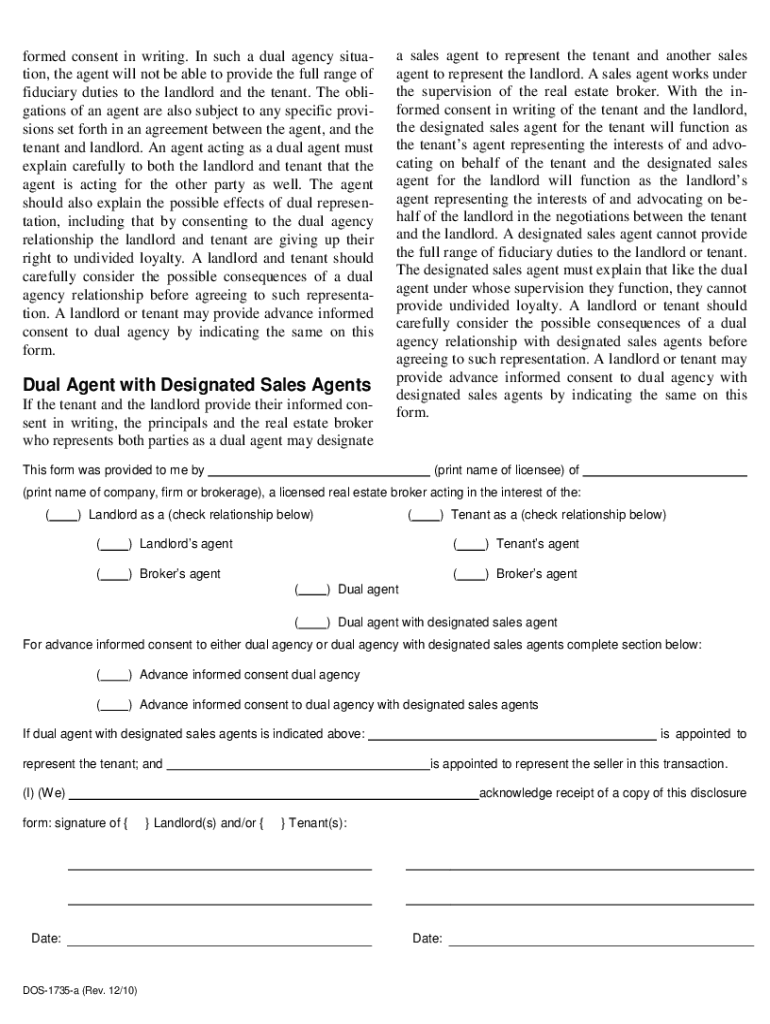
The NY DOS-1735-a is a disclosure form that real estate licensees provide to inform landlords and tenants about their agency relationships. This guide will help you understand how to fill out the form accurately and navigate its online version with ease.
Follow the steps to complete the NY DOS-1735-a online efficiently.
- Press the 'Get Form' button to access the form and open it in the online editor.
- Begin by filling in the name of the licensee who provided you with this disclosure form. Ensure this information is correct, as it identifies the real estate professional you are working with.
- Next, enter the name of the company, firm, or brokerage representing the licensee. This establishes the affiliation of the agent with a licensed real estate organization.
- Indicate the nature of the relationship you have with the agent or broker. Check the appropriate box to specify if they are acting as a landlord’s agent, tenant’s agent, broker’s agent, dual agent, or dual agent with designated sales agents.
- If applicable, provide advance informed consent for dual agency or dual agency with designated sales agents. Check the corresponding box based on your agreement with the agent.
- Complete the section for appointing designated agents if you have indicated dual agency with designated sales agents. Clearly state which agent represents the tenant and which agent represents the landlord.
- Finally, sign and date the form. This acknowledges that you have received a copy of the disclosure and understand its contents.
- After filling out the form, you can save your changes, download a copy, print it, or share it as required.
Complete your documents online for a smoother process.
Experience a faster way to fill out and sign forms on the web. Access the most extensive library of templates available.
Related content
THIS IS NOT A CONTRACT. New York State law requires real estate licensees who are acting...
Apr 4, 1994 — c. The laboratory computer, equipped with a magneto-optical drive for file...
If the download does not execute properly, verify the following: •. The COM port is...
Get answers to your most pressing questions about US Legal Forms API.
What are the exemptions for property condition disclosure in NY?
In New York, certain exemptions allow sellers to avoid full disclosure requirements. Properties such as newly constructed homes, those sold at foreclosure, or inherited properties may qualify for these exemptions. Understanding these exclusions is important for sellers, and consulting resources like US Legal Forms can guide you through the nuances of NY DOS-1735-a.
What is the New York state disclosure form?
The New York state disclosure form, known as the NY DOS-1735-a, is a document that sellers must complete when selling residential real estate. This form requires sellers to provide detailed information about the property's condition and any known issues. Using the NY DOS-1735-a ensures compliance with state laws and helps to build trust with potential buyers.
What needs to be disclosed when selling a house in NY?
When selling a house in New York, you must disclose any known issues such as water damage, pest problems, or structural defects. Additionally, sellers should inform potential buyers about any environmental hazards, lead paint, or zoning issues. Clearly understanding your responsibilities under NY DOS-1735-a can enhance the selling process and foster better buyer-seller relationships.
What is the duty to disclose in NY?
In New York, the duty to disclose involves informing buyers of any known defects or issues with the property. Sellers are expected to be transparent, providing essential details necessary for buyers to make informed decisions. Adhering to these obligations outlined in NY DOS-1735-a can prevent legal complications and promote trust between parties.
Is New York a mandatory disclosure state?
Yes, New York is a mandatory disclosure state. This means sellers must disclose specific information about the property to potential buyers. The regulations, specifically under NY DOS-1735-a, ensure that buyers are informed about any known issues, which contributes to a fair selling process.
What is the new property disclosure law in NY?
The new property disclosure law in New York enhances transparency in real estate transactions. Under this law, sellers must provide buyers with detailed information about the property's condition. This requirement falls under the guidelines established by NY DOS-1735-a, aiming to protect both buyers and sellers in the housing market.
Is New York a mandatory reporting state?
Yes, New York is a mandatory reporting state. This means that certain professionals are required to report suspected child abuse or neglect. This obligation extends to various professions, ensuring that children receive the protection they need. Understanding these requirements can help you navigate obligations more effectively and is crucial for compliance with laws like NY DOS-1735-a.
How long can a landlord hold a security deposit in NY?
In New York, a landlord may hold a security deposit for up to 14 days after the tenant leaves the rental property as per the guidelines set in the NY DOS-1735-a. During this time, landlords may conduct a final inspection and itemize any potential damages. Timely return of the deposit is crucial to avoid legal issues and ensure a smooth transition for everyone involved.
What happens if a landlord does not return a security deposit in New York?
If a landlord fails to return a security deposit in New York, tenants may seek legal recourse. The NY DOS-1735-a outlines that landlords must return the deposit within 14 days after a tenant vacates, along with an itemized list of any deductions. If a landlord does not comply, tenants can pursue a claim in small claims court for the deposit and additional damages.
Can a tenant refuse viewings in New York?
In New York, tenants have the right to refuse viewings of their rental unit, but landlords must provide reasonable notice as per the lease agreement. Under New York law, a landlord must give at least 24 hours of notice before a viewing, although the NY DOS-1735-a encourages open communication to facilitate showings. Always discuss your preferences with your landlord to reach a mutual agreement.
Use professional pre-built templates to fill in and sign documents online faster. Get access to thousands of forms.
If you believe that this page should be taken down, please follow our DMCA take down process here.