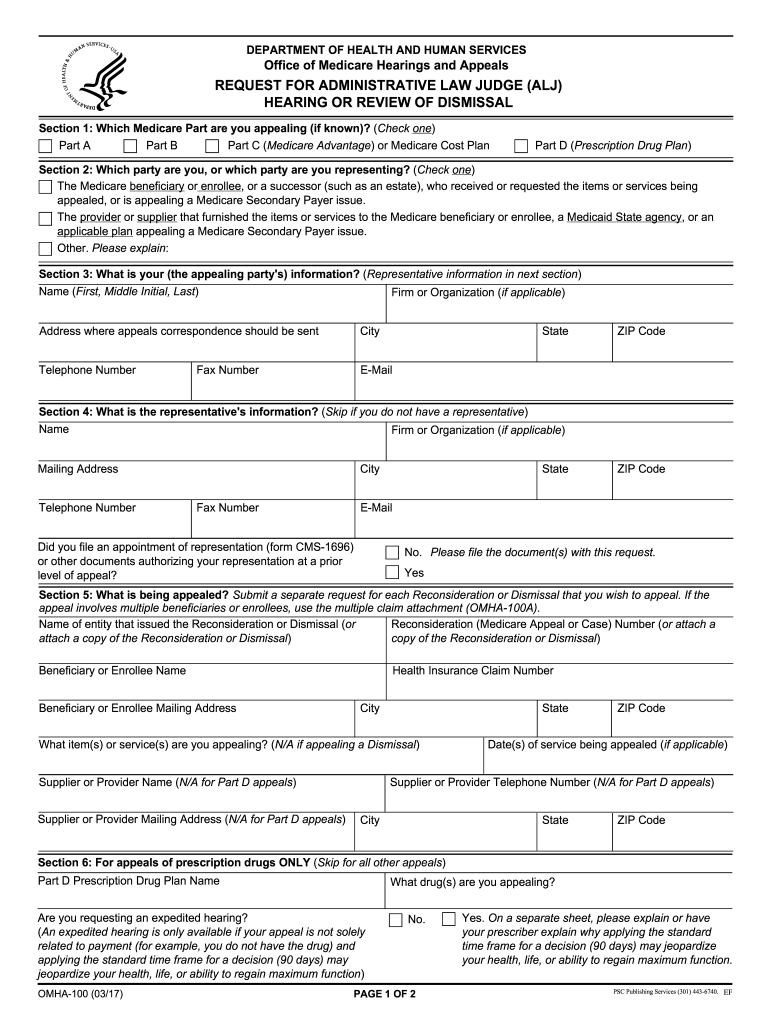
Ng (if known)? (Check one) Part A Part B Part C (Medicare Advantage) or Medicare Cost Plan Part D (Prescription Drug Plan) Section 2: Which party are you, or which party are you representing? (Check one) The Medicare beneficiary or enrollee, or a successor (such as an estate), who received or requested the items or services being appealed, or is appealing a Medicare Secondary Payer issue. The provider or supplier that furnished the items or services to the Medicare beneficiary or enrollee, a M.
Loading

Open form follow the instructions

Easily sign the form with your finger

Send filled & signed form or save
How to fill out the HHS OMHA-100 online
The HHS OMHA-100 form is essential for individuals looking to appeal a Medicare decision. This guide provides clear, step-by-step instructions for completing the form online, ensuring that users can effectively submit their appeals.
Follow the steps to fill out the HHS OMHA-100 online
- Click the ‘Get Form’ button to access the HHS OMHA-100 form and open it in your browser.
- Section 1 requires you to indicate which Medicare Part you are appealing. Check one box for Part A, Part B, Part C, or Part D as applicable.
- In Section 2, identify which party you are representing by selecting the appropriate option: the Medicare beneficiary, the provider, or another party.
- Provide your information in Section 3, including your name, address, contact information, and any relevant organization details.
- If applicable, enter your representative's information in Section 4, including their name and contact details.
- In Section 5, specify what is being appealed, including the name of the entity that issued the Reconsideration or Dismissal and any related information.
- Complete Section 6 if your appeal involves prescription drugs; provide details regarding the drug and whether you are requesting an expedited hearing.
- Use Section 7 to explain your reasons for disagreeing with the Reconsideration or Dismissal. Attach additional sheets if necessary.
- In Section 8, indicate whether you are submitting evidence and provide details if you are.
- Section 9 allows you to include any other important information regarding your appeal, including questions about claims aggregation.
- In Section 10, certify that copies of the appeal went to other parties involved, providing their name and mailing address.
- Finally, refer to Section 11 for instructions on where to send the completed form and ensure you meet the filing deadlines.
- Once you have filled out all sections, you can save your changes, download the form, print it, or share it as necessary.
Complete your HHS OMHA-100 form online today to ensure your appeal is processed efficiently.
Experience a faster way to fill out and sign forms on the web. Access the most extensive library of templates available.
Related content
Jul 9, 2025 — This form is used as an attachment to form OMHA‑100 to identify multiple...
by DR Golinghorst · Cited by 1 — However, following the decision in Illinois Council...
Dec 31, 2020 — (I.R.S. Employer. Identification No.) 9001 Liberty Parkway. Birmingham...
Get answers to your most pressing questions about US Legal Forms API.
What is the threshold for ALJ?
The threshold for ALJ hearings aligns closely with the Medicare appeal amount of $200. Meeting or exceeding this monetary figure is essential to pursue any administrative law hearing. Utilizing the HHS OMHA-100 form simplifies the process in presenting your appeal confidently.
What is the amount in controversy requirements?
The amount in controversy requirements generally stipulate a specific monetary threshold that must be met to initiate an appeal. For Medicare appeals, this amount currently requires $200. Ensure your appeal follows proper guidelines, including requests made through the HHS OMHA-100 form.
What is the amount in controversy for a class action?
In class action lawsuits, the amount in controversy can vary widely depending on the nature of the claims and the number of affected individuals. Generally, these claims are often larger than individual disputes. Understanding your specific situation is crucial, and utilizing tools like the HHS OMHA-100 can help clarify and organize your appeal process.
How does an ALJ hearing work?
An ALJ hearing functions as a structured proceeding where a claimant can present their case. During the hearing, both parties have the opportunity to provide evidence and make arguments. The outcome will ultimately depend on the details outlined in your HHS OMHA-100 submission and the interpretations of the law by the judge.
What is an appeal through an administrative law judge ALJ hearing?
An appeal through an administrative law judge (ALJ) hearing serves as a formal request for review of a decision regarding Medicare or Medicaid claims. This process allows individuals to present their cases and provide evidence. The HHS OMHA-100 form is integral to this appeal, helping to guide your claims through the system.
What is the amount in controversy for ALJ?
For cases involving an Administrative Law Judge (ALJ), the amount in controversy is generally the same as Medicare, which is $200. This amount must be met before a claim can proceed to an HHS OMHA-100 hearing. If your disagreement with a claim meets this figure, you can pursue the appeal process.
What is the amount in controversy for Medicare?
The amount in controversy for Medicare typically refers to the minimum sum needed to appeal a decision made by Medicare. Currently, this amount is set at $200. When your amount in controversy meets this threshold, you can initiate an HHS OMHA-100 appeal to seek a review.
What is the HA 501 form?
The HA 501 form is a critical document in the Medicare appeals process. It is used to request a hearing before an Administrative Law Judge (ALJ) regarding Medicare claims disputes. If you are navigating the HHS OMHA-100 process, accurately completing this form is vital for ensuring your case is considered. Make sure to include all necessary information to avoid delays in your appeal.
How to check medicare appeal status online?
Checking your Medicare appeal status online is a straightforward process. You can visit the official Medicare website and log into your account to find the latest information on your case. If you're using the HHS OMHA-100 process, you'll want to ensure you have your case number handy for efficient tracking. Keeping updated on your appeal can help you manage expectations and make informed decisions regarding your next steps.
How does the ALJ make a decision?
An Administrative Law Judge (ALJ) makes decisions based on the evidence presented in a hearing. During this process, the ALJ reviews medical records, documents, and testimony from the involved parties. This evidentiary hearing is fundamental for deciding cases under the HHS OMHA-100 process, ensuring a thorough assessment before reaching a conclusion. It's important to prepare adequately to present your case effectively.
Use professional pre-built templates to fill in and sign documents online faster. Get access to thousands of forms.
If you believe that this page should be taken down, please follow our DMCA take down process here.