Loading
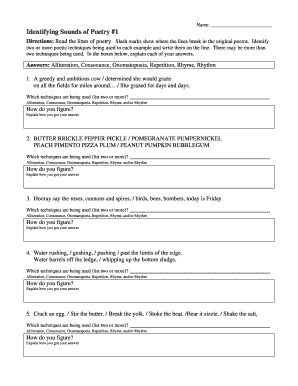
Get Identifying Sounds Of Poetry 1 Answer Key
How it works
-

Open form follow the instructions
-

Easily sign the form with your finger
-

Send filled & signed form or save
How to fill out the Identifying Sounds Of Poetry 1 Answer Key online
Filling out the Identifying Sounds Of Poetry 1 Answer Key is a crucial step in analyzing poetic techniques and enhancing your understanding of poetry. This guide will provide you with straightforward, step-by-step instructions to complete the form effectively online.
Follow the steps to fill out the form accurately
- Click the ‘Get Form’ button to access the Identifying Sounds Of Poetry 1 Answer Key and open it in your editing interface.
- Begin by entering your name in the provided field at the top of the form. This identifies you as the user of this answer key.
- Read each line of poetry carefully. After each example, designate two or more poetic techniques that are utilized. You may use options such as alliteration, consonance, onomatopoeia, repetition, rhyme, or rhythm.
- In the space provided for each example, write down the poetic techniques you have identified. Ensure that you list all relevant techniques, as some examples may contain more than two.
- For each poetic technique you identify, use the explanation section to describe your reasoning. This will help reinforce your understanding of how these techniques are used in the context of the poem.
- Once all examples have been completed and your explanations are thorough, review your answers to ensure clarity and accuracy.
- Finally, save your changes. You may choose to download, print, or share the completed answer key as needed.
Complete the Identifying Sounds Of Poetry 1 Answer Key online to enhance your poetry analysis skills!
A very common line, “The rain in Spain stays mainly on the plains” from the movie, 'My Fair Lady' is a very good example of assonance. The words rain, Spain, stays, mainly and plains used in the sentence is an example of assonance.