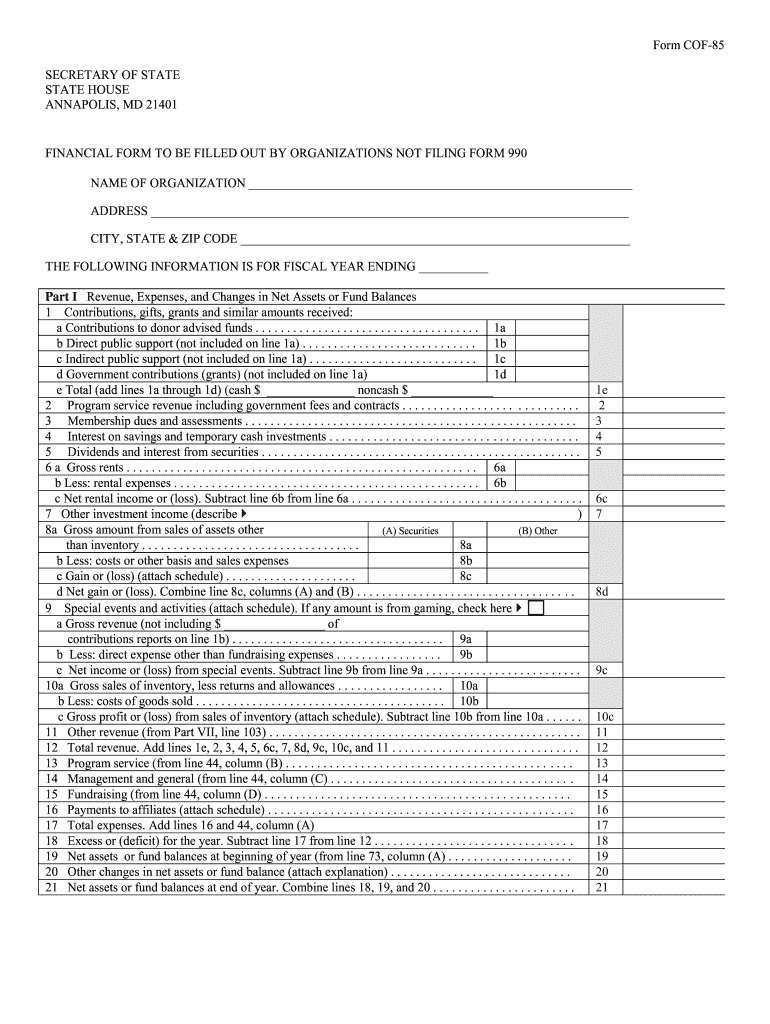
. 12 Total revenue. Add lines 1e, 2, 3, 4, 5, 6c, 7, 8d, 9c, 10c, and 11 . . . . . . . . . . . . . . . . . . . . . . . . . . . . . . 13 Program service (from line 44, column (B) . . . . . . . . . . . . . . . . . . . . . . . . . . . . . . . . . . . . . . . . . . . . . . 14 Management and general (from line 44, column (C) . . . . . . . . . . . . . . . . . . . . . . . . . . . . . . . . . . . . . . . 15 Fundraising (from line 44, column (D) . . . . . . . . . . . . . . . . . . . . . . . . . . . . . .
Loading

Open form follow the instructions

Easily sign the form with your finger

Send filled & signed form or save
How to fill out the MD COF-85 online
The MD COF-85 is a financial form designed for organizations that do not file Form 990. This guide provides comprehensive steps to assist users in accurately completing the form online. The instructions below will navigate through each section, ensuring clarity and completeness.
Follow the steps to fill out the MD COF-85 efficiently
- Press the ‘Get Form’ button to acquire the MD COF-85 and open it for editing.
- Fill in the organization name, address, and city, state, and zip code in the designated fields. Ensure all information is current and accurate.
- Indicate the fiscal year ending date in the specified field.
- Complete Part I by detailing revenue, expenses, and changes in net assets or fund balances. Enter contributions, grants, government contributions, and total revenue as applicable.
- In Part II, provide a statement of functional expenses. List each category of expenses, including salaries, compensation, and other relevant expenses. Ensure to attach all necessary schedules if required.
- For Part III, describe each program service provided, including expenses and allocations associated with those services.
- Fill out Part IV by stating program service revenue, detailing any fees from government agencies and calculating total revenues accurately.
- Complete Part V by documenting the balance sheet. Include all applicable assets and liabilities, ensuring that totals are calculated accurately.
- List all officers, directors, and trustees in Part VI, including compensation details if applicable.
- In Part VII, provide information about the five highest paid individuals for professional services. Ensure accurate reporting of compensation.
- Finally, review all sections for completeness. Ensure to sign and date the form, declaring that the information is true and correct.
- After revisions, save changes, and choose to download, print, or share the completed form as needed.
Consider completing your documents online for a streamlined experience.
Experience a faster way to fill out and sign forms on the web. Access the most extensive library of templates available.
Related content
Directions for completing the financial report; form COF-85: Part I-Statement of Revenue:...
by R Freund · Cited by 966 — Overall, this review will focus on the impressive progress...
The StarCore Assembler converts handwritten or compiler-generated StarCore assembly code...
Get answers to your most pressing questions about US Legal Forms API.
What is the 33% rule for nonprofits?
The 33% rule suggests that no more than one-third of a nonprofit’s board members should be related to ensure diversity in governance. This rule helps foster diverse perspectives, which is vital for decisions affecting the organization’s mission. For organizations navigating board composition, MD COF-85 offers helpful resources.
What are the requirements of a non-profit board?
Nonprofit boards must have at least three members, who must meet certain criteria regarding independence and engagement. Board members should have a genuine interest in the organization's mission and be willing to take on legal and fiscal responsibilities. For further guidance, referring to the MD COF-85 will help clarify these requirements.
What is the difference between a nonprofit board and a for-profit board?
The key difference is that a nonprofit board focuses on furthering the organization’s mission rather than generating profit. Members of a nonprofit board serve voluntarily and prioritize community impact. In contrast, a for-profit board’s primary goal is to maximize shareholder value, leading to different decision-making processes in the respective organizations.
Are charitable donations tax deductible in Maryland?
Yes, charitable donations made to qualified nonprofits in Maryland are generally tax-deductible. However, it's important to ensure that your organization is registered and recognized as tax-exempt. Utilizing the MD COF-85 can help clarify your charity's status for potential donors.
What are the requirements for a nonprofit board in Maryland?
Maryland requires that nonprofit boards consist of at least three people who are not related. Additionally, board members should be knowledgeable and committed to the organization’s mission. Following the MD COF-85 guidelines helps ensure that your nonprofit board meets all legal and functional requirements.
How many board members does a nonprofit need in Maryland?
In Maryland, a nonprofit organization must have a minimum of three board members. These members must not be related to ensure a diverse governance structure. Having a varied board fosters better decision-making and aligns well with the MD COF-85 requirements.
How do I renew my charity registration in Maryland?
To renew your charity registration in Maryland, visit the appropriate government website to complete the renewal process. You will need to file the MD COF-85 documentation, which includes submitting financial reports and paying any associated fees. Using services like uslegalforms can help guide you through the renewal steps seamlessly.
How do I verify a charity?
To verify a charity, you can check their registration status through the Maryland Secretary of State's website. The MD COF-85 ensures that all charities are listed and accountable for their activities. Additionally, reviewing financial statements and donor reports can provide insights into a charity's legitimacy.
What is the Maryland Charitable Solicitations Act?
The Maryland Charitable Solicitations Act regulates how charities solicit donations in the state. It ensures transparency and accountability, helping to protect donors and the public. Understanding the MD COF-85 is crucial for any charity operating in Maryland, as it outlines the requirements for registration and compliance.
How to set up a non-profit in Maryland?
Setting up a nonprofit in Maryland involves several key steps, including filing articles of incorporation and applying for tax-exempt status. Begin by developing a clear mission statement and assembling a board of directors. Utilizing the MD COF-85 resource can simplify this process, as it provides comprehensive guidelines and templates. Following these steps carefully will help ensure a successful launch for your nonprofit organization.
Use professional pre-built templates to fill in and sign documents online faster. Get access to thousands of forms.
If you believe that this page should be taken down, please follow our DMCA take down process here.