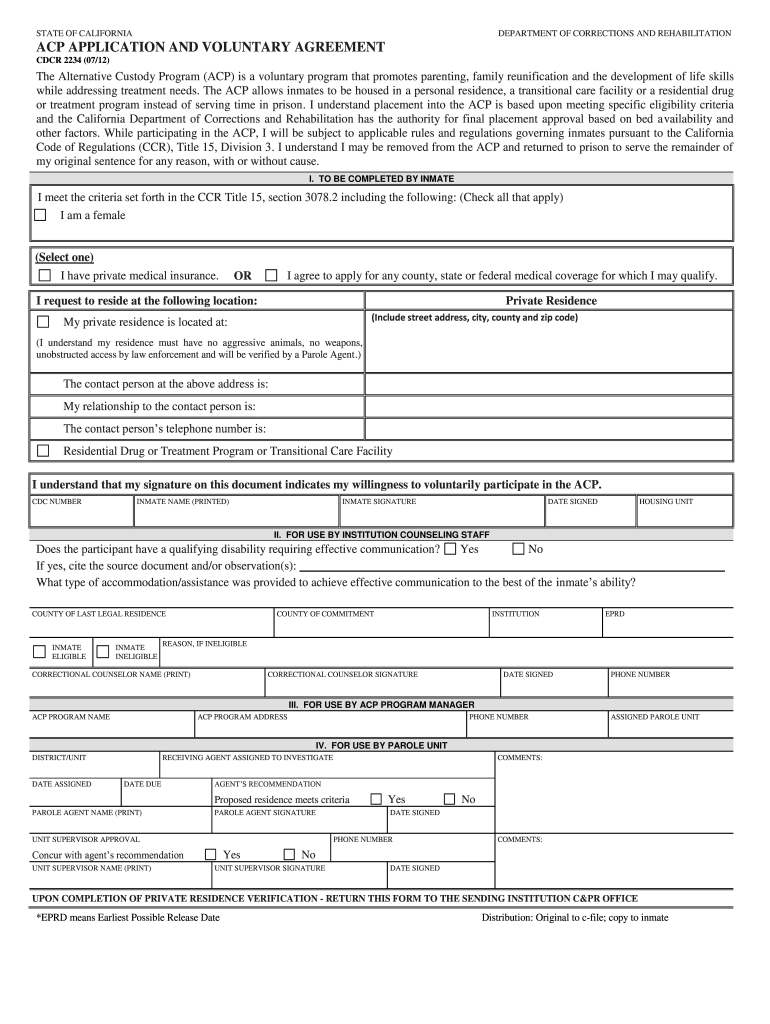
STATE OF CALIFORNIA DEPARTMENT OF CORRECTIONS AND REHABILITATION ACP APPLICATION AND VOLUNTARY AGREEMENT CDCR 2234 07/12 The Alternative Custody Program ACP is a voluntary program that promotes parenting family reunification and the development of life skills while addressing treatment needs. The ACP allows inmates to be housed in a personal residence a transitional care facility or a residential drug or treatment program instead of serving time in prison* I understand placement into the ACP is based upon meeting specific eligibility criteria and the California Department of Corrections and Rehabilitation has the authority for final placement approval based on bed availability and other factors. While participating in the ACP I will be subject to applicable rules and regulations governing inmates pursuant to the California Code of Regulations CCR Title 15 Division 3. I understand I may be removed from the ACP and returned to prison to serve the remainder of my original sentence for any....
Loading

Open form follow the instructions

Easily sign the form with your finger

Send filled & signed form or save
How to fill out the CA CDCR 2234 online
The CA CDCR 2234 form is essential for individuals seeking to participate in the Alternative Custody Program. This guide provides clear, step-by-step instructions for completing the form online, ensuring a smooth and effective submission process.
Follow the steps to successfully complete the form online
- Press the ‘Get Form’ button to access the CA CDCR 2234 form and open it in the editor.
- Begin by completing the personal information section. This includes entering your CDC number, printed name, signature, and the date signed.
- Indicate your eligibility by checking all applicable criteria listed, such as whether you are female or if you have private medical insurance.
- If you do not have private medical insurance, select the option to apply for county, state, or federal medical coverage. Include all relevant details as requested.
- Provide your proposed residence information. Include the street address, city, county, and zip code, ensuring no aggressive animals or weapons are present.
- List a contact person at the proposed residence, including their relationship to you and their contact telephone number.
- Review the section for acknowledgment of the rules and regulations, affirming your willingness to participate in the program.
- Once all sections are completed, ensure all required signatures are provided where necessary and verify the accuracy of your information.
- Save your changes, then download, print, or share the completed form as needed. Ensure that it is returned to the appropriate institution office upon completion.
Start filling out the CA CDCR 2234 online now to take the first step in your application process.
Experience a faster way to fill out and sign forms on the web. Access the most extensive library of templates available.
Related content
If an individual is requesting ACP placement in a private program, an acceptance letter...
Apr 4, 2024 — How to Apply for ACP: An incarcerated individual may request ACP placement...
0967-420-0000 series (formerly NAVSHIPS 94200 series), is to provide descriptive and...
Get answers to your most pressing questions about US Legal Forms API.
Can you be a correctional officer with a background?
Having a background does not automatically disqualify you from becoming a correctional officer in California. Each case is evaluated individually, considering factors like the severity of offenses and how long ago they occurred. Understanding how CA CDCR 2234 affects hiring decisions can help you address potential concerns during the application process.
How to pass a correctional officer interview?
To pass a correctional officer interview, preparation is key. Familiarizing yourself with the requirements and laws, such as CA CDCR 2234, will show your commitment to the role. Practice common interview questions, display confidence, and demonstrate a solid understanding of your responsibilities as a correctional officer in California.
How much of your sentence do you serve in California?
In California, the amount of time served can vary based on several factors, including the nature of the crime and any credits earned for good behavior. Generally, inmates may serve a portion of their sentence with the potential for early release under programs introduced by laws like CA CDCR 2234. Therefore, understanding these regulations can help individuals and families better navigate the complexities of sentencing.
What are the requirements to be a correctional officer in California?
To become a correctional officer in California, candidates must meet specific requirements. Applicants need to be at least 21 years old, possess a high school diploma or equivalent, and pass a series of background checks and examinations. Familiarity with CA CDCR 2234 can enhance your understanding of the evolving expectations and essential qualifications of the role.
What disqualifies you from being a correctional officer in California?
Certain criteria can disqualify you from becoming a correctional officer in California. For instance, a felony conviction, serious misdemeanor charges, or any form of misconduct during prior law enforcement employment can prevent your application from progressing. CA CDCR 2234 emphasizes the importance of integrity and character in maintaining safety within correctional facilities.
What is the new law to release inmates in California?
The new law, known as CA CDCR 2234, aims to reduce the prison population by providing incentives for inmates to earn early release. This law focuses on rehabilitative programs that help incarcerated individuals transition back into society successfully. By encouraging participation in these programs, California aims to promote public safety and lower recidivism rates.
What is the CDCR alternative custody program?
The CDCR alternative custody program allows eligible inmates to serve their time outside of prison under strict supervision, focusing on rehabilitation. This program is an aspect of CA CDCR 2234 that aims to reduce recidivism and aid reintegration into society. Participation in the program involves meeting certain criteria, including good behavior.
How long does it take to get approved for CDCR visiting?
The approval process for CDCR visiting can take anywhere from a few weeks to a month, depending on various factors under CA CDCR 2234. It is crucial to provide complete and accurate information during the application process to avoid potential delays. Checking in with the facility may also help you monitor the status of your application.
How do you get approved for conjugal visits?
To get approved for conjugal visits in CDCR, you must meet specific eligibility criteria outlined in CA CDCR 2234. The inmate must qualify, and you must submit a request with all required documentation, which includes a background check. Stay informed about the rules and guidelines to enhance your chances of approval.
How long does it take for someone to show up on VINELink?
After an inmate undergoes processing in the CDCR system, it usually takes about 24 to 48 hours for their information to appear on VINELink. This system is designed to provide timely alerts and updates under CA CDCR 2234 regulations. If you have concerns or need assistance, you can rely on uslegalforms to help you navigate the process.
Use professional pre-built templates to fill in and sign documents online faster. Get access to thousands of forms.
If you believe that this page should be taken down, please follow our DMCA take down process here.