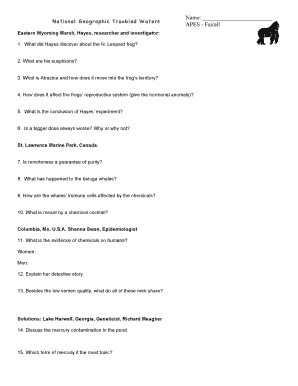
National Geographic Troubled W aters Name: APES Fairall Eastern Wyoming Marsh, Hayes, researcher and investigator: 1. What did Hayes discover about the N. Leopard frog? 2. What are his suspicions?.

How it works
  • Open form

    Open form follow the instructions

  • Easily sign form

    Easily sign the form with your finger

  • Share form

    Send filled & signed form or save

How to fill out the What Did Hayes Discover About The N Leopard Frog online

This guide provides detailed, step-by-step instructions on completing the form titled 'What Did Hayes Discover About The N Leopard Frog' online. Designed for a broad audience, it aims to assist users in navigating the form's components effectively.

Follow the steps to complete your form accurately and efficiently.

  1. Press the ‘Get Form’ button to access the form and open it in your chosen editor.
  2. Begin by entering your name in the designated field at the top of the form.
  3. In the first section, respond to the question about what Hayes discovered regarding the N. Leopard frog, providing a concise summary of the findings.
  4. Next, address Hayes’ suspicions by detailing his concerns or theories related to the frog’s condition.
  5. Describe Atrazine, focusing on its nature and the pathways through which it contaminates the frog’s environment.
  6. Detail the effects of Atrazine on the frogs' reproductive systems, including any hormonal anomalies that were observed in Hayes' research.
  7. Summarize Hayes' conclusions from his experiment, highlighting key insights and the broader implications of his findings.
  8. Consider the discussion on dosage. Reflect on whether a larger dose of the substances involved is necessarily more harmful and explain why or why not.
  9. Continue through the subsequent sections of the form, addressing questions related to the St. Lawrence Marine Park, Columbia, Missouri, and mercury contamination as outlined in the form.
  10. Finally, review all entries for accuracy before saving your changes. You can download, print, or share the completed form as needed.

Begin completing the What Did Hayes Discover About The N Leopard Frog form online today!

Get form

Experience a faster way to fill out and sign forms on the web. Access the most extensive library of templates available.

Related content

WDFW Status Report for the Northern Leopard Frog

Oct 4, 1999 — Department of Fish and Wildlife, 600 Capitol Way N, Olympia, WA 98501-1091...

Learn more
Atrazine exposure disturbs frogs' sexual...

As Hayes later discovered, many atrazine-contaminated ponds in the Midwest contain native...

Learn more
The Art And Craft Of Fiction: A Writer's Guide...

If you have fact-checking or research to do for your story, save it until the end of...

Learn more
Questions & Answers

Get answers to your most pressing questions about US Legal Forms API.

Contact support

What is the conclusion of Hayes experiment?

Hayes's research suggests that this chemical, Atrazine, can cause the male hormone to turn into the female hormone estrogen. This extra estrogen can cause males to not only grow eggs but even develop ovaries.

Adult Northern Leopard Frogs feed on insects, small mammals, small fish, worms, and other frogs and tadpoles. Cannibalism has been reported in Northern Leopard Frogs. They are nocturnal. Breeding sometimes will start even before the ice has left their breeding site, sometimes starting in April, but mostly in May.

Eats terrestrial invertebrates such as insects and insect larvae, spiders, slugs, snails and earthworms. Large adults also eat other frogs.

As adults, Northern Leopard Frogs are carnivores and are not picky about what they eat. They will eat all sorts of bugs as well as frogs, snakes, bats and birds that happen to be smaller than them.

The northern leopard frog is a smooth-skinned, green, brown, or sometimes yellow-green frog covered with large, oval dark spots, each of which is surrounded by a lighter halo or border. It has a white to cream-colored underside and distinct, unbroken paler dorsolateral ridges, or fins, along both sides of the back.

Their range is most of northern North America, except on the Pacific Coast. They generally live near ponds and marshes, but will often venture into well-covered grasslands as well, earning them their other common name, the meadow frog.

They consume insects and small invertebrates. Predators such as fish, raccoons, skunks and aquatic snakes feed on the leopard frog.

Snakes are their main enemies on land. Turtles will catch frogs and tadpoles in the water. Mammals like raccoons, skunks, mink and otters will eat them, too. Many birds eat Northern Leopard Frogs and their tadpoles.

Get This Form Now!

Use professional pre-built templates to fill in and sign documents online faster. Get access to thousands of forms.

If you believe that this page should be taken down, please follow our DMCA take down process here.

Get What Did Hayes Discover About The N Leopard Frog