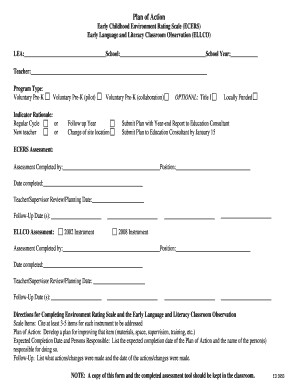
Plan of Action Early Childhood Environment Rating Scale (ECERS) Early Language and Literacy Classroom Observation (ELLCO) LEA: School: School Year: Teacher: Program Type: Voluntary PreK Voluntary.
Open form follow the instructions
Easily sign the form with your finger
Send filled & signed form or save
How to fill out the Early Childhood Environment Rating Scale online
Filling out the Early Childhood Environment Rating Scale (ECERS) online is a streamlined process that helps educators evaluate and enhance their early childhood programs. This guide provides step-by-step instructions to assist users in completing the form accurately and efficiently.
Follow the steps to successfully fill out the Early Childhood Environment Rating Scale.
- Press the ‘Get Form’ button to access the Early Childhood Environment Rating Scale and open it in your preferred editor.
- Begin by filling in the required information at the top of the form, including the LEA, school name, school year, and teacher's name. Ensure that all details are accurate and up to date.
- Select the appropriate program type from the given options, such as voluntary Pre-K, and indicate any relevant indicator rationale if applicable.
- Complete the ECERS Assessment section by filling in your name, position, the date completed, and scheduling any necessary follow-up dates for reviews.
- Transition to the ELLCO Assessment section. Similarly, fill in the assessor's information, and select the instrument version being utilized.
- In the 'Scale Items' section for both assessments, list at least 3-5 items that need to be addressed. For each item, develop a comprehensive Plan of Action that includes details on materials, training, space, supervised changes, and expected completion dates.
- Document any follow-up actions by listing changes made, corresponding dates, and initials of responsible individuals. Make sure this information reflects your plan for improvement.
- At the end of the form, request signatures from the teacher and supervisor. Leave space for initials to denote follow-up confirmation.
- Once all sections are completed, securely save your changes, download the document for your records, or print it if a physical copy is required.
Start filling out the Early Childhood Environment Rating Scale online today to enhance your early childhood program!
Experience a faster way to fill out and sign forms on the web. Access the most extensive library of templates available.
Related content
Items 38 - 43 — SCORE SHEET – EXPANDED VERSION. Early Childhood Environment Rating...
Early Childhood Environment Rating Scale®, 3rd ed. -- A thorough revision of the...
Literacy is popularly understood as an ability to read, write and use numeracy in at least...
Get answers to your most pressing questions about US Legal Forms API.
What are the seven assessment areas of the Early Childhood Environment Rating Scale?
The ECERS-R is organized into seven subscales: Space and Furnishings, Personal Care Routines, Language–Reasoning, Activities, Interaction, Program Structure, and Parents and Staff.
What are the 4 environmental rating scales?
There are 4 (four) different tools that are used in the ERS: the Infant and Toddler Environment Rating Scale (ITERS), the Early Childhood Environment Rating Scale (ECERS), the Family Child Care Environment Rating Scale (FCCERS) and the School Age Care Environment Rating Scale (SACERS).
What is the Early Childhood Environment Rating Scale?
The ECERS is a classroom assessment tool designed to measure the quality of group programs for infants and toddlers (birth to age 3) by collecting data through classroom observations and a staff interview. The assessment is a 43-item rating scale organized into seven environmental subscales.
What is the ECERS-3 rating scale?
The long-anticipated new version of the internationally recognized Early Childhood Environment Rating Scale, the ECERS-3 focuses on the full range of needs of preschool- and kindergarten-aged children.
What is Early Childhood Environment Rating Scale revised?
The revised ECERS contains inclusive and culturally sensitive indicators for many items. Also, new items have been added on Interaction (staff-child, child-child and discipline), Curriculum (nature/science and math/number) Health & Safety and Parents & Staff.
What is the ECERS rating scale?
The ECERS is a classroom assessment tool designed to measure the quality of group programs for infants and toddlers (birth to age 3) by collecting data through classroom observations and a staff interview. The assessment is a 43-item rating scale organized into seven environmental subscales.
How do you score an environmental rating scale?
1:08 8:24 ECERS 3 Scoring narrated 3 31 - YouTube YouTube Start of suggested clip End of suggested clip Period no interview questions are necessary or noted in the ecers. 3 the score sheet provides roomMorePeriod no interview questions are necessary or noted in the ecers. 3 the score sheet provides room for notes. The notes can be very helpful when reflecting and scoring items.
What is the difference between ECERS R and ECERS-3?
ECERS-3 assesses programs for ages three through five. ECERS-R assessed programs for children 2½ through 5 years of age. Teacher interviews are no longer a part of the process, but three hours of observation time is required.
Use professional pre-built templates to fill in and sign documents online faster. Get access to thousands of forms.
If you believe that this page should be taken down, please follow our DMCA take down process here.