Loading
Get Texas Standard Prior Authorization Form
How it works
-

Open form follow the instructions
-

Easily sign the form with your finger
-

Send filled & signed form or save
How to fill out the Texas Standard Prior Authorization Form online
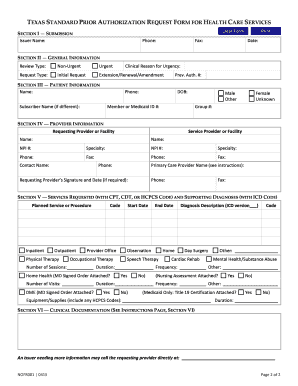
The Texas Standard Prior Authorization Form is essential for obtaining authorization for various healthcare services, including ophthalmology procedures. This guide provides step-by-step instructions to help users accurately complete the form online.
Follow the steps to effectively fill out the Texas Standard Prior Authorization Form.
- Click ‘Get Form’ button to obtain the Texas Standard Prior Authorization Form and open it in the online editor.
- In Section I – Submission, enter the issuer’s name, phone number, and fax number. Confirm that these details are correct as this section initiates your request.
- In Section II – General Information, select the review type (Non-Urgent or Urgent) and indicate whether this is an Initial Request or an Extension/Renewal/Amendment.
- Proceed to Section III – Patient Information by providing the patient’s name, date of birth, member ID number, and any additional subscriber information if necessary.
- In Section IV – Provider Information, fill in the details of both the requesting provider or facility and the service provider or facility. Enter the NPI and specialty codes, along with relevant contact information.
- For Section V – Services Requested, outline the planned services or procedures along with their corresponding CPT codes. Include additional details, such as start and end dates, and any diagnosis descriptions using ICD codes.
- In Section VI – Clinical Documentation, should you require the issuer to contact the requesting provider directly for more information, include the direct phone number.
- Once all sections are completed, ensure you review the form for accuracy. Save your changes, and then proceed to download, print, or share the form as needed.
Complete your documents online now for a smooth authorization process.
Clinical information specific to the treatment requested that the payer can use to establish medical necessity, such as: Service type requiring authorization. This could include categories like ambulatory, acute, home health, dental, outpatient therapy, or durable medical equipment. Service start date. CPT and ICD codes.