Loading
Get Locating An Epicenter Lab Answer Key
How it works
-

Open form follow the instructions
-

Easily sign the form with your finger
-

Send filled & signed form or save
How to fill out the Locating An Epicenter Lab Answer Key online
Filling out the Locating An Epicenter Lab Answer Key online is a straightforward process that allows users to neatly compile the necessary data for earthquake analysis. This guide will walk you through each section of the form to ensure accurate completion and submission.
Follow the steps to complete your Locating An Epicenter Lab Answer Key.
- Click ‘Get Form’ button to access the Locating An Epicenter Lab Answer Key. This action will open the form in the designated editor where you can begin filling it out.
- In the 'Name' field, enter your full name. This identifies who has completed the lab.
- In the 'Period' section, indicate the class period during which the lab was conducted.
- Input the 'Teacher' name to ensure the correct instructors review your work.
- Enter the 'Date' when you completed the lab. This helps keep track of the submission timeline.
- Review the 'Introduction' and 'Objective' sections for context on the activity. No form entry is required here, but understanding the content is essential.
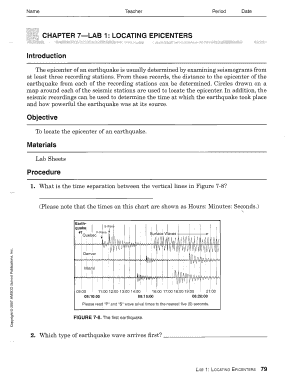
- Proceed to the data tables for Earthquake #1 and Earthquake #2. Fill in the arrival times for P-waves and S-waves as instructed, ensuring all times are recorded to the nearest 5 seconds.
- Complete the subsequent calculations regarding the distances to the epicenter based on provided data and travel time graph.
- For drawing the circles to locate the epicenter, use a compass as described in the procedure. Make sure to only draw the necessary arcs.
- Finally, review all sections for accuracy and completeness. When confident, save your changes, and consider downloading, printing, or sharing the completed form for further use.
Complete your Locating An Epicenter Lab Answer Key online today!
The epicenter is located on the surface directly above the focus (hypocenter), which is located on the fault at depth. The latitude and longitude will be the same for the epicenter and hypocenter of the same event.