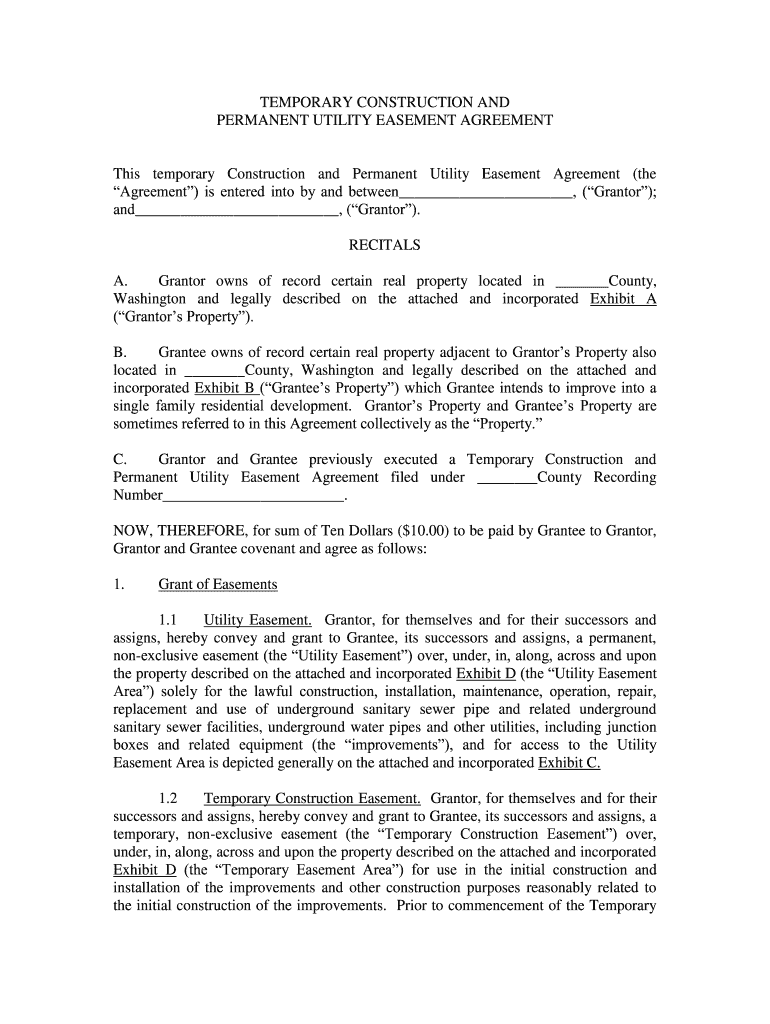
______________, (“Grantor”); and___________________________, (“Grantor”). RECITALS A. Grantor owns of record certain real property located in _______County, Washington and legally described on the attached and incorporated Exhibit A (“Grantor’s Property”). B. Grantee owns of record certain real property adjacent to Grantor’s Property also located in ________County, Washington and legally described on the attached and incorporated Exhibit B (“Grantee’s Property”) which Grant.
Loading

Open form follow the instructions

Easily sign the form with your finger

Send filled & signed form or save
How to fill out the WA Temporary Construction and Permanent Utility Easement Agreement online
Filling out the WA Temporary Construction and Permanent Utility Easement Agreement online can be a straightforward process with the right guidance. This user-friendly guide provides step-by-step instructions to help you accurately complete the form, ensuring all necessary details are included.
Follow the steps to complete the waiver agreement easily.
- Click ‘Get Form’ button to access the WA Temporary Construction and Permanent Utility Easement Agreement and open it in your preferred editor.
- Begin by filling in the names of the Grantor and Grantee in the designated fields. Ensure that the information is accurate as these names are critical to the agreement.
- Specify the county where the property is located. This information is crucial for legal recognition and should be taken from official property records.
- Complete the description fields for Grantor’s Property and Grantee’s Property using the information provided in Exhibit A and Exhibit B. Make sure these descriptions are precise to prevent future disputes.
- Indicate the agreed amount of Ten Dollars ($10.00) under the consideration clause as this is part of establishing the agreement formally.
- Detail the utility easement information under Section 1, specifying the Utility Easement Area. Refer to Exhibit D for specifics on the area included in this easement.
- Fill in the section for the Temporary Construction Easement, including what the easement will be used for and referencing the corresponding Exhibit C that illustrates this area.
- Proceed to fill out the terms and duration of both easements outlined in Section 2. Make note of the relevant dates for commencement and termination.
- Address all general provisions relevant to the agreement, ensuring to complete the sections on covenants and the effective date, as these are essential for enforcement.
- Finally, have the necessary representatives sign the document. Ensure that the signers are authorized, as outlined in Section 5.3. Notary acknowledgment may be required, so prepare to have this part properly documented.
- After completing all sections, review the document for accuracy and completeness. Once satisfied, you can save changes, download, print, or share the form as needed.
Start completing your WA Temporary Construction and Permanent Utility Easement Agreement online today!
Experience a faster way to fill out and sign forms on the web. Access the most extensive library of templates available.
Related content
Sep 1, 2024 — Temporary easements are shown on the right of way plans, in accordance...
... utility easement for which the applicable Master Agreement makes ... Utility easements...
Temporary or permanent loss of access to structures or roads; loss of lower ... permanent...
Get answers to your most pressing questions about US Legal Forms API.
How do easements work in NJ?
In New Jersey, easements function similarly to those in other states, allowing one party to use another's land under specific agreements. A WA Temporary Construction and Permanent Utility Easement Agreement is often necessary to outline rights, responsibilities, and any compensation due. It’s important for landowners and users alike to understand state laws to avoid disputes and ensure compliance.
What is a temporary construction easement?
A temporary construction easement allows a contractor or utility company to use a portion of a property for construction activities within a specified timeframe. This type of easement is critical in projects requiring access to install utility lines or perform construction work. The agreement outlines the terms of access and ensures property owners are informed and compensated.
What are easement fees?
Easement fees are payments made to landowners for granting the right to use their land for a specific purpose, as seen in a WA Temporary Construction and Permanent Utility Easement Agreement. These fees can vary based on the type of easement, its duration, and the land's value. Understanding these costs is crucial when negotiating access rights.
How to get a utility easement?
To obtain a utility easement, you typically need to negotiate with the property owner to gain permission or access rights over their land. This process often involves creating a WA Temporary Construction and Permanent Utility Easement Agreement. Consulting with legal experts helps ensure that all terms are clear and meet local regulations.
What is the difference between a permanent easement and a temporary easement?
A permanent easement grants one party the right to use another party's land indefinitely, while a temporary easement, as outlined in a WA Temporary Construction and Permanent Utility Easement Agreement, allows for use for a defined period. Permanent easements often persist beyond the property owner's ownership, whereas temporary easements conclude when the specified timeframe ends. Understanding this distinction helps in planning property use and rights.
What is the disadvantage of an easement?
One disadvantage of an easement, specifically in the context of a WA Temporary Construction and Permanent Utility Easement Agreement, is that it can limit the property owner's use of their land. While you may retain ownership, the easement allows another party to use a portion of your property. This can affect property value and create potential disputes over property boundaries.
What are the rules for easement in Washington state?
In Washington state, easement rules require clear documentation and adherence to established agreements. The WA Temporary Construction and Permanent Utility Easement Agreement is a valuable resource for navigating these rules. These agreements ensure both property owners and easement holders are aware of their rights, limits, and responsibilities, thus promoting harmonious use of the land.
Can a property owner block a utility easement?
Property owners cannot generally block a utility easement once it has been established. Doing so may violate the WA Temporary Construction and Permanent Utility Easement Agreement and result in legal consequences. It's crucial for property owners to understand their responsibilities and rights regarding easements before taking any action that might hinder utility access.
What is the difference between a temporary easement and a permanent easement?
A temporary easement provides limited access to land for a specified time period, while a permanent easement gives ongoing access. The WA Temporary Construction and Permanent Utility Easement Agreement often includes both types, where the temporary easement allows for construction activities and the permanent easement ensures necessary utility access for years to come.
What are permanent easements?
Permanent easements grant rights to one party to use a portion of another party's land indefinitely. These easements remain in place even after ownership of the land changes. A WA Temporary Construction and Permanent Utility Easement Agreement may include provisions for both permanent and temporary easements, clearly outlining the extent of each party’s rights.
Use professional pre-built templates to fill in and sign documents online faster. Get access to thousands of forms.
If you believe that this page should be taken down, please follow our DMCA take down process here.