Loading
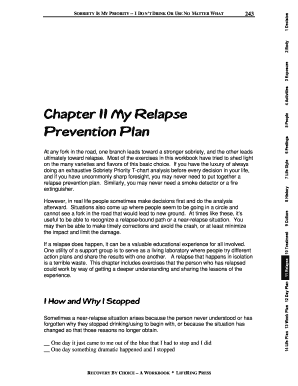
Get Chapter 11 My Relapse Prevention Plan - Angelfire
How it works
-

Open form follow the instructions
-

Easily sign the form with your finger
-

Send filled & signed form or save
How to fill out the Chapter 11 My Relapse Prevention Plan - Angelfire online
This guide provides a comprehensive walkthrough for completing the Chapter 11 My Relapse Prevention Plan - Angelfire online. Whether you are new to this process or looking to refine your approach, the following instructions will help you navigate each section effectively.
Follow the steps to complete your relapse prevention plan successfully.
- Click the ‘Get Form’ button to acquire the Chapter 11 My Relapse Prevention Plan - Angelfire form and access it in your preferred digital editor.
- Start with the 'How and Why I Stopped' section. Reflect on the reasons that led you to stop drinking or using, and choose options that resonate with your personal experience.
- Proceed to 'Body', 'Exposure', and 'Activities'. Provide detailed insights into your physical and emotional state related to sobriety.
- In the 'People' section, list the individuals who support your recovery. Consider the influence of these relationships on your sobriety.
- Address the 'Feelings' section. Share the emotions you associate with staying clean and sober, and identify any challenges you face.
- For 'Life Style', describe how your everyday behaviors and choices support your recovery.
- In 'History', assess whether the reasons for your sobriety still hold true. This reflection can help strengthen your resolve.
- Finalize the entries by reviewing sections on 'Culture', 'Treatment', 'Relapse', 'Day Plan', 'Week Plan', and 'Life Plan'. Provide insights and additional plans that fortify your relapse prevention strategy.
- Save your changes. You can then download, print, or share the form as required.
Complete your Chapter 11 My Relapse Prevention Plan online today to enhance your recovery strategy.
The RP model of relapse is centered around a detailed taxonomy of emotions, events, and situations that can precipitate both lapses and relapses to drinking. This taxonomy includes both immediate relapse determinants and covert antecedents, which indirectly increase a person's vulnerability to relapse.