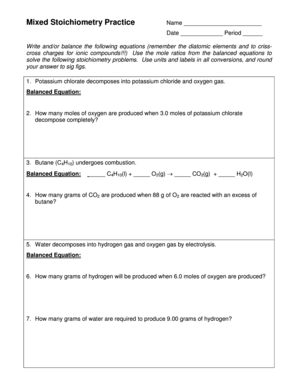
Mixed Stoichiometry Practice Name Write and/or balance the following equations remember the diatomic elements and to crisscross charges for ionic compounds Use the mole ratios from the balanced equations to solve the following stoichiometry problems. Use units and labels in all conversions and round your answer to sig figs. 1. Potassium chlorate decomposes into potassium chloride and oxygen gas. Balanced Equation 2. How many moles of oxygen are produced when 3. 0 moles of potassium chlorate decompose completely 3. Butane C4H10 undergoes combustion* C4H10 l O2 g CO2 g H2O l 4. How many grams of CO2 are produced when 88 g of O2 are reacted with an excess of butane 5. Water decomposes into hydrogen gas and oxygen gas by electrolysis. 8. Cobalt II chloride reacts with fluorine in a single replacement reaction to produce cobalt II fluoride and chlorine gas. CoCl2 F2 CoF2 Cl2 10. Balance the following equation* SrCl2 aq H2SO4 aq HCl aq SrSO4 s 11. What is the mass of strontium chloride that ....

How it works
  • Open form

    Open form follow the instructions

  • Easily sign form

    Easily sign the form with your finger

  • Share form

    Send filled & signed form or save

How to fill out the Mixed Stoichiometry Practice Answers online

Filling out the Mixed Stoichiometry Practice Answers form can enhance your understanding of stoichiometry concepts. This guide will provide a clear, step-by-step approach to help you navigate the form effectively and improve your skills.

Follow the steps to complete the Mixed Stoichiometry Practice Answers form.

  1. Press the ‘Get Form’ button to access the Mixed Stoichiometry Practice Answers document and open it in your preferred editor.
  2. Begin by entering your name, date, and period in the designated fields at the top of the form. This information helps organize your work and identify your submission.
  3. Read each instruction carefully. For problems that require balancing equations, ensure you consider diatomic elements and crisscross charges for ionic compounds.
  4. In the sections where you balance equations, write the balanced equation as requested. Use the appropriate symbols and coefficients for clarity.
  5. Move on to the stoichiometry problems. For each question, apply the mole ratios derived from the balanced equations to answer the questions accurately.
  6. Make sure to include units and labels in all conversions and round your answers to the correct number of significant figures as indicated.
  7. Once you have filled out all the required fields and solved the problems, review your work for any errors or omissions.
  8. Finally, save your changes, and depending on your needs, download, print, or share the completed form as required.

Start completing your Mixed Stoichiometry Practice Answers online today!

Get form

Experience a faster way to fill out and sign forms on the web. Access the most extensive library of templates available.

Related content

Mixed Stoichiometry Worksheet Answers - CA.gov

This is likewise one of the factors by obtaining the soft documents of this mixed...

Learn more
Practice Problems: Stoichiometry (Answer Key)

Practice Problems: Stoichiometry (Answer Key). Balance the following chemical reactions:...

Learn more
Using the Casio fx-82AU PLUS Scientific Calculator

The calculator can display the answer as an improper fraction, mixed numeral or ... 4 :...

Learn more
Questions & Answers

Get answers to your most pressing questions about US Legal Forms API.

Contact support

Is stoichiometry easy?

Stoichiometry can be difficult because it builds upon a number of individual skills. To be successful you must master the skills and learn how to plan your problem solving strategy. Master each of these skills before moving on: Calculating Molar Mass.

There are four steps in solving a stoichiometry problem: Write the balanced chemical equation. Convert the units of the given substance (A) to moles. Use the mole ratio to calculate the moles of wanted substance (B). Convert moles of the wanted substance to the desired units.

We can tackle this stoichiometry problem using the following steps: Step 1: Convert known reactant mass to moles. ... Step 2: Use the mole ratio to find moles of other reactant. ... Step 3: Convert moles of other reactant to mass.

Stoichiometric Calculations Balance the equation. Convert units of a given substance to moles. Using the mole ratio, calculate the moles of substance yielded by the reaction. Convert moles of wanted substance to desired units.

0:27 6:55 So you want to identify that mole ratio. Then you're gonna use dimensional analysis to do theMoreSo you want to identify that mole ratio. Then you're gonna use dimensional analysis to do the following three things. First office determine the mole number of moles of the given substance.

Almost all stoichiometric problems can be solved in just four simple steps: Balance the equation. Convert units of a given substance to moles. Using the mole ratio, calculate the moles of substance yielded by the reaction. Convert moles of wanted substance to desired units.

18:36 25:15 Stoichiometry Basic Introduction, Mole to Mole, Grams to ... - YouTube YouTube Start of suggested clip End of suggested clip Using the molar mass of substance b. So there are three steps that we need to take this is step oneMoreUsing the molar mass of substance b. So there are three steps that we need to take this is step one step two step three. So in our particular.

Flowchart of steps in stoichiometric calculations. Step 1: grams of A is converted to moles by multiplying by the inverse of the molar mass. Step 2: moles of A is converted to moles of B by multiplying by the molar ratio. Step 3: moles of B is converted to grams of B by the molar mass.

Get This Form Now!

Use professional pre-built templates to fill in and sign documents online faster. Get access to thousands of forms.

If you believe that this page should be taken down, please follow our DMCA take down process here.

Get Mixed Stoichiometry Practice Answers