(3) 7G. Other Intermediate Assets 7H. Retirement Accounts (4) 7I. Non-Farm Business 7J. Non-Farm Real Estate 8H. Other Liabilities 7K. Other Long Term Assets 7L. TOTAL PERSONAL ASSETS (Items 7A through 7K) 8I. TOTAL PERSONAL LIABILITIES 7M. TOTAL ASSETS (Item 4I and Item 7L) 8J. TOTAL LIABILITIES (Item 6I and Item 8I) 8K. TOTAL EQUITY (Item 7M minus Item 8J) I - WARNING I certify that the information provided is true, complete, and correct to the best of my knowledge and is provided in.
Loading

Open form follow the instructions

Easily sign the form with your finger

Send filled & signed form or save
How to fill out the USDA FSA-2037 online
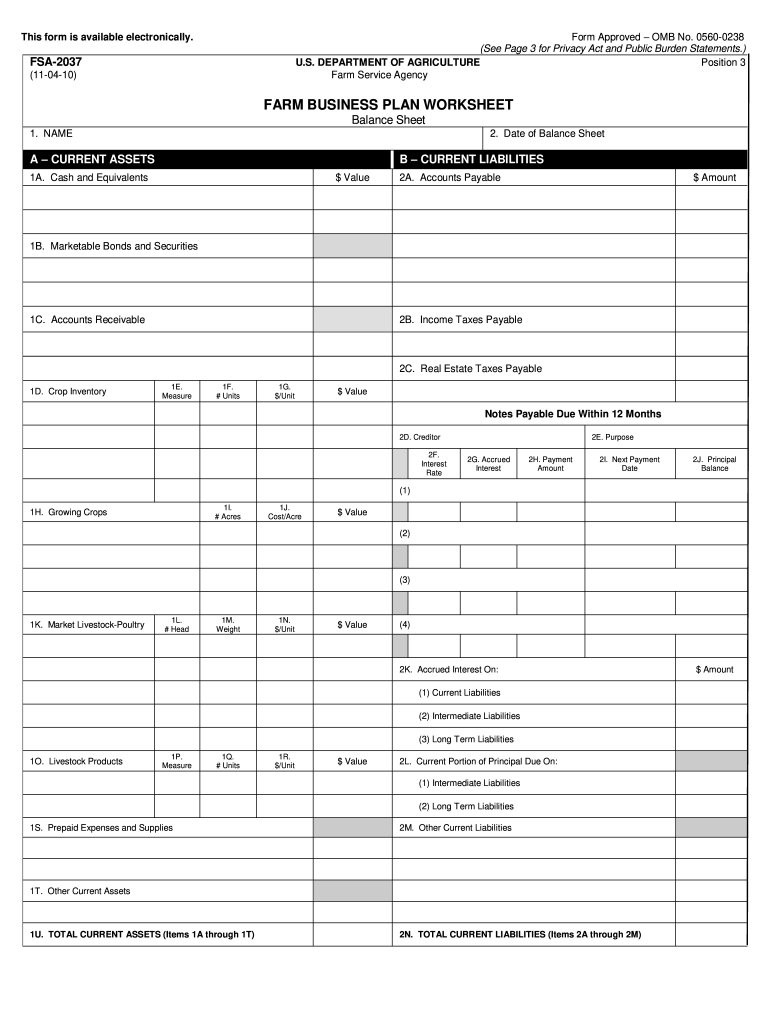
The USDA FSA-2037 is a farm business plan worksheet that helps users assess their financial situation through a comprehensive balance sheet. This guide provides clear, step-by-step instructions for completing the form online, ensuring that you can efficiently manage your farm's financial information.
Follow the steps to complete the USDA FSA-2037 online.
- Press the ‘Get Form’ button to access the USDA FSA-2037 form and open it in your preferred online editor.
- Begin with Section 1: Name and Date. Provide your name and the date when the balance sheet is prepared. This information is essential for identifying the document.
- In Section A, current assets, list each type of asset in the designated fields, including cash equivalents and accounts receivable. For each item, enter the corresponding dollar value.
- Move to Section B, current liabilities, and complete the fields with your obligations, such as accounts payable and income taxes payable. Ensure that you accurately reflect the amounts owed.
- Proceed to Section C, intermediate assets. Here, you will need to detail items such as machinery and equipment, providing the number of units and their monetary value.
- Next, complete Section D for long-term assets, including buildings and land. Make sure to specify values for each item and total the long-term assets at the end.
- In Section E, document long-term liabilities by noting creditors and obligations, similar to the previous sections. The accuracy of these figures is crucial.
- Continue to Section G for personal assets and Section H for personal liabilities, mixing similar details as in the business sections. Sum these figures in the designated areas.
- Finally, review Section I, which includes a certification statement. Sign and date the form at the end, confirming the information provided is accurate to the best of your knowledge.
- Once you have completed all sections, save your changes, and choose to download, print, or share the completed USDA FSA-2037 form as required.
Take the next step in managing your farm's financial plan by filling out the USDA FSA-2037 online today.
Experience a faster way to fill out and sign forms on the web. Access the most extensive library of templates available.
Related content
Form_FSA_2037_Farm_Business_Plan_Worksheet.pdf. Document. Download. Top. For Farmers and...
Nov 4, 2010 — USDA/FSA-14, Applicant/Borrower. Providing the requested information is...
Get answers to your most pressing questions about US Legal Forms API.
What is the mission of the USDA FSA?
The mission of the USDA FSA is to provide support to farmers, ranchers, and agricultural communities through various programs and services. The FSA aims to help agricultural producers improve their operations, manage risks, and access vital resources. Through initiatives such as USDA FSA-2037, they strive to enhance farm income and promote sustainable agricultural practices.
What agencies are under USDA?
The USDA contains several agencies, including the FSA, Animal and Plant Health Inspection Service (APHIS), Food Safety and Inspection Service (FSIS), and the Rural Development agency. Each agency plays a unique role in supporting the agricultural sector in various ways. These agencies work together to promote food security and enhance the livelihoods of farmers.
Is FSA the same as USDA?
FSA is not the same as USDA. Instead, the FSA is one of the many agencies that fall under the USDA's oversight. While the USDA encompasses a wide range of agricultural initiatives, the FSA specifically provides targeted support and services designed for farmers and agricultural stakeholders.
What does FSA stand for with USDA?
With USDA, FSA stands for Farm Service Agency. This agency is crucial for farmers seeking support through various USDA programs. By engaging with the FSA, you can unlock access to significant resources like funding and technical assistance through initiatives like USDA FSA-2037.
What agency is FSA under?
The FSA operates under the United States Department of Agriculture (USDA). This relationship allows the FSA to access USDA resources and programs designed to support farmers nationwide. By leveraging the functionalities of the USDA, the FSA can offer a range of services that enhance agricultural operations.
What does FSA mean in agriculture?
FSA stands for Farm Service Agency, which plays a key role in providing assistance and resources to farmers. The agency administers programs designed to support agricultural production and sustainability. By participating in FSA programs, such as USDA FSA-2037, farmers can access various benefits catering to their specific needs.
Is FSA and USDA the same?
No, the FSA and USDA are not the same, but the FSA operates under the USDA. The USDA, or United States Department of Agriculture, oversees various agencies, including the FSA, which focuses specifically on agricultural services and support. Think of the USDA as the umbrella, with the FSA serving as one important agency under it.
How to get a FSA farm number?
To obtain a FSA farm number, you must contact your local USDA Farm Service Agency office. They will guide you through the process, which includes providing necessary documentation such as proof of ownership or rental agreements. Once the paperwork is completed and reviewed, you will receive your unique farm number, essential for participating in USDA FSA-2037 programs.
What is the disaster set aside program for USDA?
The disaster set aside program by the USDA, including the FSA, helps farmers manage financial challenges caused by natural disasters. This program allows farmers to set aside a portion of their loans, thereby easing their financial burdens. Utilizing such programs ensures farmers maintain stability in difficult times.
What is the difference between NRCS and FSA?
The NRCS, or Natural Resources Conservation Service, and FSA serve different purposes within the USDA. The NRCS focuses on conservation and natural resource management, while the FSA provides financial assistance and support to farmers. Understanding these differences ensures that farmers can seek the right resources for their needs.
Use professional pre-built templates to fill in and sign documents online faster. Get access to thousands of forms.
If you believe that this page should be taken down, please follow our DMCA take down process here.