Loading
Get Energy Reading Study Guide
How it works
-

Open form follow the instructions
-

Easily sign the form with your finger
-

Send filled & signed form or save
How to fill out the Energy Reading Study Guide online
This guide provides clear and supportive instructions for completing the Energy Reading Study Guide online. By following the steps outlined, users can effectively capture and organize their understanding of energy concepts.
Follow the steps to complete the Energy Reading Study Guide online
- Press the ‘Get Form’ button to access the Energy Reading Study Guide and open it in your preferred editor.
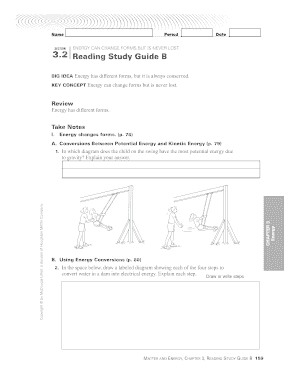
- Begin by reviewing the 'BIG IDEA' and 'KEY CONCEPT' sections to understand the foundational concepts of energy. Make notes for segment II: 'Energy is always conserved'.
- In section I, focus on potential and kinetic energy conversions. Refer to the provided page numbers for additional guidance. Answer the question regarding the child on the swing by analyzing the potential energy based on its height.
- For section I, item B, complete the task of drawing a labeled diagram that illustrates the conversion of water in a dam to electrical energy. Ensure that each step is clearly explained.
- Move to section II and fill in the frame game with definitions and characteristics related to the conservation of energy. Consider examples that demonstrate this concept.
- In section II, answer the question about the kinetic energy changes during the collision of two balls. Detail what happens to the kinetic energy of the first ball after the collision.
- In section III, explain the meaning of energy efficiency and its relevance to household appliances. Refer to specific examples to clarify your explanation.
- Once all sections are completed, review your answers for clarity and completeness. You may then save your changes, download, print, or share the Energy Reading Study Guide.
Complete your Energy Reading Study Guide online today for a better understanding of energy concepts.
Chemists make a distinction between two different types of changes that they study—physical changes and chemical changes. Physical changes are changes that do not alter the identity of a substance. Chemical changes are changes that occur when one substance is turned into another substance.