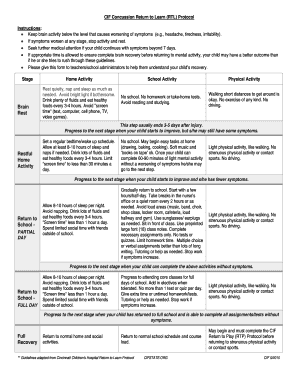
CIF Concussion Return to Learn (RTL) Protocol Instructions: Keep brain activity below the level that causes worsening of symptoms (e.g., headache, tiredness, irritability). If symptoms worsen at any.

How it works
  • Open form

    Open form follow the instructions

  • Easily sign form

    Easily sign the form with your finger

  • Share form

    Send filled & signed form or save

How to use or fill out the CIF Concussion Return To Learn (RTL) Protocol online

The CIF Concussion Return To Learn Protocol is a vital tool designed to assist users in managing the return to academic activities after a concussion. This guide provides clear and concise instructions for filling out the protocol online, ensuring a smooth process for parents, educators, and health professionals.

Follow the steps to effectively complete the CIF Concussion RTL Protocol.

  1. Click the ‘Get Form’ button to access the CIF Concussion RTL Protocol. This will open the form in an online editor for you to begin completing it.
  2. Begin by identifying the personal details section at the top of the form. Enter the name, date of birth, and contact information for the person recovering from the concussion.
  3. Next, navigate to the recovery stages outlined in the protocol. Carefully review each section, which includes instructions for brain rest, home activities, school activities, and physical activity.
  4. In the section for each recovery stage, follow the specific requirements closely. For example, during the brain rest phase, indicate the level of rest the person will be undergoing and any adjustments needed at home or school.
  5. As you fill out the subsequent sections related to home activity and school activity, ensure to provide detailed information about the activities permitted and restrictions based on the individual's recovery progress.
  6. Continue through the full document by describing the expected outcomes and support needed at each stage. Mark down any notes or recommendations for staff and educators to facilitate the recovery process.
  7. Once all sections have been carefully filled out, review the entire form for accuracy. Make any necessary changes to ensure all details reflect the individual's condition and needs.
  8. After completing the form, you can save your changes, download it for your records, print a copy for distribution, or share it directly with teachers and school administrators.

Complete the CIF Concussion Return To Learn Protocol online to support a smooth recovery for the individual.

Get form

Experience a faster way to fill out and sign forms on the web. Access the most extensive library of templates available.

Related content

concussions in youth sports - US Government...

May 13, 2016 — concussion, generally referred to as "return to learn", to bring these...

Learn more
Cif Concussion Return To Learn Rtl Protocol...

cif-concussion-return-to-learn-rtl-protocol-instructions. 1/6. Downloaded from...

Learn more
Questions & Answers

Get answers to your most pressing questions about US Legal Forms API.

Contact support

What is the stepwise return to play protocol for concussion?

The 7-step RTP protocol consists of the following steps: (1) complete cognitive rest, (2) full return to school, (3) light exercise, (4) running progression, (5) noncontact training drills and weight training, (6) full-contact practice or training, and (7) return to game play.

Here's a quick recap of each protocol step (you can read the official outline from the NFL here). Step 1: Rest and recovery. This one is simple. ... Step 2: Light aerobic activities. ... Step 3: More aerobic exercise and strength training. ... Step 4: Football specific activities. ... Step 5: Full football activity.

Do not let the child perform any strenuous activity or go back to playing in sports. Do not use aspirin or ibuprofen for headaches for the first 48 hours. Use acetaminophen (Tylenol) only. Encourage your child to rest and eat a light diet.

This may include staying home from school during the short period of rest (typically no more than 1-2 days) followed by a lighter school schedule for a few days, or longer, if necessary. Decreasing the stress to the brain in the early phase after a concussion may lessen symptoms and shorten the recovery time.

Immediately after a concussion, it is beneficial to take a break from cognitive (thinking, processing) activities for up to a few days. This may mean no school, no homework, no computer, no texting, no video games and maybe no TV if it makes symptoms worse. In general, it is beneficial to minimize screen time.

Relative rest, which includes limiting activities that require thinking and mental concentration, is recommended for the first two days after a concussion. However, complete rest, such as lying in a dark room and avoiding all stimuli, does not help recovery and is not recommended.

1. The law requires a student athlete who may have a concussion during a practice or game to be removed from the activity for the remainder of the day. 2. Any athlete removed for this reason must receive a written note from a medical doctor trained in the management of concussion before returning to practice.

Most students will be advised by a healthcare provider to rest for no more than 2-3 days after the injury. This is when symptoms, like headaches or fatigue, are usually most severe. Like recovering from some other injuries, students recovering from a concussion may need to rest. But they don't just need physical rest.

Get This Form Now!

Use professional pre-built templates to fill in and sign documents online faster. Get access to thousands of forms.

If you believe that this page should be taken down, please follow our DMCA take down process here.

Get CIF Concussion Return To Learn (RTL) Protocol