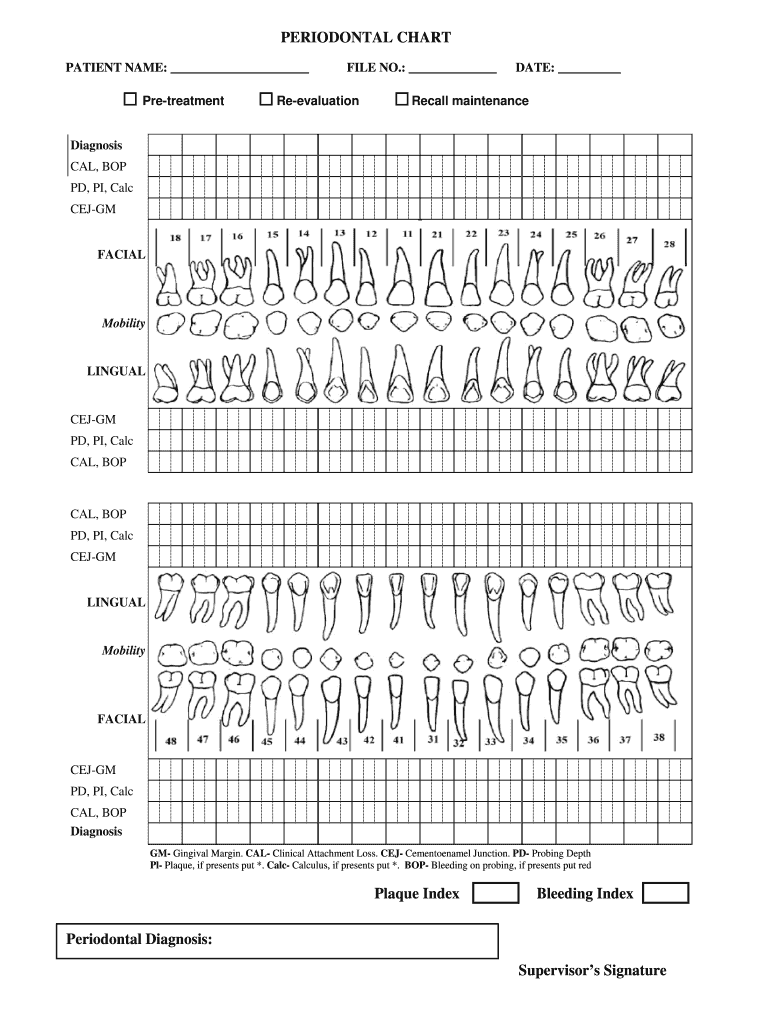
PERIODONTAL CHART PATIENT NAME Pre-treatment FILE NO. Re-evaluation DATE Recall maintenance Diagnosis CAL BOP PD PI Calc CEJ-GM FACIAL Mobility LINGUAL GM- Gingival Margin. CAL- Clinical Attachment Loss. CEJ- Cementoenamel Junction* PD- Probing Depth Pl- Plaque if presents put. Calc- Calculus if presents put. BOP- Bleeding on probing if presents put red Plaque Index Bleeding Index Periodontal Diagnosis Supervisor s Signature. CEJ- Cementoenamel Junction* PD- Probing Depth Pl- Plaque if presents put. Calc- Calculus if presents put. BOP- Bleeding on probing if presents put red Plaque Index Bleeding Index Periodontal Diagnosis Supervisor s Signature. .
Loading

Open form follow the instructions

Easily sign the form with your finger

Send filled & signed form or save
How to fill out the Periodontal Chart online
Filling out the Periodontal Chart is essential for tracking oral health and periodontal conditions. This guide will help you navigate the online form, ensuring that all required information is accurately recorded.
Follow the steps to complete the Periodontal Chart with ease
- Click ‘Get Form’ button to obtain the form and open it in the editor.
- Begin by entering the patient's name in the designated field at the top of the chart. This information helps identify the individual for whom the assessment is performed.
- Fill in the file number in the provided space to ensure accurate record-keeping within your practice.
- Select the appropriate date for the re-evaluation or recall maintenance to document when this assessment is being conducted.
- In the diagnosis section, proceed to fill in Clinical Attachment Loss (CAL) and Bleeding on Probing (BOP) as needed.
- Document Probing Depth (PD), Plaque Index (PI), and Calculus (Calc) values in the relevant fields, noting any present conditions with symbols as instructed.
- For each section labeled 'Facial' and 'Lingual', indicate the values for CEJ-GM, PD, PI, Calc, and any occurrences of BOP or plaque, placing asterisks as needed.
- Finally, complete the Periodontal Diagnosis field and ensure the supervisor’s signature is obtained, verifying the accuracy of the assessment.
- Once all sections are filled out, be sure to save your changes, and download or print the form for your records, or share it with your dental team as necessary.
Start completing your Periodontal Chart online today for efficient dental record management.
Experience a faster way to fill out and sign forms on the web. Access the most extensive library of templates available.
Related content
A printable periodontal chart serves as an essential tool for dental professionals to...
Introduction: The Importance of Periodontal Charts in Dental Practice. Chapter 1: Anatomy...
Removes bacteria and debris from hard to reach areas around dental restorations. Specially...
Get answers to your most pressing questions about US Legal Forms API.
What are the depths that are recorded during periodontal charting?
During periodontal charting, depths recorded typically range from 1 to 10 millimeters. Probing depths above 3 millimeters may indicate potential gum issues that need addressing. By closely monitoring these depths in your periodontal chart, you can assess the patient's periodontal health accurately.
How do you do periodontal charting?
To perform periodontal charting, you will need a periodontal probe to measure pocket depths around each tooth. Start by recording each depth at several sites around the tooth and documenting any noticeable gum recession or bleeding. Proper training and use of systematic methods will improve your accuracy and efficiency.
How do you read a perio chart?
Reading a periodontal chart involves understanding the various measurements and indicators listed. You should look for pocket depths, gum recession, and any signs of periodontal disease. These details will give you a clear picture of the patient’s gum health and the necessary treatment options.
What is recorded in a full periodontal charting?
A full periodontal charting records measurements such as probing depths, gum recession, and clinical attachment levels. It also notes any bleeding points, tooth mobility, and furcation involvement. This thorough documentation is essential for monitoring periodontal health over time.
What information is included in periodontal charting?
Periodontal charting includes crucial information such as pocket depths, tooth alignment, and gum tissue condition. Each element provides insights into the overall periodontal health of the patient. By using a detailed periodontal chart, dental professionals can recommend appropriate care and preventive measures.
What is a full periodontal assessment?
A full periodontal assessment involves a comprehensive evaluation of your gum health through a detailed periodontal chart. This assessment typically includes measurements of pocket depths, gum recession, and checks for plaque or tartar buildup. Obtaining a complete picture of your periodontal status helps guide treatment options.
How to get faster at perio charting?
To improve your speed in periodontal charting, practice regularly and familiarize yourself with the tools used for measurements. Organizing your approach helps streamline the process, allowing for efficient data collection. Utilizing the periodontal charting features on USLegalForms can also enhance your efficiency.
What measurements are taken in a periodontal chart?
A periodontal chart records several important measurements, including pocket depth, gum recession, and tooth mobility. Each measurement provides vital information about the health of your gums and the surrounding tissues. Using a periodontal chart helps track changes over time, allowing for better treatment decisions.
Is periodontal charting painful?
Generally, periodontal charting is not a painful process; however, you may feel some discomfort. Your dentist will gently measure gum pockets, and while some sensitivity can occur, the overall procedure is quick. Having your Periodontal Chart updated regularly ensures any gum issues are caught early, leading to more effective treatments. Ensuring your comfort during appointments is important for us at uslegalforms.
What is a six point periodontal charting?
Six point periodontal charting involves measuring pocket depths around each tooth at six specific sites. These measurements provide a comprehensive view of gum health and any existing periodontal disease. This detailed assessment is crucial for creating an effective treatment plan. By regularly reviewing your Periodontal Chart, you can gain insights into your progress.
Use professional pre-built templates to fill in and sign documents online faster. Get access to thousands of forms.
If you believe that this page should be taken down, please follow our DMCA take down process here.