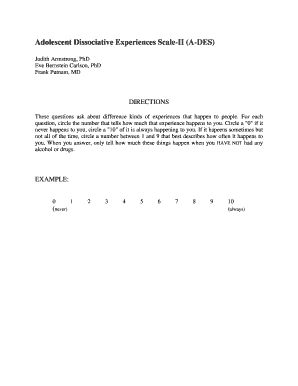
Adolescent Dissociative Experiences Scale-II (A-DES) Judith Armstrong, PhD Eve Bernstein Carlson, PhD Frank Putnam, MD DIRECTIONS These questions ask about difference kinds of experiences that happen.

How it works
  • Open form

    Open form follow the instructions

  • Easily sign form

    Easily sign the form with your finger

  • Share form

    Send filled & signed form or save

How to fill out the Adolescent Dissociative Experiences Scale-II A-DES - Drjenna online

The Adolescent Dissociative Experiences Scale-II A-DES - Drjenna is a tool designed to assess dissociative experiences in adolescents. This guide will provide you with clear steps to easily complete the form online, ensuring you understand each question and how to respond appropriately.

Follow the steps to fill out the form online effectively.

  1. Press the ‘Get Form’ button to access the form and open it in your preferred online editor.
  2. Begin filling out the introductory information, including the date and your age. Ensure that the age entered reflects your current age.
  3. Indicate your sex by selecting 'M' for male or 'F' for female. It's important to answer this as accurately as possible.
  4. For each question, read the statement carefully. You will circle a number from 0 to 10 that best describes how often the experience occurs for you, where 0 means 'never' and 10 means 'always'.
  5. If your experiences fall somewhere in the middle, circle a number that reflects the frequency of the experience, being as honest as possible.
  6. Continue through all 30 statements, circling your responses for each item based on your personal experiences.
  7. Once all questions are answered, review your responses to ensure accuracy and completeness.
  8. Finally, you may want to save the completed form to your device, or choose to download, print, or share it as required.

Start completing the Adolescent Dissociative Experiences Scale-II A-DES - Drjenna online today!

Get form

Experience a faster way to fill out and sign forms on the web. Access the most extensive library of templates available.

Related content

nih summer research program poster day - NIH...

Aug 6, 2015 — 1-2. National Human Genome Research Institute (NHGRI) . ... cancer...

Learn more
Using Big Data in Psychotherapy Research - Digital...

Table 2 Results for Question 2: Difference in therapeutic alliance and treatment...

Learn more
Questions & Answers

Get answers to your most pressing questions about US Legal Forms API.

Contact support

How do you interpret the DES scale?

The DES score is the average of all the questions, so the minimum score is 0 and the maximum score is 100.[2] To calculate this yourself, all the questions are scored by dropping the zero on the percentage of each answer, e.g., 30% = 3; 80% = 8, these numbers are then added up.

Dissociative Experiences Scale Scores Explained Only 1% of people with Dissociative Identity Disorder have been found to have a DES score below 30. A very high number of people who score above 30 have been shown to have Posttraumatic Stress Disorder or a dissociative disorder other than Dissociative Identity Disorder.

The total scores can be between 0 and 100, where high levels of dissociation are indicated by scores of 30 or more.

How do I score the DES?” The total score for the entire DES is the average score for all items. Once the clinician has verified that all items have been answered, simply add all of the item scores and divide by 28 to determine the total DES score. This yields a score in a range from 0 to 100.

Scoring and Interpretation The total scores can be between 0 and 100, where high levels of dissociation are indicated by scores of 30 or more. The total score is also presented as percentile ranks compared with clinical and non-clinical samples (as reported by IJzendoorn & Schuengel, 1996).

The A-DES is scored by summing item scores and dividing by 30 (number of items). The overall score ranges from 0 to 10. A-DES scores of 4 or greater suggest pathological levels of dissociation, and further evaluation is warranted. Information on the A-DES-T is also included.

Each item on the measure is rated on a 5-point scale (0=Not at all; 1=Once or twice; 2=Almost every day; 3=About once a day, and 4=More than once a day). The total score can range from 0 to 32, with higher scores indicating greater severity of dissociative experiences.

The Dissociative Experiences Scale-II (DES-II) is a self-report questionnaire that measures dissociative experiences such as derealization, depersonalization, absorption and amnesia. The DES-II has been prevalently used as a screening tool in patients suffering from psychotic disorders or schizophrenia.

Get This Form Now!

Use professional pre-built templates to fill in and sign documents online faster. Get access to thousands of forms.

If you believe that this page should be taken down, please follow our DMCA take down process here.

Get Adolescent Dissociative Experiences Scale-II A-DES - Drjenna