Es Yes Yes Yes Doppler Doppler Doppler Doppler No No No No No No No No R hand/ arm R knee to thigh R ankle to knee R foot/ ankle No No No No Edema Non-pitting Non-pitting Non-pitting Non-pitting Pitting ___+ Pitting ___+ Pitting ___+ Pitting ___+ L hand/ arm L knee to thigh L ankle to knee L foot/ ankle Sacrum No No No No No Non-pitting Non-pitting .
Loading

Open form follow the instructions

Easily sign the form with your finger

Send filled & signed form or save
How to fill out the Easy Guide to Head to Toe Assessment online
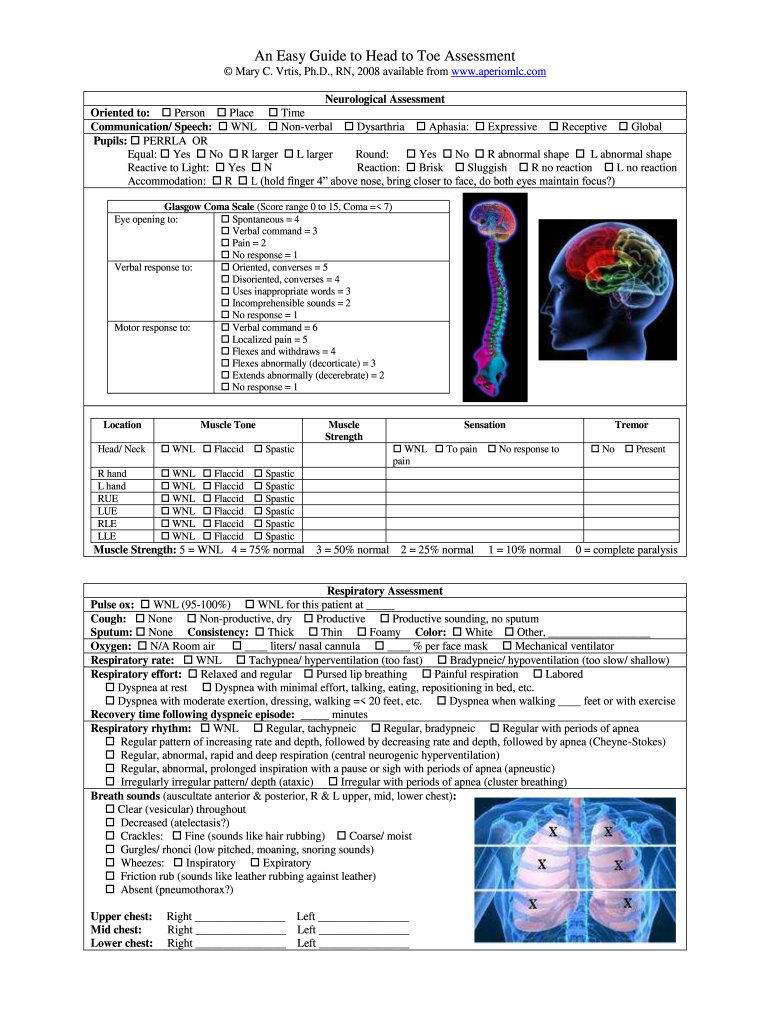
This guide provides a comprehensive overview on how to effectively complete the Easy Guide to Head to Toe Assessment online. Users will find step-by-step instructions tailored for clear understanding and ease of use.
Follow the steps to successfully complete the assessment form.
- Press the ‘Get Form’ button to access the assessment form and open it in your editor.
- Begin by filling out the 'Neurological Assessment' section, indicating the orientation of the person, communication status, pupil reactions, and performing the Glasgow Coma Scale assessment. Ensure to mark the appropriate boxes based on observations.
- Proceed to the 'Location' section, recording muscle tone and strength for each limb as required. Use the provided scale for muscle strength, noting any abnormalities.
- Complete the 'Respiratory Assessment' section by documenting vital signs such as pulse oximetry, respiratory rate, and effort. Assess cough production and sputum characteristics, entering observations accurately.
- Fill out the 'Cardiovascular Assessment' by evaluating skin condition, capillary refill time, and apical pulse details. Record any any irregularities in heart sounds.
- In the 'Genitourinary Assessment' section, describe any noted abnormalities in urination and urine characteristics to ensure thorough evaluation.
- Continue to the 'Gastrointestinal Assessment', providing insights on oral mucosa, abdomen condition, bowel movements, and any required tube feedings.
- Assess skin integrity under the 'Skin Integrity Assessment', documenting skin color, integrity, and potential wounds or pressure ulcers.
- Comment on pain in the 'Pain Assessment' section, noting location, type, and scale rating as per user experience.
- Complete the 'IV Assessment' section if applicable, by recording insertion site details and evaluating IV fluids and medications administered.
- Finally, review all sections for accuracy before saving your changes. Choose to download, print, or share the completed document as necessary.
Encourage others to fill out their documents online for a more efficient process.
Experience a faster way to fill out and sign forms on the web. Access the most extensive library of templates available.
Related content
Head-to-Toe Assessment Checklist · 1. Perform a subjective assessment. Ask if headache...
Mar 14, 2022 — Learn everything you need to know about head to toe nursing assessments...
An early warning score is an assessment tool used to help recognize the early signs of...
Get answers to your most pressing questions about US Legal Forms API.
What are the 4 techniques of assessment?
The four techniques of assessment include observation, physical examination, health history review, and diagnostic testing. Each technique complements the others, providing a holistic view of the patient's health. By incorporating these techniques into your practice, you improve your clinical judgment and patient outcomes. Explore our Easy Guide to Head to Toe Assessment for more insights on effectively utilizing these techniques.
What are the 4 cardinal techniques of physical examination?
The four cardinal techniques of physical examination are inspection, palpation, percussion, and auscultation. These techniques provide a comprehensive understanding of the patient's health status. By applying these methods accurately, you enhance your ability to diagnose and plan treatment effectively. Our Easy Guide to Head to Toe Assessment offers clear instructions for using these techniques proficiently.
What is the first thing a nurse should do while conducting a head to toe assessment?
The first thing a nurse should do while conducting a head to toe assessment is to establish rapport with the patient. This helps create a comfortable environment where the patient feels safe to discuss their health concerns. Following this, conduct a brief overview of the patient's history to inform your assessment. You can find tips on building rapport and conducting effective assessments in our Easy Guide to Head to Toe Assessment.
What are the 4 steps of head-to-toe assessment?
The four steps of a head-to-toe assessment involve preparation, inspection, palpation, and documentation. Start by preparing your environment and the patient for comfort. Then, inspect and palpate each area systematically, noting any abnormalities. Finally, document your findings to ensure continuity of care. Our Easy Guide to Head to Toe Assessment can help you streamline these steps.
How to do a head to toe assessment step by step?
To perform a head to toe assessment step by step, first introduce yourself to the patient and explain the procedure. Then, follow the sequence of examination from the head down to the feet, using the four techniques mentioned earlier. Make sure to document your findings as you go along. For detailed guidance, our Easy Guide to Head to Toe Assessment can provide you with a structured approach.
What 4 techniques are used in a head to toe assessment?
The four primary techniques used in a head to toe assessment are inspection, palpation, percussion, and auscultation. Each technique serves a specific purpose, allowing you to gather essential information about the patient's health. By mastering these techniques, you can improve your assessment skills. Refer to our Easy Guide to Head to Toe Assessment for a detailed explanation of each technique.
What is the sequence of the head to toe exam?
The sequence of a head to toe exam typically starts with the patient's general appearance and vital signs. Next, you should systematically assess each body system, moving from the head down to the feet. This methodical approach ensures that nothing is overlooked. To make your assessment easier, consider following our Easy Guide to Head to Toe Assessment.
What is the order of head to toe assessment?
The order of the head to toe assessment in the Easy Guide to Head to Toe Assessment is straightforward. Start with the head, examining the eyes, ears, nose, and throat, then progress to the neck, chest, abdomen, and extremities. Conclude by assessing the patient's mobility and strength. This organization helps in systematically identifying any potential health issues.
How to do a quick head to toe assessment?
To conduct a quick head to toe assessment using the Easy Guide to Head to Toe Assessment, begin with patient identification and privacy. Quickly check vital signs and perform a brief physical examination from head to toe, focusing on significant findings like skin condition, range of motion, and neurological status. This efficient method allows you to identify urgent issues while informing your comprehensive assessment later.
What is the correct assessment order?
The correct assessment order in an Easy Guide to Head to Toe Assessment generally begins with the head and moves down to the feet. Start with the patient's vital signs, followed by a thorough examination of the head, neck, chest, abdomen, and extremities. This systematic approach helps you notice any significant changes while ensuring no area is overlooked.
Use professional pre-built templates to fill in and sign documents online faster. Get access to thousands of forms.
If you believe that this page should be taken down, please follow our DMCA take down process here.