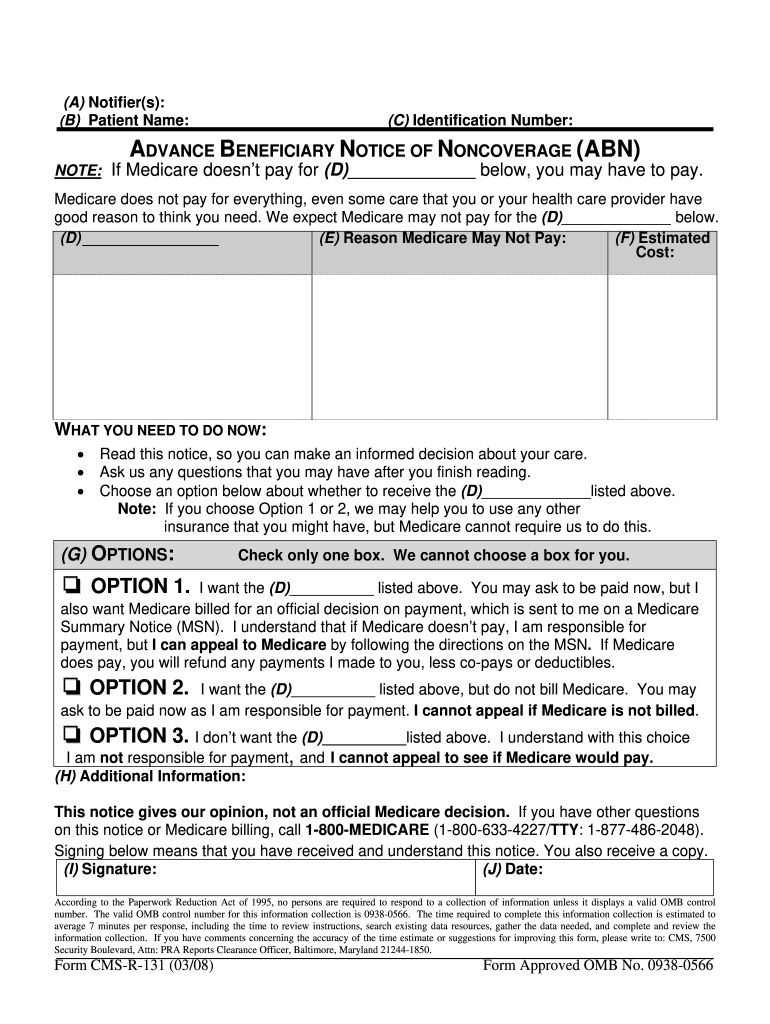
laboratories), as well as hospice providers and religious non-medical health care institutions (RNHCIs) paid exclusively under Part A. They must complete the ABN as described below, and deliver the notice to affected beneficiaries or their representative before providing the items or services that are the subject of the notice. (Note that although Medicare inpatient hospitals and home health agencies (HHAs) use other approved notices for this purpose, skilled nursing facilities (SNFs) must use .

Open form follow the instructions

Easily sign the form with your finger

Send filled & signed form or save
How to fill out the Form CMS-R-131 online
Filling out the Form CMS-R-131, also known as the Advance Beneficiary Notice of Noncoverage (ABN), online provides a structured approach to notifying beneficiaries about services that may not be covered by Medicare. This guide offers clear, step-by-step instructions for completing each section of the form efficiently.
Follow the steps to complete the Form CMS-R-131 online.
- Press the ‘Get Form’ button to access the Form CMS-R-131 and open it in your web browser.
- In the header section, complete blanks (A) through (C). Enter the name, address, and phone number of the notifier in blank (A), the patient's full name in blank (B), and an optional identification number in blank (C).
- In blank (D), specify the items or services that Medicare may not cover. Use clear descriptors such as 'item', 'service', or 'procedure' as needed.
- In blank (E), provide a user-friendly explanation that outlines why Medicare may not pay for the services listed in blank (D). Ensure to include reasons that beneficiaries can understand.
- Fill in blank (F) with an estimated cost for the services listed in blank (D). Provide a reasonable estimate that is clear and easy to understand.
- In blank (G), the beneficiary or their representative must select one of the three options regarding their choice to receive the listed items or services. Only one box may be checked.
- In blank (H), add any additional information that may help the beneficiary understand their situation better. This is optional but can provide valuable context.
- Lastly, complete the signature section in blanks (I) and (J). The beneficiary should sign their name in blank (I) and write the date in blank (J) to indicate their understanding and receipt of the notice.
- After filling out the form, review it for accuracy and clarity. Once satisfied, you can save changes, download, print, or share the completed form as necessary.
Complete your Form CMS-R-131 online today to ensure clarity regarding potential Medicare noncoverage.
Experience a faster way to fill out and sign forms on the web. Access the most extensive library of templates available.
Related content
Form #. CMS R-131 ; Form Title. ADVANCE BENEFICIARY NOTICE (ABN) ; Revision Date...
Advance Beneficiary Notice of Non-coverage. (ABN). NOTE: If Medicare doesn't pay for...
Advance Beneficiary Notice of Non-coverage (ABN). NOTE: If Medicare doesn't pay for a...
Get answers to your most pressing questions about US Legal Forms API.
Who is required to give an advance beneficiary notice?
Healthcare providers who deliver services to Medicare beneficiaries are required to provide an Advance Beneficiary Notice (ABN) when there is a possibility that Medicare may not cover those services. By issuing an ABN, you ensure that patients are aware of their financial obligations before receiving care. This requirement helps maintain clear communication and transparency in the provider-patient relationship.
How do you explain an ABN to a patient?
When explaining an ABN to a patient, focus on its role in keeping them informed about potential out-of-pocket costs for services that Medicare may not cover. Clarify that this notice gives them the choice to accept or refuse the proposed services based on their financial situation. By being transparent about the ABN, you help empower patients to make decisions about their care.
What is the purpose of an advance beneficiary notice?
An Advance Beneficiary Notice (ABN) serves to notify patients that Medicare may not cover certain services, allowing them to make informed choices about their treatment. This proactive communication helps prevent billing surprises and builds trust between providers and patients. By using an ABN, you ensure transparency in billing practices.
What is the purpose of completing a CMS Form 116?
The purpose of completing CMS Form 116 is to apply for a reconsideration of Medicare claim decisions based on new evidence or arguments. This form is an important tool for healthcare providers to advocate for their services and seek fair reimbursement. By submitting Form 116, you show your commitment to securing the benefits that your patients deserve.
How to fill out Medicare form CMS 1763?
To fill out Medicare form CMS 1763, you need to provide essential information, including the patient's name, Medicare number, and the reason for requesting a voluntary termination of Medicare benefits. This form is crucial for ensuring clarity in the patient's coverage status. You can also utilize platforms like uslegalforms to simplify this process and ensure accuracy.
Can you bill a patient without an ABN?
Billing a patient without an Advance Beneficiary Notice (ABN) can lead to challenges, especially for Medicare-covered services. The ABN informs patients that Medicare may not cover certain services and allows them to make informed decisions. If you proceed without an ABN, you may face difficulties collecting payment from the patient.
What is a CMS R 131 form?
The CMS R 131 form, also known as Form CMS-R-131, is a document used by healthcare providers to seek an advance decision on the necessity of services provided to Medicare beneficiaries. It ensures that patients are informed about their financial responsibilities in relation to their care. By using this form, you can help avoid unexpected charges and clarify coverage issues upfront.
What is the purpose of the advance beneficiary notice?
The purpose of the Advance Beneficiary Notice is to inform Medicare beneficiaries about the possibility of non-coverage for specific services. By using this notice, your healthcare provider aims to ensure clear communication about your potential financial responsibilities. This proactive measure can help you seek alternatives or verify your options, with guidance from Form CMS-R-131, making the process easier.
Why is getting an ABN so important?
Obtaining an ABN is crucial because it helps protect you from unexpected medical bills. When you receive an ABN, you gain insight into what services Medicare might deny, allowing you to plan accordingly. Understanding this document also means you will be more prepared to manage your healthcare costs, especially when using resources like Form CMS-R-131.
What form is used to notify a Medicare beneficiary?
The form used to notify a Medicare beneficiary is the Advance Beneficiary Notice of Noncoverage, commonly referred to as the ABN. This form outlines potential out-of-pocket costs for services that Medicare might not cover. Although the ABN informs you about these costs, it specifically includes references to Form CMS-R-131 as a foundational resource for understanding your rights and responsibilities.
Use professional pre-built templates to fill in and sign documents online faster. Get access to thousands of forms.
If you believe that this page should be taken down, please follow our DMCA take down process here.
This form is available in several versions. Select the version you need from the drop-down list below.