P Activity step Person responsible 5 6 7 8 Controls Implemented Decide what controls to use to eliminate or minimise the risks. Detail the controls in this column, and enter the revised risk rating in the next column. Note: If the risk rating is still 1-3, do not begin work. Revised risk rating (1-6) Break the activity down into steps. List the steps in this column. Hazards Identification Identify any potential hazards associated with each step – and any related risks. Detail the ha.
Loading

Open form follow the instructions

Easily sign the form with your finger

Send filled & signed form or save
How to fill out the Safe Work Method Statement online
The Safe Work Method Statement (SWMS) is a crucial document that helps ensure safety during work activities by identifying hazards and outlining control measures. This guide provides a clear and structured approach to completing the SWMS online, enabling users to effectively manage workplace safety.
Follow the steps to successfully complete the SWMS online
- Click the ‘Get Form’ button to access the SWMS and open it in your preferred online editor.
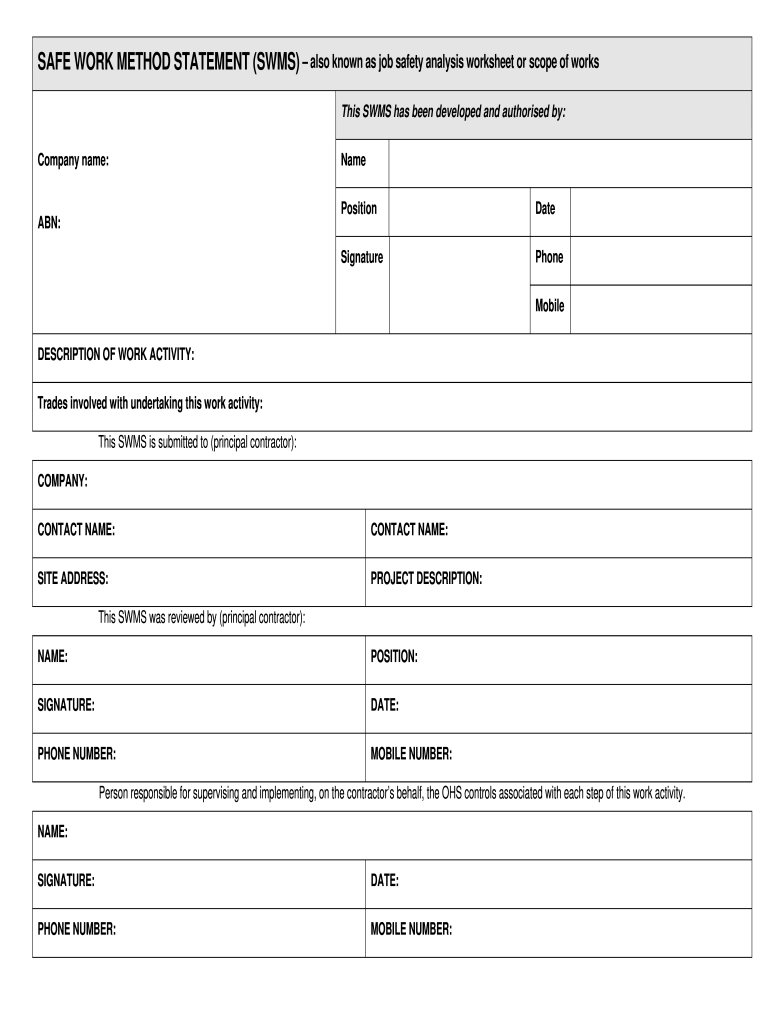
- Complete the top section by providing the company name, your name, position, date, signature, ABN, phone, and mobile number.
- Describe the work activity to be undertaken, including the trades involved. Specify the principal contractor’s details, including the company name, contact name, site address, and project description.
- Indicate the person responsible for supervising and implementing safety controls, documenting their name, signature, date, phone, and mobile number.
- List all plant, equipment, and tools that will be used, and provide details of any hazardous substances involved, referring to Material Safety Data Sheets (MSDS) where applicable.
- Document personal protective equipment (PPE) needed for the activity, and list potential hazards to consider while conducting the work.
- Assess the likelihood of serious incidents occurring due to identified hazards, classifying them based on frequency of occurrence.
- Fill in the risk table by identifying potential hazards for each step of the work activity and assigning an initial risk rating.
- List the controls you will implement to mitigate identified risks and record the revised risk rating after these controls are applied.
- Ensure that individuals responsible for implementing controls are documented, along with their positions.
- Once all sections are thoroughly completed and reviewed, save your changes to the SWMS document.
- At this point, you can download, print, or share the completed SWMS as necessary.
Begin filling out your Safe Work Method Statement online today to prioritize safety in your work activities.
Experience a faster way to fill out and sign forms on the web. Access the most extensive library of templates available.
Related content
Maintain safe working distances based upon the voltage of the line for any part of the...
A SWMS is a site specific statement that must be prepared before any task is commenced...
• Complete a Safe Work Method. Statement (SWMS). • Set up an exclusion zone. •...
Get answers to your most pressing questions about US Legal Forms API.
What is a method statement for emergency procedures?
A method statement for emergency procedures focuses on how to respond effectively during emergencies. It outlines specific actions to take, roles for team members, and communication strategies to ensure a swift response. This type of method statement not only aims to protect workers but also ensures compliance with safety regulations, creating a safer workplace overall.
How do you write a safe work procedure?
Writing a safe work procedure requires you to begin with a clear outline of the task and its objectives. Next, break down the task into manageable steps while identifying risks and necessary safety measures. Each step should include clear instructions and establish the roles of all involved. By doing this, you create a useful document that enhances safety and ensures compliance.
What is the difference between a method statement and a work procedure?
A method statement provides a comprehensive overview of how a task will be completed safely, while a work procedure focuses on specific steps required to perform that task. The method statement addresses potential hazards and safety measures, ensuring risk is minimized. Conversely, work procedures are often more focused on the practical aspects of carrying out a job.
What should be included in a method statement?
structured method statement should include the task description, procedures to be followed, potential hazards, and control measures to mitigate those hazards. Additionally, it should specify roles and responsibilities, necessary training, and the personal protective equipment required. Including these elements ensures everyone understands the expectations and safe practices associated with the task.
What is the difference between a safety statement and a method statement?
A safety statement primarily outlines an organization's overall safety policy and its commitment to maintaining a safe work environment. In contrast, a method statement provides specific instructions on how to safely perform individual tasks or activities. While both documents aim to enhance workplace safety, they serve distinct purposes in the safety management framework.
What is a method statement for safe work procedures?
A method statement for safe work procedures is a document that details how to perform specific tasks safely. It typically includes risk assessments, safe work practices, and personal protective equipment required for the task. By creating this method statement, organizations help ensure compliance with legal safety standards while promoting worker safety and health.
How to fill in a method statement?
Filling in a method statement involves several key steps. First, you identify the specific task and its associated risks. Next, outline the procedures you will follow to complete the task safely, including necessary equipment and resources. Finally, review the statement with your team to ensure everyone understands their roles and responsibilities.
What is an example of a safe work method?
A safe work method is a structured approach to completing a task while minimizing risk. For instance, a construction team may use a safe work method statement to outline procedures for safely erecting scaffolding. This includes specifying protective equipment, outlining step-by-step actions, and identifying potential hazards. By following such a method, workers can execute tasks professionally and safely.
What are examples of safe work?
Examples of safe work include following proper lockout/tagout procedures when maintaining equipment and using personal protective equipment (PPE) regularly. These practices protect workers from accidents and injuries. A well-structured Safe Work Method Statement reinforces these safety measures, promoting a safer working environment.
What is a safe work method statement or JSA?
A safe work method statement, or Job Safety Analysis (JSA), is a document that outlines how to perform a job safely and efficiently. It identifies hazards, assesses risks, and prescribes control measures. Utilizing a Safe Work Method Statement or JSA supports businesses in maintaining workplace safety and compliance.
Use professional pre-built templates to fill in and sign documents online faster. Get access to thousands of forms.
If you believe that this page should be taken down, please follow our DMCA take down process here.