Fore or when this agreement is signed. Tenancy laws The Residential Tenancies Act 2010 and the Residential Tenancies Regulation 2010 apply to this agreement. Both the landlord and the tenant must comply with these laws. For information about your rights and responsibilities under this agreement, contact Fair Trading at www.fairtrading.nsw.gov.au or call 13 32 20. 2 The Agreement Right to occupy the premises 1. The landlord agrees that the tenant has the right to occupy the residential premi.
Loading

Open form follow the instructions

Easily sign the form with your finger

Send filled & signed form or save
How to fill out the AU NSW Residential Tenancy Agreement online
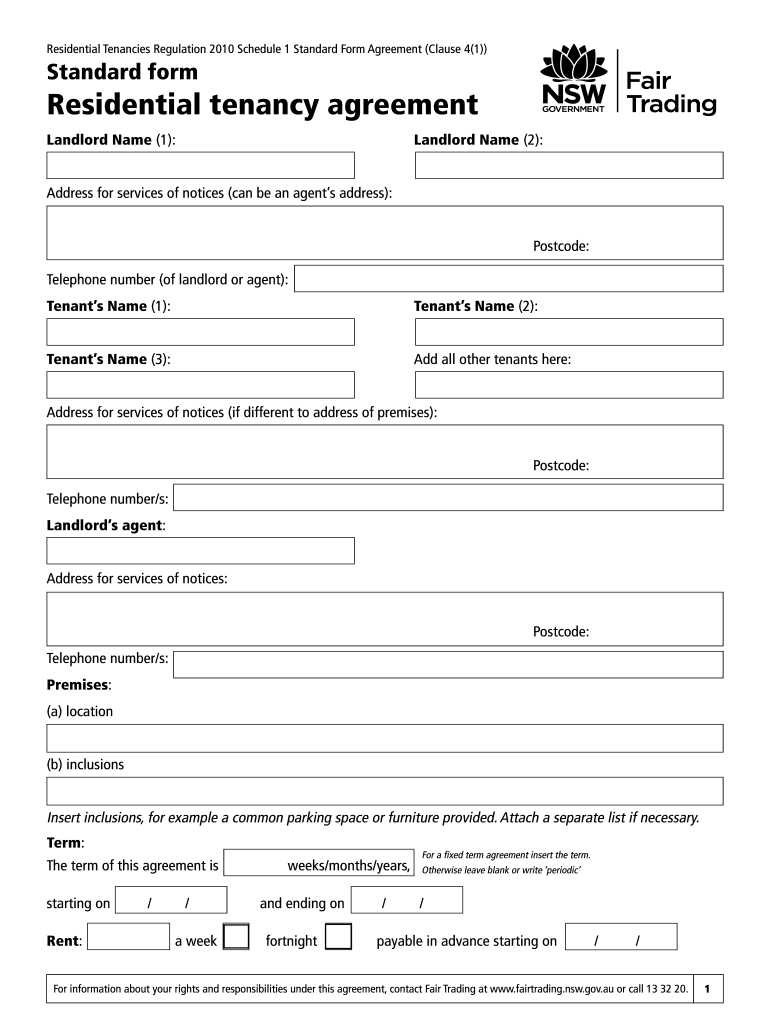
Navigating the AU NSW Residential Tenancy Agreement can seem daunting, but this guide provides clear, step-by-step instructions for completing the form online. The agreement outlines the terms and conditions between landlords and tenants, ensuring a mutual understanding of rights and responsibilities.
Follow the steps to complete your residential tenancy agreement online.
- Click ‘Get Form’ button to obtain the form and open it in your preferred online editor.
- Enter the landlord's names in the specified fields. If there are two landlords, include both names. Provide the address for service of notices, ensuring it is accurate and up to date.
- Fill in the tenant's names. If there are multiple tenants, make sure to add all relevant names in the corresponding fields. Include the address for service of notices, if it differs from the premises address.
- Specify the premises by providing the location and inclusions, such as furniture or parking spaces, if applicable. If there is a long list of inclusions, consider attaching a separate document.
- Indicate the term of the agreement. Specify the start and end dates and whether the agreement is fixed-term or periodic by writing the appropriate term in the designated section.
- Detail the rent amount and payment frequency (weekly, fortnightly, or monthly). Additionally, provide the information regarding the method by which rent will be paid, ensuring at least one option does not incur costs for the tenant.
- If applicable, specify the rental bond amount and ensure it does not exceed four weeks' rent. Note any additional details required about the bond.
- Complete any additional sections such as maximum number of occupants, urgent repairs, water usage requirements, and strata by-laws. Be sure to answer each question accurately.
- Sign the agreement in the designated spaces, ensuring all parties involved (landlord and tenants) sign and date the document. Witness signatures may also be required.
- Review the completed agreement for accuracy. Once satisfied with all entered information, save the changes, and familiarize yourself with available options to download, print, or share the completed agreement.
Complete your residential tenancy agreement online today to ensure a smooth renting experience.
Experience a faster way to fill out and sign forms on the web. Access the most extensive library of templates available.
Related content
Any lease of a term longer than 3 years will require registration under the Real Property...
These agreements must clearly outline the terms and conditions of the tenancy, including...
You will sign a rental agreement with the village operator, and your tenancy will operate...
Get answers to your most pressing questions about US Legal Forms API.
When a new tenant moves in?
When a new tenant moves in, a thorough inspection of the property should be conducted to document its condition. This step is crucial as it affects both your AU NSW Residential Tenancy Agreement and the bond refund process. Providing clear information about utilities and upkeep can help the new tenant settle in smoothly.
How to fill out a residential tenancy agreement in NSW?
Filling out a residential tenancy agreement in NSW involves providing personal details, setting rental terms, and clarifying obligations of both parties. It is important to be clear and precise to avoid misunderstandings. Using a professional platform like uslegalforms can simplify this process and ensure that your AU NSW Residential Tenancy Agreement meets all legal requirements.
What are the new tenancy laws in NSW?
The new tenancy laws in NSW focus on improving tenant rights and responsibilities, particularly around rent payments and maintenance requests. These laws intended to create a more balanced rental market will also address the issue of renting with pets. Familiarizing yourself with your AU NSW Residential Tenancy Agreement will help you navigate these changes effectively.
What are the changes to the Residential Tenancy Act in NSW?
Recent changes to the Residential Tenancy Act in NSW include updates concerning rent increases, pets in rental properties, and tenant rights. These adjustments aim to enhance rental security and fairness for tenants. It is essential to review your AU NSW Residential Tenancy Agreement periodically to understand how these changes may affect you.
Does a residential lease need to be registered in NSW?
No, you do not need to register a residential lease in NSW for short-term agreements. However, for certain longer leases or commercial agreements, registration may be beneficial. An AU NSW Residential Tenancy Agreement remains enforceable without registration, but it is important to understand your rights and obligations under the law.
Do you need to clean carpets at the end of a lease in NSW?
Yes, tenants are generally required to clean carpets at the end of a lease in NSW. This requirement is often specified in the AU NSW Residential Tenancy Agreement. Proper cleaning helps ensure the property is returned in good condition and protects your bond deposit from potential deductions.
How much notice does a tenant need to give to vacate in NSW?
In NSW, tenants must provide a minimum of 30 days' written notice if they wish to vacate at the end of a lease. This requirement is part of the AU NSW Residential Tenancy Agreement, ensuring both parties have adequate time to prepare. By adhering to this guideline, you maintain a smooth transition and comply with legal obligations.
What is the most common tenancy agreement?
The most common tenancy agreement utilized in AU NSW is the fixed-term agreement. This type creates security for both tenants and landlords by specifying set terms and conditions. It provides a clear framework for the duration, rental amount, and responsibilities. By utilizing an AU NSW Residential Tenancy Agreement, you can effectively outline these important details.
How much notice does a landlord have to give a tenant to vacate in NSW?
In NSW, a landlord typically must provide a minimum of 30 days' notice if seeking to terminate a tenancy without a specified reason. For tenancies of a specific duration, the notice period may extend to 60 days or longer. To guarantee compliance with local laws, an AU NSW Residential Tenancy Agreement will outline these notice requirements clearly.
What is the most common type of tenancy?
The most common type of tenancy in residential sectors is the standard lease agreement, often a fixed-term lease. This type provides both the landlord and tenant with defined terms and protections. It clearly outlines the responsibilities of both parties while ensuring conformability to the AU NSW Residential Tenancy Agreement standards.
Use professional pre-built templates to fill in and sign documents online faster. Get access to thousands of forms.
If you believe that this page should be taken down, please follow our DMCA take down process here.
This form is available in several versions. Select the version you need from the drop-down list below.