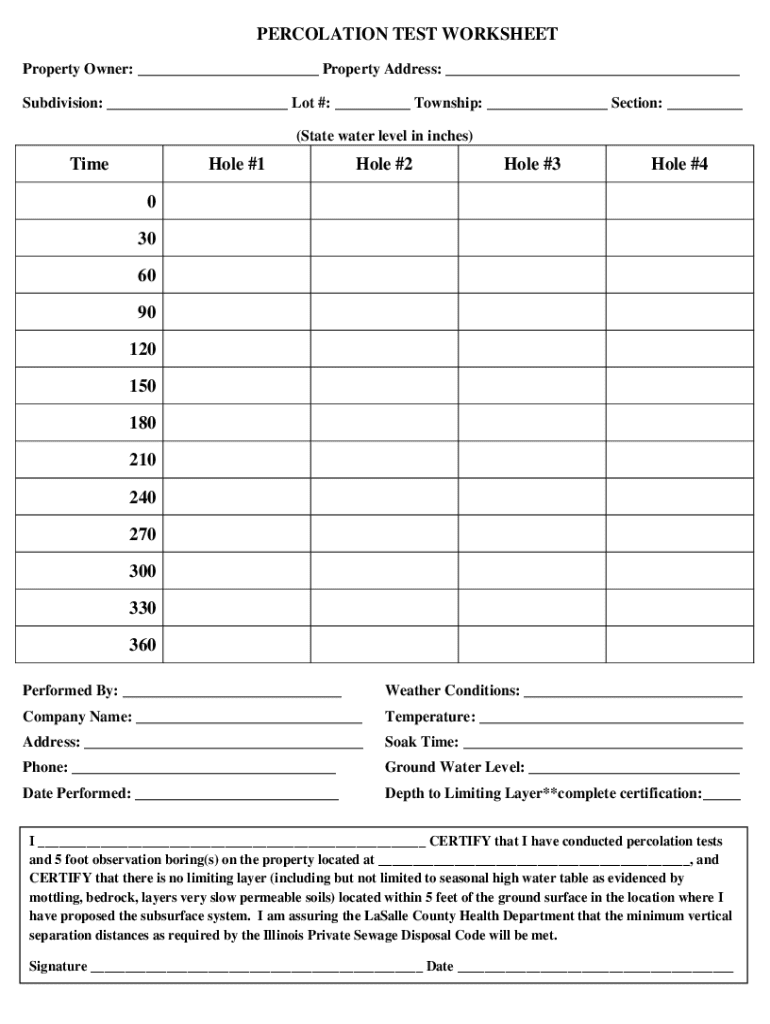
LASALLE COUNTY HEALTH DEPARTMENT 717 ETNA ROAD OTTAWA, ILLINOIS 61350 PERCOLATION TESTS SHALL NOT BE CONDUCTED IN FROZEN GROUND OR IN GROUND THAT HAS BEEN FILLED IN THE PRECEDING 12 MONTHS. SOIL TEST.

Open form follow the instructions

Easily sign the form with your finger

Send filled & signed form or save
How to fill out the Percolation Test Sheet online
Filling out the Percolation Test Sheet online is essential for determining the suitability of soil for septic absorption systems. This guide provides a comprehensive overview of the steps needed to successfully complete the form, ensuring a streamlined submission.
Follow the steps to successfully complete the Percolation Test Sheet
- Click ‘Get Form’ button to access the Percolation Test Sheet and open it in the editor.
- Begin filling in the property owner’s name in the designated field, ensuring that all information is accurate and matches official records.
- Enter the property address, including all relevant details such as street name and number, to ensure correct identification of the testing location.
- Complete the subdivision, lot number, township, and section fields as applicable to your property, providing precise location details.
- Record the water levels and timing for each hole. Complete the measurements for each observation point as directed, ensuring to follow the specified intervals.
- Document the weather conditions and temperature at the time of testing; this information is crucial for the accuracy of the results.
- Fill in the ground water level and soak time to provide context for the test results.
- Once all data is entered, ensure that you certify the results by signing and dating the document. This certification confirms the validity of the conducted tests.
- Finally, save your completed form, and choose to download, print, or share the document as necessary to complete the process.
Complete your Percolation Test Sheet online today to ensure compliance and functionality for your septic system.
Experience a faster way to fill out and sign forms on the web. Access the most extensive library of templates available.
Related content
(2) Dig each hole with vertical sides approximately 12 inches in diameter. If an...
Each sheet that is part of your design must be printed separately as there is not a way...
Appendix C: Water Quality Impact Assessment Data Sheet. Appendix D: ... Soil types...
Get answers to your most pressing questions about US Legal Forms API.
What is a good percolation test result?
A minimum value of 15 ensures that the soil's percolation rate is slow enough to allow the effluent to be sufficiently treated before reaching the ground water. Any value lower than 15 would mean that the untreated effluent could drain away too rapidly and pollute the groundwater.
How do you calculate a perc test?
The percolation rate is calculated for each test hole by dividing the time interval used between measurements by the magnitude of the last water level drop. This calculation results in a percolation rate in terms of minutes per inch.
What is a perc test measure?
The percolation rate is determined by conducting a percolation (perc) test. The percolation test measures the amount of time it takes for water in a test hole to drop 1 inch.
How much water is needed for a percolation test?
For septic tank systems and wells, the minimum requirement varies from 15-60m depending on whether the well is up, across or downgradient, the percolation value, soil type and depth.
What is a normal percolation rate?
Soils with a percolation rate faster than five minutes per inch are acceptable if a 12-inch-thick loamy sand soil liner with a percolation rate of 15 to 20 minutes per inch is installed in the trench or bed. The trench or bed is then sized based on this soil liner percolation rate.
How deep do you test for percolation?
After placing the sand or fine gravel in the percolation test hole, the hole must be slowly filled with clear water to a minimum depth of 12 inches over the sand or gravel. This water level should be maintained for at least two hours.
How do you calculate percolation area?
Percolation test method to calculate area of drainage field for Septic tanks or sewage treatment systems. Step 1: Excavate a test hole 300mm square x 300mm deep below proposed. Step 2: Fill the test hole with water and allow drain away over night. Step 3: Refill to a depth of 300mm and note time taken in seconds to drain.
Use professional pre-built templates to fill in and sign documents online faster. Get access to thousands of forms.
If you believe that this page should be taken down, please follow our DMCA take down process here.