Loading
Get Computer Basics For Kids
How it works
-

Open form follow the instructions
-

Easily sign the form with your finger
-

Send filled & signed form or save
How to fill out the Computer Basics For Kids online
Filling out the Computer Basics For Kids worksheet is a straightforward process designed to help young learners understand the fundamental components of a computer. This guide will provide clear, step-by-step instructions to assist users in successfully completing the form online.
Follow the steps to fill out the Computer Basics For Kids worksheet
- Click the ‘Get Form’ button to access the worksheet and open it in your preferred editor.
- Start with the first section of the form where you will need to provide your name. Locate the field marked 'Name:' and enter your name clearly.
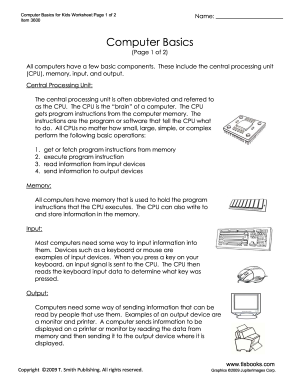
- Proceed to page one of the worksheet to read about the central processing unit (CPU), memory, input, and output. This information will help you answer the questions effectively.
- After reviewing the information, navigate to the questions section. For question one, list the four basic components of a computer system in the provided space.
- For question two, mark the component that is considered the 'brain' of a computer by selecting the correct option from the provided choices.
- In question three, select an example of an output device from the list and mark your answer.
- Question four asks about input devices. Choose the correct input device from the given options and indicate your selection.
- Finally, label the parts of the computer as indicated. Provide appropriate labels in the designated area.
- Once you have filled out all sections of the form, review your answers for accuracy and completeness.
- After verifying that all fields are correctly filled, you can save changes, download, print, or share the completed form as needed.
Complete your Computer Basics For Kids worksheet online today!
Kids will also need to learn how to use traditional computers with keyboards because they are likely to be using them at school and because learning on an actual computer will help them understand the basics of hardware and software, and boost their typing and mouse skills in a way that touchscreens cannot.