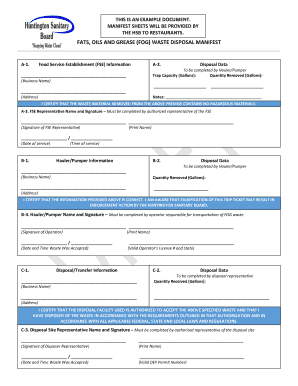
THIS IS AN EXAMPLE DOCUMENT. MANIFEST SHEETS WILL BE PROVIDED BY THE HSB TO RESTAURANTS. FATS, OILS AND GREASE (FOG) WASTE DISPOSAL MANIFEST A1. Food Service Establishment (FSE) Information A2. Disposal.

How it works
  • Open form

    Open form follow the instructions

  • Easily sign form

    Easily sign the form with your finger

  • Share form

    Send filled & signed form or save

How to use or fill out the Grease Trap Cleaning Manifest - Sanitary Board online

The grease trap cleaning manifest is an essential document for food service establishments to track the disposal of fats, oils, and grease waste. This guide provides a clear and user-friendly approach to completing the manifest online, ensuring compliance with sanitary board regulations.

Follow the steps to efficiently fill out the grease trap cleaning manifest online.

  1. Click ‘Get Form’ button to obtain the form and open it in the editor.
  2. Begin with section A-1, where you need to fill in the food service establishment (FSE) information, including the business name and address.
  3. Navigate to section A-2, where the disposal data should be completed by the hauler or pumper. Enter the trap capacity in gallons and the quantity removed in gallons.
  4. In section A-3, the FSE representative must provide their name and signature, certifying that no hazardous materials are present in the waste. Include the date and time of service.
  5. Proceed to section B-1, which requires hauler/pumper information, including business name and address.
  6. Complete section B-2 with the quantity removed in gallons and ensure the hauler certifies the truthfulness of the information. The operator's signature, name, and date/time of waste acceptance are also needed here.
  7. In section C-1, fill out the valid operator’s license number and state, followed by disposal/transferred site information, including the business name and address.
  8. Complete section C-2, detailing the quantity received in gallons by the disposal representative.
  9. The disposal site representative must sign in section C-3, providing their printed name, date, and time of acceptance, along with the valid DEP permit number.
  10. After completing all sections, you can save changes, download, print, or share the completed manifest form as required.

Complete the grease trap cleaning manifest online today to ensure proper waste disposal compliance.

Get form

Experience a faster way to fill out and sign forms on the web. Access the most extensive library of templates available.

Related content

Fats, Oils and Grease (FOG) - California State...

Sewer line cleaning, repair & replacement costs ... M – Maintenance of sanitary sewer...

Learn more
Sanitary Sewer Management Plan SSMP - San Jose...

Includes BFD. 9. Overflow Reporting – Chart /. Spreadsheet. 10. Overflow Report Forms...

Learn more
draft mitigation monitoring and reporting program...

Dec 24, 2013 — and 3x5 rock to facilitate tire soil removal prior to leaving the site...

Learn more
Questions & Answers

Get answers to your most pressing questions about US Legal Forms API.

Contact support

How often do you clean a grease interceptor?

Most grease traps should be cleaned out every 1-3 months, depending on usage. To know exactly how often your business needs to attend to the grease traps, consider the “1/4th rule.” In simple terms, the grease trap should be cleaned out when it reaches a quarter of its capacity.

Scope of Work:, The Contractor shall clean designated grease traps and remove and dispose of grease to ensure they function properly. The work covered consists of furnishing all labor, material, equipment, transportation and supervision for performing all necessary operations.

Scrape the interior to remove any excess grease. You can also use a shop vacuum to suck out smaller bits of waste or bits stuck in hard-to-reach places. Scrub your grease trap with a steel pot scrubber and some soap and water. Flush the screens and parts out with water to remove the soap and leftover waste.

Which log must be filled out each time the outdoor grease traps are cleaned? The maintenance log serves as a record of the frequency and volume of cleaning the interceptor. It is required by the pretreatment program to ensure that grease trap/interceptor maintenance is performed on a regular basis.

It cools warm or hot greasy water by allowing the fats, oils and greases to cool. A grease trap is able to separate the different layers of waste with water because the FOG material rises to the top and water remains at the bottom with the solid food debris.

For a thorough cleaning, utilize the shop vacuum to suck out any lingering FOGs from the grease trap. Next, refresh the grease trap and free the tank from obnoxious odors with a little elbow grease, a steel pot scrubber, dish soap and tepid water. Thoroughly scrub down the grease trap's baffles, sides and lid.

Get This Form Now!

Use professional pre-built templates to fill in and sign documents online faster. Get access to thousands of forms.

If you believe that this page should be taken down, please follow our DMCA take down process here.

Get Grease Trap Cleaning Manifest - Sanitary Board