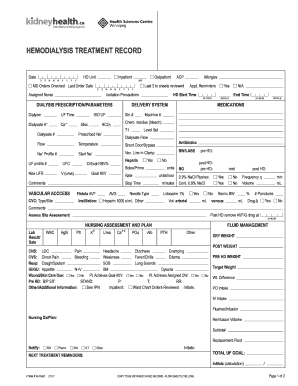
HEMODIALYSIS TREATMENT RECORD DateDDMMMYYYHD UnitYMD Orders Checked Last Order DateInpatient DDMAssigned NurseMMYYYOutpatientUNITDialysate K+Ca++HD Start TimeStn. #ISO UF Gluc.T1FlowTemperatureShunt.

How it works
  • Open form

    Open form follow the instructions

  • Easily sign form

    Easily sign the form with your finger

  • Share form

    Send filled & signed form or save

How to fill out the Hemodialysis Treatment Record online

The Hemodialysis Treatment Record is a crucial document used to track and manage hemodialysis treatments. Completing this form accurately ensures that the necessary medical information is documented for patient care and treatment effectiveness.

Follow the steps to complete the Hemodialysis Treatment Record online.

  1. Click ‘Get Form’ button to obtain the Hemodialysis Treatment Record and open it in the editor.
  2. Begin by entering the date of treatment in the specified format (DD/MM/YYYY). This provides a timeline for the patient's records.
  3. Indicate the HD unit where the treatment is taking place. Select between inpatient or outpatient options as applicable.
  4. Document the assigned nurse’s name and the last checked MD orders date to maintain clear communication regarding the patient's care.
  5. Fill in the details for dialysate components including K+, Ca++, and other relevant parameters according to the prescription.
  6. Record the start time of the hemodialysis session and any relevant temperatures or flow rates associated with the treatment.
  7. Complete sections related to vascular access, including type and site of the cannulation, and record any medications administered during treatment.
  8. Enter nursing assessments and lab results, ensuring to note any critical observations that require attention.
  9. Document post-treatment observations, including patient weight and vital signs. Confirm if the patient meets discharge criteria.
  10. Review the entire document for accuracy and completeness. Once validated, you can save changes, download, print, or share the form as needed.

Complete your Hemodialysis Treatment Record online to ensure comprehensive care and documentation.

Get form

Experience a faster way to fill out and sign forms on the web. Access the most extensive library of templates available.

Related content

Record Keeping, Reporting and Hemodialysis - NCBI...

Record keeping in a dialysis unit involves many different facets and is important to...

Learn more
A Major Qualifying Project - Worcester Polytechnic...

May 14, 2017 — hemodialysis treatment process. Currently, there are no devices...

Learn more
Obesity - Wikipedia

Obesity is a medical condition in which excess body fat has accumulated to an extent that...

Learn more
Questions & Answers

Get answers to your most pressing questions about US Legal Forms API.

Contact support

What is the best dialysis treatment?

Peritoneal dialysis is an effective form of dialysis, has been proven to be as good as hemodialysis. Peritoneal dialysis is not for everyone. People must receive training and be able to perform correctly each of the steps of the treatment. A trained helper may also be used.

Peritoneal dialysis is an effective form of dialysis, has been proven to be as good as hemodialysis. Peritoneal dialysis is not for everyone. People must receive training and be able to perform correctly each of the steps of the treatment. A trained helper may also be used.

When your kidneys fail, dialysis keeps your body in balance by: removing waste, salt and extra water to prevent them from building up in the body. keeping a safe level of certain chemicals in your blood, such as potassium, sodium and bicarbonate. helping to control blood pressure.

Under hemodialysis, if the pressure outside the hollow fiber is lower than inside, body water is removed from the blood that flows through the hollow fiber. This process is called ultrafiltration and removes excess water from the body.

Peritoneal dialysis is done more continuously than hemodialysis, resulting in less accumulation of potassium, sodium and fluid. This allows you to have a more flexible diet than you could have on hemodialysis. Longer lasting residual kidney function.

Monitor serum electrolytes, blood urea nitrogen, creatinine, and hemoglobin and hematocrit levels before and after dialysis. Monitor fluid status. Monitor coagulation studies because is used to prevent clotting during dialysis.

Peritoneal dialysis is ongoing dialysis (daily) that collects waste from the blood by washing the empty space in the abdomen (peritoneal cavity). It can be done from home. The access for this is in your abdomen.

Compared with PD, hemodialysis (HD) has a higher dialysis efficacy and better capacity control, but a greater impact on hemodynamics and an increased tendency to bleed. At present, only one study has shown the effect of post-transplant dialysis modality in renal transplant recipients with DGF on 1-year outcomes.

Renal dietitians encourage most people on hemodialysis to eat high-quality protein because it produces less waste for removal during dialysis. High-quality protein comes from meat, poultry, fish, and eggs. Avoid processed meats such as hot dogs and canned chili, which have high amounts of sodium and phosphorus.

Life expectancy on dialysis can vary depending on your other medical conditions and how well you follow your treatment plan. Average life expectancy on dialysis is 5-10 years, however, many patients have lived well on dialysis for 20 or even 30 years.

Get This Form Now!

Use professional pre-built templates to fill in and sign documents online faster. Get access to thousands of forms.

If you believe that this page should be taken down, please follow our DMCA take down process here.

Get Hemodialysis Treatment Record