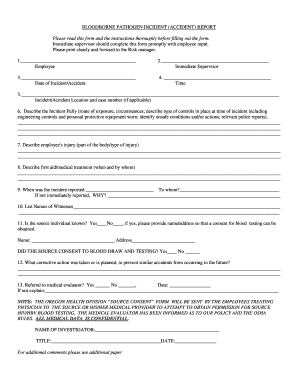
Input. Please print clearly and forward to the Risk manager. 1. Employee 2. Immediate Supervisor 3. Date of Incident/Accident 4. Time 5. Incident/Accident Location and case number (if applicable) 6. Describ.
Open form follow the instructions
Easily sign the form with your finger
Send filled & signed form or save
How to fill out the bloodborne pathogen incident (accident) report - Co Douglas Or online
Filling out the bloodborne pathogen incident report is a critical step in ensuring workplace safety and compliance with regulations. This guide will provide you with a clear and structured approach to complete the report online effectively.
Follow the steps to accurately complete your incident report.
- Press the ‘Get Form’ button to access the report form. This will allow you to open the document in an online format that is easy to navigate.
- Begin by entering the name of the employee who is reporting the exposure incident in the designated field.
- Next, input the name of the immediate supervisor of the reporting employee. This ensures proper communication and accountability.
- Provide the specific date when the incident occurred, using the appropriate format.
- Indicate the time of the incident clearly. This timestamp will help in further investigation.
- In the section titled 'Incident/Accident Location and case number,' describe where the incident took place and include a case number if applicable.
- Detail the incident by addressing the route of exposure, the circumstances surrounding it, and any safety controls that were in place at the time, including personal protective equipment.
- Describe any injuries sustained by the employee. Provide as much detail as possible about the affected body part and type of injury.
- Record any first aid or medical treatment provided, including who administered it and when.
- Document when the incident was reported to the management and to whom. If there was a delay in reporting, include the reasons.
- List the names of witnesses to the incident for thoroughness.
- Indicate whether the source individual is known and provide their information only if consent for blood testing is obtained.
- Outline any corrective actions taken or planned to prevent similar incidents in the future.
- Indicate whether a medical referral was made and provide details if it was not.
- Finally, fill in the name, title, and date for the investigator who will be reviewing this report.
- Once all fields are completed, review the form for accuracy and clarity. You can then save changes, download, print, or share the completed report as needed.
Complete your bloodborne pathogen incident report online today to enhance workplace safety.
Experience a faster way to fill out and sign forms on the web. Access the most extensive library of templates available.
Related content
References: 29 CFR 1910.1030, Occupational Exposure to Bloodborne Pathogens ... B. The...
Protocol in the Event of an Accident at a Health Care Facility 22 ... C. Nursing & Allied...
research);. □ taking appropriate action when a co-worker has a ... identifying hazards...
Get answers to your most pressing questions about US Legal Forms API.
How do I report bloodborne pathogen to OSHA?
To file a complaint by phone, report an emergency, or get OSHA advice, assistance, or products, contact your nearest OSHA office under the “U.S. Department of Labor” listing in your phone book, or call us toll-free at (800) 321-OSHA (6742).
What is included in an exposure incident?
An exposure incident is any eye, mouth, mucous membrane, non-intact skin, or other parenteral contact with blood or other potentially infectious material (OPIM). (For example, a puncture from a contaminated sharp such as an injection needle or a cut from a scalpel blade or suture needle.)
What are the four things done when reporting an exposure?
Employers must tell the employee what to do if an exposure incident occurs. Medical Evaluation and Follow-up. ... Written Opinion. ... Confidentiality. ... Recordkeeping.
What are the four requirements an exposure control plan must have?
Exact personal protective equipment (PPE) requirements. Hygiene facilities and decontamination procedures. Education and training. Annual review process.
How soon should you report an exposure incident?
Reporting Incident — Employees should immediately report exposure incidents to the employer to permit timely medical follow-up. ing to the U.S. Public Health Service, if HIV postexposure prophylaxis is medically indicated it should be initiated promptly, preferably within 1-2 hours after the exposure incident.
How do I report exposure to bloodborne pathogens?
Report this immediately to your employer and seek immediate medical attention. CDC: Emergency Needlestick Information also provides immediate access to treatment protocols following blood exposures involving HIV, HBV and HCV, including the Clinicians' Post Exposure Prophylaxis Hotline (PEPline) at 1-888-448-4911.
What 4 things should be included when reporting an exposure?
Exposure Incident Reporting An exposure incident should include the following: The time, date, and location of the exposure. An account of all the people involved, including the exposed person, names of their first aid providers, and if possible, the name of the source individual.
What must be included in the exposure determination?
The exposure determination must include a list of the job classifications with occupational exposure, and a list of all the tasks and procedures in which occupational exposure occurs within the job classifications identified.
Use professional pre-built templates to fill in and sign documents online faster. Get access to thousands of forms.
If you believe that this page should be taken down, please follow our DMCA take down process here.