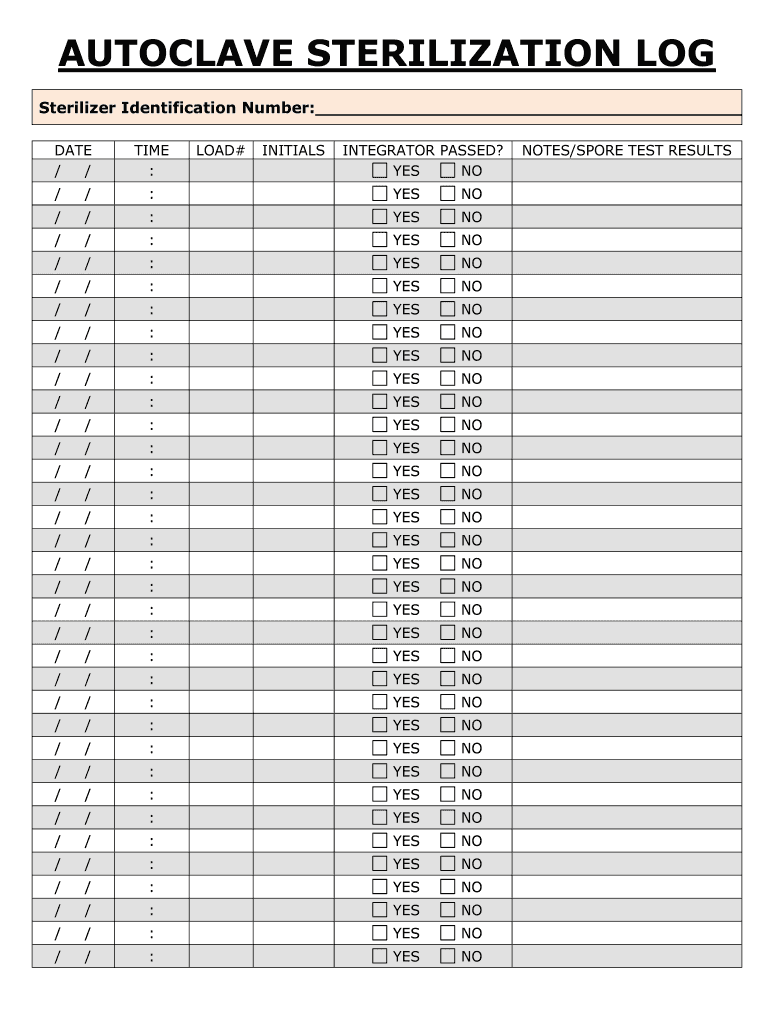
AUTOCLAVE STERILIZATION LOG. Sterilizer Identification Number: DATE. TIME. LOAD# INITIALS INTEGRATOR PASSED? NOTES/SPORE TEST RESULTS.
Loading

Open form follow the instructions

Easily sign the form with your finger

Send filled & signed form or save
How to fill out the EBAP Autoclave Sterilization Log - Oregon online
The EBAP Autoclave Sterilization Log is an essential document for tracking the sterilization process in various settings. This guide provides you with clear, step-by-step instructions to help you accurately complete the form online.
Follow the steps to effectively fill out the EBAP Autoclave Sterilization Log
- Click the ‘Get Form’ button to access the EBAP Autoclave Sterilization Log. This will open the form for you to begin filling it out.
- Locate the 'Sterilizer Identification Number' field at the top of the log. Enter the unique identification number for the autoclave being used.
- Proceed to the 'DATE' field. Enter the current date in the format of MM/DD/YYYY.
- Next, find the 'TIME' field. Specify the time the sterilization process begins. Use the format of HH:MM.
- In the 'LOAD#' section, record the designated load number for this cycling process.
- For each sterilization load, you will see an 'INITIALS' field. Have the person responsible for the sterilization process initial here to confirm their oversight.
- Under the 'INTEGRATOR PASSED?' section, for each load tested, mark 'YES' or 'NO' based on whether the integrator passed the validation.
- Continue filling in the subsequent load sections as necessary by repeating the process for each load being sterilized, ensuring you document the results clearly.
- Finally, in the 'NOTES/SPORE TEST RESULTS' section, provide any additional comments or results of spore tests conducted, if applicable.
- Once you have filled in all required fields, save your changes, and then you can choose to download, print, or share the completed log.
Complete the EBAP Autoclave Sterilization Log online today to ensure compliance and safety in your sterilization processes.
Experience a faster way to fill out and sign forms on the web. Access the most extensive library of templates available.
Related content
The facility has a sterilization area separated from public areas, service areas ... Steam...
Jan 10, 2017 — Department of Environmental and Molecular Toxicology, Oregon State...
'MSI' Autoclave Portable: Fitted with pressure gauge up to 20 psi, the unit has spring...
Get answers to your most pressing questions about US Legal Forms API.
How do you wrap instruments for sterilization in an autoclave?
0:56 2:29 Suggested clip 346 Wrapping - YouTubeYouTubeStart of suggested clipEnd of suggested clip 346 Wrapping - YouTube
How do you sterilize medical equipment with an autoclave?
The autoclave machine should run for a certain period of time at a specific temperature and pressure. Wrapped instruments should be in the autoclave at 250 degrees for 30 minutes at 15 PSI or 273 degrees for 15 minutes at 30 PSI. Once the machines has run, you need to open the door a small bit to let the steam out.
How long does it take to sterilize in autoclave?
Many autoclaves are used to sterilize equipment and supplies by subjecting them to pressurized saturated steam at 121 °C (250 °F) for around 15 20 minutes depending on the size of the load and the contents.
Is used in sterilization by autoclaving?
An autoclave is used to sterilize surgical equipment, laboratory instruments, pharmaceutical items, and other materials. ... A very basic autoclave is similar to a pressure cooker; both use the power of steam to kill bacteria, spores and germs resistant to boiling water and powerful detergents.
Why autoclaving is the best method of sterilization?
Autoclaves can inactivate fungi, bacteria, spores, viruses and other microorganisms on surgical instruments such as scalpels, forceps, scissors and other metal items. Because autoclaving sterilizes without the use of reagents and allows for the re-use of lab equipment and supplies, it is environmentally friendly.
How long does it take for steam to sterilize?
Typical sterilization temperatures and times are 132°C to 135°C with 3 to 4 minutes exposure time for porous loads and instruments. Like other sterilization systems, the steam cycle is monitored by mechanical, chemical, and biological monitors.
How do you sterilize medical equipment?
Medical devices are sterilized in a variety of ways including using moist heat (steam), dry heat, radiation, ethylene oxide gas, vaporized hydrogen peroxide, and other sterilization methods (for example, chlorine dioxide gas, vaporized peracetic acid, and nitrogen dioxide).
How does an autoclave sterilize?
An autoclave is a machine that uses steam under pressure to kill harmful bacteria, viruses, fungi, and spores on items that are placed inside a pressure vessel. The items are heated to an appropriate sterilization temperature for a given amount of time.
What are the conditions of sterilization in an autoclave?
Autoclave Cycles To be effective, the autoclave must reach and maintain a temperature of 121° C for at least 30 minutes by using saturated steam under at least 15 psi of pressure. Increased cycle time may be necessary depending upon the make-up and volume of the load.
How do you sterilize medical equipment without an autoclave?
1. Simply placing them in gently boiling water for 30 minutes would be a reasonable strategy, but may not eliminate some bacterial spores and could cause issues with rusting over time, especially on sharp instruments like scissors or knives. Note: always sterilize scissors and clamps in the open position. 2.
Use professional pre-built templates to fill in and sign documents online faster. Get access to thousands of forms.
If you believe that this page should be taken down, please follow our DMCA take down process here.