Loading
Form preview
  • US Legal Forms
  • Form Library
  • More Forms
  • More Multi-State Forms
  • Modal Verbs Pdf

Get Modal Verbs Pdf

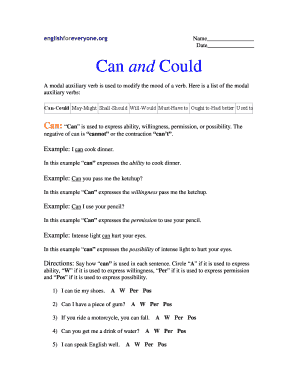
Is used to express ability, willingness, permission, or possibility. The negative of can is cannot or the contraction can t . Example: I can cook dinner. In this example can expresses the ability to cook dinner. Example: Can you pass me the ketchup? In this example Can expresses the willingness pass me the ketchup. Example: Can I use your pencil? In this example Can expresses the permission to use your pencil. Example: Intense light can hurt your eyes. In this.

How it works

  1. Open form

    Open form follow the instructions

  2. Easily sign form

    Easily sign the form with your finger

  3. Share form

    Send filled & signed form or save

How to fill out the Modal Verbs Pdf online

This guide provides a comprehensive overview of filling out the Modal Verbs Pdf online. Users will find clear instructions and helpful tips for completing each section of the form effectively.

Follow the steps to successfully fill out the Modal Verbs Pdf online.

  1. Click the ‘Get Form’ button to obtain the Modal Verbs Pdf and open it in your preferred form editor.
  2. Begin by entering your name in the designated field at the top of the form.
  3. Proceed to fill in the date in the space provided.
  4. For the section regarding ‘can’, read the examples carefully. In the sentences provided, circle 'A' to express ability, 'W' for willingness, 'Per' for permission, and 'Pos' for possibility based on how 'can' is used in each context.
  5. Complete the following sentences using 'can' in your own examples, ensuring they reflect its intended use.
  6. Now, shift to the section about ‘could’. Review the examples given and understand that 'could' serves different functions.
  7. Circle the correct auxiliary modal verb in the provided sentences, selecting between 'can' and 'could' as instructed.
  8. Finally, create two original sentences using 'could', applying the modal verb in ways that demonstrate your understanding.
  9. Once all fields are filled out, save the changes, and choose to download, print, or share the completed form as needed.

Start filling out your Modal Verbs Pdf online today!

Get form

Experience a faster way to fill out and sign forms on the web. Access the most extensive library of templates available.
Get form

Related content

Modal Auxiliary Verbs in Prescribed Malaysian...
Gueron and Lecarme (2008) support the fact that grammar devotes a lot of space to...
Learn more
Modal Verbs - Yale Center for Teaching and...
Here is a list of modal verbs, with some of their most common meanings and examples: Modal...
Learn more
Perfect (grammar) - Wikipedia
The perfect tense or aspect (abbreviated PERF or PRF) is a verb form that indicates that...
Learn more

Related links form

Recommendation Forms - The University Of Texas At Arlington Form FMS-cfc2 - The University Of Texas At Austin - Utexas Grade /100 + 2 Bonus Points REGISTRATION FORM - University Of Tampa - Ut

Questions & Answers

Get answers to your most pressing questions about US Legal Forms API.

Contact support

There are ten types of modal verbs: can, could, may, might, will, would, shall, should, must, ought to. Can (or cannot/can't) shows ability, in the sense of knowing how or being able to do something. In informal situations, it expresses permission, in the sense of being allowed to do something.

Modal auxiliaries are auxiliary verbs that lend different shades of meaning to the main verb to which they are attached. Modals help to express the mood or attitude of the speaker and convey ideas about possibility, probability, necessity, obligation, advisability, and permission.

Modal verbs are auxiliary verbs (also called helping verbs) like can, will, could, shall, must, would, might, and should. ... Modal verbs add meaning to the main verb in a sentence by expressing possibility, ability, permission, or obligation. You must turn in your assignment on time. He might be the love of my life.

MODAL VERBS. There are nine modal verbs in English: can, could, may, might, will (shall), would, should, must and ought. They are auxiliary verbs, used before the infinitive form of main verbs (without 'to' except after 'ought').

Modal verbs are auxiliary verbs (also called helping verbs) like can, will, could, shall, must, would, might, and should. ... Modal verbs add meaning to the main verb in a sentence by expressing possibility, ability, permission, or obligation. You must turn in your assignment on time. He might be the love of my life.

However, when talking about modal verbs in general, the usual number that people talk about is nine - there are nine common modal verbs in the English language.

There are ten types of modal verbs: can, could, may, might, will, would, shall, should, must, ought to.

Modals are can, could, may, might, must, ought to, shall, should, will, would and need (need can also be a main verb).

The principal English modal verbs are can, could, may, might, must, shall, should, will and would. Certain other verbs are sometimes, but not always, classed as modals; these include ought, had better, and (in certain uses) dare and need.

Get This Form Now!

Use professional pre-built templates to fill in and sign documents online faster. Get access to thousands of forms.
Get form
If you believe that this page should be taken down, please follow our DMCA take down processhere.
Get Modal Verbs Pdf
Get form
  • Adoption
  • Bankruptcy
  • Contractors
  • Divorce
  • Home Sales
  • Employment
  • Identity Theft
  • Incorporation
  • Landlord Tenant
  • Living Trust
  • Name Change
  • Personal Planning
  • Small Business
  • Wills & Estates
  • Packages A-Z
  • Affidavits
  • Bankruptcy
  • Bill of Sale
  • Corporate - LLC
  • Divorce
  • Employment
  • Identity Theft
  • Internet Technology
  • Landlord Tenant
  • Living Wills
  • Name Change
  • Power of Attorney
  • Real Estate
  • Small Estates
  • Wills
  • All Forms
  • Forms A-Z
  • Form Library
  • Legal Hub
  • About Us
  • Help Portal
  • Legal Resources
  • Blog
  • Affiliates
  • Contact Us
  • Delete My Account
  • Site Map
  • Industries
  • Forms in Spanish
  • Localized Forms
  • State-specific Forms
  • Forms Kit
  • Real Estate Handbook
  • All Guides
  • Notarize
  • Incorporation services
  • For Consumers
  • For Small Business
  • For Attorneys
  • USLegal
  • FormsPass
  • pdfFiller
  • signNow
  • altaFlow
  • DocHub
  • Instapage
Form Packages
  • Adoption
  • Bankruptcy
  • Contractors
  • Divorce
  • Home Sales
  • Employment
  • Identity Theft
  • Incorporation
  • Landlord Tenant
  • Living Trust
  • Name Change
  • Personal Planning
  • Small Business
  • Wills & Estates
  • Packages A-Z
Form Categories
  • Affidavits
  • Bankruptcy
  • Bill of Sale
  • Corporate - LLC
  • Divorce
  • Employment
  • Identity Theft
  • Internet Technology
  • Landlord Tenant
  • Living Wills
  • Name Change
  • Power of Attorney
  • Real Estate
  • Small Estates
  • Wills
  • All Forms
  • Forms A-Z
  • Form Library
Customer Service
  • Legal Hub
  • About Us
  • Help Portal
  • Legal Resources
  • Blog
  • Affiliates
  • Contact Us
  • Delete My Account
  • Site Map
  • Industries
  • Forms in Spanish
  • Localized Forms
  • State-specific Forms
  • Forms Kit
Legal Guides
  • Real Estate Handbook
  • All Guides
Prepared for you
  • Notarize
  • Incorporation services
Our Customers
  • For Consumers
  • For Small Business
  • For Attorneys
Our Sites
  • USLegal
  • FormsPass
  • pdfFiller
  • signNow
  • altaFlow
  • DocHub
  • Instapage
Social Media
Call us now toll free:
+1 833 426 79 33
As seen in:
© Copyright 1999-2026 airSlate Legal Forms, Inc. 17 Station Street, Suite 303, Brookline, MA 02445
  • Your Privacy Choices
  • Terms of Service
  • Privacy Notice
  • Content Takedown Policy
  • Bug Bounty Program