Loading
Get Sbar For Dementia Patient
How it works
-

Open form follow the instructions
-

Easily sign the form with your finger
-

Send filled & signed form or save
How to fill out the Sbar for dementia patient online
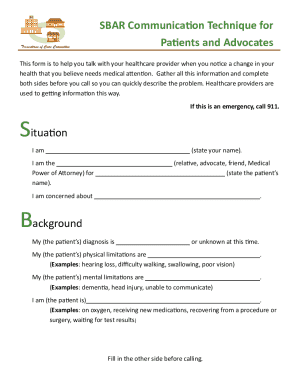
The SBAR communication technique is an essential tool for effectively conveying important information about a dementia patient’s condition. This guide will assist you in filling out the SBAR form online, ensuring you provide clear and comprehensive information to healthcare providers.
Follow the steps to complete the SBAR form accurately and effectively.
- Click ‘Get Form’ button to obtain the form and open it in the editor.
- In the 'Situation' section, fill in your name and your relationship to the patient. Clearly state your concerns regarding the patient’s health or well-being.
- Proceed to the 'Background' section. State the reason the patient came to the hospital and provide their diagnosis, if known. Describe any physical or mental limitations the patient experiences, such as dementia or communication barriers.
- Continue by detailing any specific medical status in the 'Background' section. Mention if the patient is on oxygen, receiving new medications, or awaiting tests.
- Move on to the 'Assessment' section. Document any new symptoms you have noticed in the patient and any changes in their condition. Include observations related to vital signs, pain levels, or mental status.
- In the same section, describe the patient's overall status, using terms like stable, unstable, or deteriorating to give a clear picture of their current health.
- Finally, proceed to the 'Request' section. State any actions you would like to discuss with the healthcare team, such as additional tests or consultations. Indicate how and when you wish to be contacted if there is no improvement in the patient's condition.
- Review all the information entered for accuracy. Once satisfied, save your changes, and choose to download, print, or share the completed form as needed.
Complete the SBAR form online today to ensure effective communication about the patient’s needs.
Engage the person in one-on-one conversation in a quiet space that has minimal distractions. Speak slowly and clearly. Maintain eye contact. ... Give the person plenty of time to respond so he or she can think about what to say. Be patient and offer reassurance. ... Ask one question at a time.