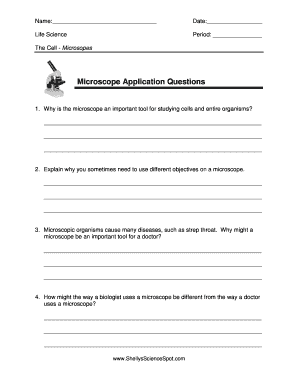
Name: Date: Life Science Period: The Cell Microsopes Microscope Application Questions 1. Why is the microscope an important tool for studying cells and entire organisms? 2. Explain why you sometimes.
Open form follow the instructions
Easily sign the form with your finger
Send filled & signed form or save
How to fill out the Science Spot Microscope online
Filling out the Science Spot Microscope form is a crucial step for individuals engaging in life science studies. This guide provides clear, step-by-step instructions to assist users in successfully completing the form.
Follow the steps to complete the Science Spot Microscope form.
- Press the ‘Get Form’ button to access the form and open it in your document management tool.
- Begin by entering your name in the designated field at the top of the form. Ensure your name is properly formatted for clarity.
- Indicate your class period by filling in the period field. This information helps categorize your submission.
- Proceed to question two, where you will explain the necessity of using different objectives on a microscope. Be concise yet informative.
- Finally, address question four by comparing the uses of microscopes by biologists versus doctors, ensuring your views are clear and well-articulated.
Complete your Science Spot Microscope form online today to enhance your learning experience in life sciences.
Experience a faster way to fill out and sign forms on the web. Access the most extensive library of templates available.
Related content
Physical Science. Physics. Students build microscopes by using mailing tubes and convex...
Parts of the Light Microscope. T. Trimpe 2003 http://sciencespot.net/. A. EYEPIECE...
That's why installing Olympus microscope components is, ... The multiple-spots sensor...
Get answers to your most pressing questions about US Legal Forms API.
What provides light to allow you to view materials?
Microscopes are designated as either light microscopes or electron microscopes. The former use visible light or ultraviolet rays to illuminate specimens.
What are the 4 types of microscopes?
There are several different types of microscopes used in light microscopy, and the four most popular types are Compound, Stereo, Digital and the Pocket or handheld microscopes.
What is a microscope science?
A microscope is an instrument that can be used to observe small objects, even cells. The image of an object is magnified through at least one lens in the microscope. This lens bends light toward the eye and makes an object appear larger than it actually is.
What is microscope and its function?
First, the purpose of a microscope is to magnify a small object or to magnify the fine details of a larger object in order to examine minute specimens that cannot be seen by the naked eye.
What is the light called on a microscope?
Because of these and other reasons, most microscopes have built-in lights or mirrors called illuminators. A microscope gets its light from the specimen in two ways.
What provides light on a microscope?
Illuminator is the light source for a microscope, typically located in the base of the microscope. Most light microscopes use low voltage, halogen bulbs with continuous variable lighting control located within the base. Condenser is used to collect and focus the light from the illuminator on to the specimen.
What is microscopy used for?
Microscopy is the technical field of using microscopes to view samples & objects that cannot be seen with the unaided eye (objects that are not within the resolution range of the normal eye).
What is the purpose of a light source on a microscope?
The illumination system of the standard optical microscope is designed to transmit light through a translucent object for viewing. In a modern microscope it consists of a light source, such as an electric lamp or a light-emitting diode, and a lens system forming the condenser.
Use professional pre-built templates to fill in and sign documents online faster. Get access to thousands of forms.
If you believe that this page should be taken down, please follow our DMCA take down process here.