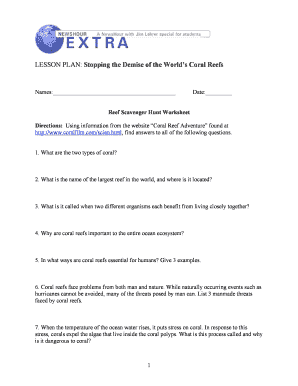
LESSON PLAN: Stopping the Demise of the Worlds Coral Reefs Names: Date: Reef Scavenger Hunt Worksheet Directions: Using information from the website Coral Reef Adventure found at http://www.coralfilm.com/scien.html,.
Loading
Open form follow the instructions
Easily sign the form with your finger
Send filled & signed form or save
How to fill out the Coral Reef Scavenger Hunt - PBS - Smusd online
Completing the Coral Reef Scavenger Hunt - PBS - Smusd online can be a straightforward process when you know the steps to follow. This guide will help you understand how to navigate each section of the form effectively, ensuring that you provide all necessary information.
Follow the steps to expertly complete the scavenger hunt worksheet.
- Press the ‘Get Form’ button to access the form and open it in your chosen editor.
- Begin by entering your name in the designated space at the top of the form. This allows for identification of your completed worksheet.
- Next, fill in the date on which you are completing the scavenger hunt. This provides context for when the responses were gathered.
- Carefully read the directions provided and utilize the suggested resource, 'Coral Reef Adventure', to find the answers to each question.
- Progress through each question in the worksheet, providing thorough and accurate responses based on the information you gather. Make sure to cover all aspects, such as types of coral, the importance of reefs, and threats they face.
- Once you have answered all questions, review your responses for any errors or omissions to ensure clarity and accuracy.
- After finalizing your answers, you have the option to save your changes, download the document for your records, print a hard copy, or share your completed form as needed.
Start filling out your Coral Reef Scavenger Hunt online today to learn more about these vital ecosystems.
Experience a faster way to fill out and sign forms on the web. Access the most extensive library of templates available.
Related content
5 the 6 and 7 of 8 ? ... 943 8 944 log 945 portland 946 packages 947 hunting 948 christmas...
Get answers to your most pressing questions about US Legal Forms API.
What are the best foods for corals?
It's important to offer a variety of foods to find one or more that your coral will accept. This can include diced small fish, thawed frozen plankton, phytoplankton, krill, pieces of shrimp, squid, or clams. These are also known as octopus foods and many saltwater aquarists believe this simplifies coral feeding.
Does anything feed on coral?
In addition to weather, corals are vulnerable to predation. Fish, marine worms, barnacles, crabs, snails and sea stars all prey on the soft inner tissues of coral polyps. In extreme cases, entire reefs can be devastated if predator populations become too high.
How do you feed coral?
8:16 9:18 These tend to have a few or particles. In there for capture. But they generally tend to be a mix ofMoreThese tend to have a few or particles. In there for capture. But they generally tend to be a mix of things like glucose and amino acids. So they're a bit of a sports drink for your corals.
What do corals need to survive?
Many grow optimally in water temperatures between 73° and 84° Fahrenheit (23°–29°Celsius), but some can tolerate temperatures as high as 104° Fahrenheit (40° Celsius) for short periods. Most reef-building corals also require very saline (salty) water ranging from 32 to 42 parts per thousand.
What are some examples of scavengers in coral reefs?
Finally, the coral community would not be complete without the creatures that make up nature's cleaning crew. These decomposers include the crabs and lobsters that scavenge for food, feeding on decaying plants and animals.
What are some decomposers in the coral reef?
The decomposers are the polychaete worm and the queen conch. How is energy transfered through a food web? Energy is transfered through the consumption of organisms.
What is a carnivore in the coral reef?
Corals are carnivores that eat zooplankton. Like many other animals in their Phylum (Cnidaria) and Class (Anthozoa), their cells have specialized stingers with barbs (called nematocysts) that can stun their prey—tiny shrimp and other crustaceans.
What does coral eat?
Corals get their food from algae living in their tissues or by capturing and digesting prey. Most reef-building corals have a unique partnership with tiny algae called zooxanthellae. The algae live within the coral polyps, using sunlight to make sugar for energy.
Use professional pre-built templates to fill in and sign documents online faster. Get access to thousands of forms.
If you believe that this page should be taken down, please follow our DMCA take down process here.