Loading
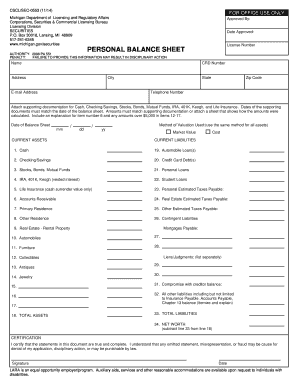
Get Personal Balance Sheet - Michigan
How it works
-

Open form follow the instructions
-

Easily sign the form with your finger
-

Send filled & signed form or save
How to fill out the PERSONAL BALANCE SHEET - Michigan online
Completing the personal balance sheet for Michigan is essential for individuals seeking to manage their financial standing accurately. This guide provides a step-by-step approach to help users fill out the form effectively and confidently.
Follow the steps to complete your personal balance sheet online.
- Click ‘Get Form’ button to access the personal balance sheet and open it in your preferred editor.
- Begin filling out your personal information. Enter your name, CRD number, address, city, state, zip code, email address, and telephone number.
- Specify the date of the balance sheet by filling in the fields for month, day, and year.
- Select the method of valuation for the assets being reported—choose between 'Market Value' or 'Cost.' Ensure consistency across all asset entries.
- List your current assets, filling in the respective amounts for cash, checking/savings, stocks, bonds, mutual funds, IRAs, 401Ks, Keoghs, life insurance, and other specified items.
- Document your current liabilities as required. Include details for each liability category, such as automobile loans, credit card debts, personal loans, and student loans.
- If applicable, provide supporting documentation for the amounts reported in your assets and liabilities. Ensure that the amounts match the attached documentation.
- For any amounts over $5,000 in specific items (12-17), prepare a separate explanation sheet detailing those figures.
- Calculate your total assets and total liabilities, and compute your net worth by subtracting total liabilities from total assets.
- Review your completed balance sheet for accuracy. Certify the document by signing and dating it at the bottom.
- Once you have completed and reviewed the form, proceed to share it, download it for your records, or print it as needed.
Start completing your personal balance sheet online today for effective financial management.
Typical line items included in the balance sheet (by general category) are: Assets: Cash, marketable securities, prepaid expenses, accounts receivable, inventory, and fixed assets. Liabilities: Accounts payable, accrued liabilities, customer prepayments, taxes payable, short-term debt, and long-term debt.