Loading
Get 50 Frequently Forgotten Fun Facts
How it works
-

Open form follow the instructions
-

Easily sign the form with your finger
-

Send filled & signed form or save
How to fill out the 50 Frequently Forgotten Fun Facts online
This guide provides a comprehensive overview of how to successfully complete the 50 Frequently Forgotten Fun Facts online form. Users will find clear, step-by-step instructions tailored to enhance their understanding and ensure accuracy in filling out the form.
Follow the steps to complete your form effectively.
- Press the ‘Get Form’ button to access the form. This action will allow you to retrieve the document for completion in your preferred online format.
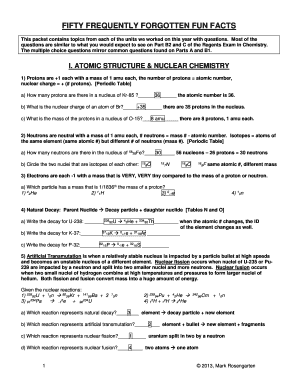
- Familiarize yourself with the sections of the form. Begin by reviewing the introductory content and instructions that provide context for the questions covering various chemistry topics, such as atomic structure, physical behavior of matter, and reactions.
- Begin filling in your personal or identifying information as required at the top of the form. This may include your name, date, and any other necessary details to properly identify your submission.
- Navigate through the multiple choice questions related to each topic. Carefully read each question and select your answer by clicking on the corresponding option. Ensure you review the answer choices to avoid mistakes.
- For open-ended questions, provide concise and clear answers based on your understanding of the material. Be as specific as possible in your responses, reflecting knowledge from your chemistry studies.
- Double-check your completed answers for accuracy and completeness before proceeding. Use any available review tools within the online platform to assist in this process.
- Once satisfied with your entries, choose to save your changes. You may have options to download, print, or share the form directly from the interface, depending on your needs.
Complete your 50 Frequently Forgotten Fun Facts online now for insightful and engaging learning!
Elements are the tiny particles that make up matter. Science describes an element as a pure substance made of only 1 type of atom that can not be broken down further into other substances. For example, hydrogen (H) and oxygen (O) are elements, but water ( H 2 O ) which is made of hydrogen and oxygen is NOT.