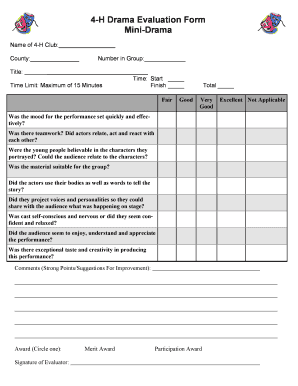
Me: Start Time Limit: Maximum of 15 Minutes Finish Fair Good Total Very Good Was the mood for the performance set quickly and effectively? Was there teamwork? Did actors relate, act and react with each other? Were the young people believable in the characters they portrayed? Could the audience relate to the characters? Was the material suitable for the group? Did the actors use their bodies as well as words to tell the story? Did they project voices and personalities so they.

How it works
  • Open form

    Open form follow the instructions

  • Easily sign form

    Easily sign the form with your finger

  • Share form

    Send filled & signed form or save

How to fill out the Drama Evaluation Categories Form online

Completing the Drama Evaluation Categories Form online is a straightforward process that allows you to provide valuable feedback on performances. This guide offers clear, step-by-step instructions to assist you in filling out each section of the form effectively.

Follow the steps to complete the form accurately.

  1. Click the ‘Get Form’ button to access the form and open it in your preferred editing tool.
  2. Fill in the name of your 4-H club in the designated field.
  3. Specify the number of participants in your group.
  4. Record the start time of the performance in the appropriate field.
  5. Mark the performance based on the categories provided, such as fair, good, very good, ensuring you assess each aspect thoughtfully.
  6. Add any comments regarding strong points and suggestions for improvement in the comments section.
  7. Have the evaluator sign the form at the bottom to validate your evaluation.

Complete the Drama Evaluation Categories Form online today to provide your feedback effectively!

Get form

Experience a faster way to fill out and sign forms on the web. Access the most extensive library of templates available.

Related content

NAEP and Theatre: Framework, Field Test, and...

Aug 3, 1998 — draw on a wide range of dramatic forms and use both paper- and-pencil...

Learn more
Performance/Acting Rubric - Chapman University

CRITICAL EVALUATION/RESEARCH WRITING RUBRIC ... format). MLA format with ... CHAPMAN...

Learn more
DSM-IV codes - Wikipedia

DSM-IV codes are the classification found in the Diagnostic and Statistical Manual of...

Learn more
Questions & Answers

Get answers to your most pressing questions about US Legal Forms API.

Contact support

What are the technical elements of Drama?

The areas of technical theatre are scenery,lighting, properties,costuming,and sound. All of these areas work together in a production to establish the place, time period, and mood of the production. If successful the audience will not even notice many of the technical elements of the show.

Aristotle wondered about many things, including drama. He came to the conclusion that there were 6 elements of drama. They are: plot, character, thought, diction, melody, and spectacle.

Performance analysis and evaluation identify (locate, determine) describe (give an account of) discuss (provide arguments (both 'for' and 'against') using evidence to arrive at a conclusion) analyse (examine closely and critically and discuss the impact using evidence)

There are four basic theatrical forms either defined, implied, or derived by or from Aristotle: Tragedy; Comedy; Melodrama; and Drama. Any number of styles can be used to convey these forms. A good working definition of, "Style", is how something is done.

We've selected eight of those transferable skills that can be developed through drama activities. Communication. Confidence. Teamwork and leadership. Listening and responding. Creativity. Critical thinking and problem-solving. Time management. Research.

Form. Form is the basis of the drama. It is how the drama is constructed. Form. Think of Form as the skeleton of the drama – as we go through the drama process we add and build upon it…

Drama is created and shaped by the elements of drama which, for the Drama ATAR course, are listed as: role, character and relationships, situation, voice, movement, space and time, language and texts, symbol and metaphor, mood and atmosphere, audience and dramatic tension.

performance elements include acting (e.g., character motivation and analysis, empathy), speaking (breath control, vocal expression and inflection, projection, speaking style, diction), and nonverbal expression (gestures, body alignment, facial expression, character blocking, movement).

Get This Form Now!

Use professional pre-built templates to fill in and sign documents online faster. Get access to thousands of forms.

If you believe that this page should be taken down, please follow our DMCA take down process here.

Get Drama Evalution Categories Form