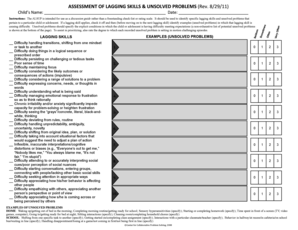
ASSESSMENT OF LAGGING SKILLS & UNSOLVED PROBLEMS (Rev. 8/29/11) Difficulty handling transitions, shifting from one mindset or task to another Difficulty doing things in a logical sequence or prescribed.
Open form follow the instructions
Easily sign the form with your finger
Send filled & signed form or save
How to fill out the Assessment Of Lagging Skills And Unsolved Problems online
Filling out the Assessment Of Lagging Skills And Unsolved Problems online is an important step in identifying and addressing specific difficulties that a person may encounter in various settings. This guide provides clear instructions to help users navigate through the form with ease and effectiveness.
Follow the steps to complete the form accurately.
- Click ‘Get Form’ button to obtain the form and open it for editing purposes.
- Begin by entering the name of the child or adolescent in the designated field at the top of the form. This helps to personalize the assessment and directs the focus to their specific needs.
- Next, record the date on which you are filling out the form. Accurate dating can be useful for tracking progress over time.
- Proceed to the section detailing lagging skills. Review each skill listed and check off those that apply to the individual. For each checked skill, reflect on specific examples of unsolved problems that illustrate how the lagging skill manifests in daily life.
- For each lagging skill checked, identify and document explicit unsolved problems in the space provided. These problems should specify the conditions under which difficulties arise, which can assist in prioritizing intervention efforts.
- Utilize the rating scale for unsolved problems by marking the degree to which they lead to challenges. This helps to evaluate the severity of each issue and can guide further actions.
- Once all sections are completed, review the form for accuracy. Ensure that all lagging skills and unsolved problems are clearly documented.
- Finally, save your changes. You may also have the option to download, print, or share the completed form as necessary.
Start completing your document online to effectively identify lagging skills and unsolved problems.
Experience a faster way to fill out and sign forms on the web. Access the most extensive library of templates available.
Related content
UNSOLVED PROBLEMS GUIDE: Unsolved problems are the specific expectations a child is having...
Identifying lagging skills and unsolved problems is accomplished through use of an...
the field instructor, and forms the foundation for evaluation. The responsibilities and...
Get answers to your most pressing questions about US Legal Forms API.
What is assessment of lagging skills and unsolved problems?
The Assessment of Lagging Skills and Unsolved Problems (ALSUP) is a discussion guide created to assist caregivers in identifying a child's lagging skills and unsolved problems. Lagging skills provide caregivers with new lenses.
How do you identify unsolved problems?
STEP 2: Identifying Unsolved Problems Unsolved problems begin with the words Difficulty and are followed by a verb. Unsolved problems should contain no adult theories. Unsolved problems should be split, not clumped together. Unsolved problems should be specific.
What are examples of lagging skills?
The primary CPS lagging skills include executive function (e.g. limited working memory, poor impulse control), emotion regulation (e.g. emotional reactivity, chronic irritability and/or anxiety), language (e.g. limited expressive language, difficulty with language processing), and social skills (e.g. poor perception of ...
What is the concept of lagging skills?
Lagging skills are the reasons that a child is having difficulty meeting these expectations or responding adaptively to these triggers. Take a guess at which specific lagging skills are contributing by looking at the list of triggers/expectations, and referring to the Thinking Skills Inventory on the following pages.
What is behind every challenging behavior is an unsolved problem or a lagging skill?
Lagging skills are the why of challenging behavior. Unsolved problems are the who, what, when, and where. “Behind every challenging behavior is either an unsolved problem or a lagging skill” or both. Challenging behavior is a form of communication letting us know there is an unsolved problem or lagging skill.
What are lagging skills in ADHD?
If they are lagging in social skills, you may find your child seeking attention in inappropriate ways or having a difficulty paying attention to social cues. If your child is lagging in language processing skills then they may experience a difficulty in following conversations or expressing their needs.
Use professional pre-built templates to fill in and sign documents online faster. Get access to thousands of forms.
If you believe that this page should be taken down, please follow our DMCA take down process here.