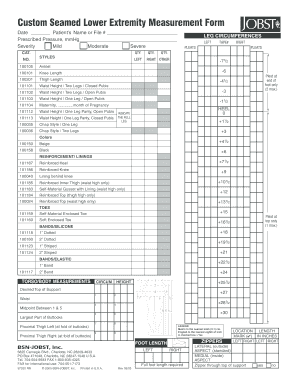
Custom Seamed Lower Extremity Measurement Form Date Patient s Name or File # Prescribed Pressure, mmHg Severity Mild Moderate Severe NO. QTY. STYLES LEFT QTY. LEG PLEATS LEFT TAPE# RIGHT CIRCUMFERENCES.

How it works
  • Open form

    Open form follow the instructions

  • Easily sign form

    Easily sign the form with your finger

  • Share form

    Send filled & signed form or save

How to fill out the Custom Seamed Lower Extremity Measurement Form - Jobst online

Filling out the Custom Seamed Lower Extremity Measurement Form - Jobst online is a straightforward process that ensures accurate measurements for lower extremity support. This guide will provide you with step-by-step instructions to help you complete the form efficiently.

Follow the steps to successfully fill out the form online.

  1. Press the ‘Get Form’ button to obtain the Custom Seamed Lower Extremity Measurement Form and open it in your document editor.
  2. Enter the date in the section labeled 'Date'. This helps in tracking the measurement session accurately.
  3. In the 'Patient’s Name or File #' field, input the name of the patient or their relevant identification number for reference.
  4. Specify the prescribed pressure in mmHg in the designated space. Choose the correct level based on your healthcare provider's instructions.
  5. Indicate the severity level of the condition by selecting either Mild, Moderate, or Severe. This is important for determining suitable support.
  6. In the 'Quantity' (QTY) section, list the number of garments needed for each style, clarifying whether they are for the left or right leg.
  7. Select the appropriate styles from the provided list (e.g., Anklet, Knee Length), ensuring you check the corresponding left or right leg as needed.
  8. For leg circumferences, measure and document the circumferences of both legs in the allotted spaces, specifying left and right accurately.
  9. Choose options for pleats, colors, and any reinforcement or lining preferences based on your requirements.
  10. Complete the torso/body measurements section, including waist and hip circumferences, height, and proximal thigh measurements as indicated.
  11. Conclude by reviewing all entries for accuracy. Once satisfied, save your changes, then download, print, or share the form as needed.

Start completing your Custom Seamed Lower Extremity Measurement Form online today to ensure all your details are accurately captured.

Get form

Experience a faster way to fill out and sign forms on the web. Access the most extensive library of templates available.

Related content

16. Abstra_

Jobst Institute, a great number of circumferential measurements were ob- ... measuring...

Learn more
16. Abstra_

Jobst Institute, a great number of circumferential measurements were ob- ... measuring...

Learn more
Questions & Answers

Get answers to your most pressing questions about US Legal Forms API.

Contact support

What the difference between 20 30 mmHg 15-20 mmHg compression socks?

15-20 mmHg: Great for daily wear, travel, and sports. They help improve circulation without being too tight. 20-30 mmHg: Great for sports recovery, daily wear, medical recovery, and to manage mild symptoms of varicose and spider veins. Ideal for patients looking for more support.

Compression Socks and mmHg Class 1: 10-15 mmHg (Very light compression) Class 2: 15-20 mmHg (Light compression) Class 3: 20-36 mmHg (Moderate compression) Class 4: 36+ mmHg (Strong compression)

Steps Measure the size 1cm below the knee fold. Tip: put two fingers in the knee fold, below is the first measuring point. Measure the thickest size of the calf. Measure the narrowest size of the ankle. Measure the size of the heel-rubbing line. Measure the length of the leg to 1cm below the knee fold. ... Give up your shoe size.

To determine the correct size for your leg use a tape measure to measure your minimum ankle circumference and the maximum calf circumference as shown in the diagram. The calf circumference is measured around the LARGEST part of the calf. The ankle circumference is measured around the SMALLEST part of the ankle.

Foot length with tip: from the tips of the toes to the end of the heel. Take circumferential measurement A at the metatarsophalangeal joint. Measure circumference B and length a-B above the ankle at the narrowest point of the calf. Take circumferential measurement Y around the instep and heel at maximal dorsiflexion.

Measuring Instructions Ankle Measurement. Measure around your ankle (this measurement is called the circumference). Place the measuring tape at the narrowest part of the ankle, above the ankle bone. ... Calf Measurement. Find the widest part of your calf. ... Calf Length. Sit on a chair with your legs at a 90-degree angle.

Get This Form Now!

Use professional pre-built templates to fill in and sign documents online faster. Get access to thousands of forms.

If you believe that this page should be taken down, please follow our DMCA take down process here.

Get Custom Seamed Lower Extremity Measurement Form - Jobst