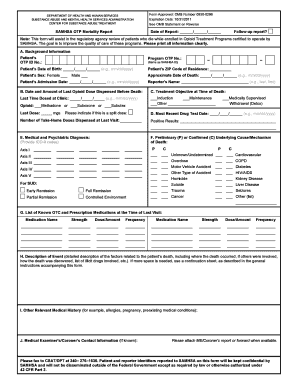
DEPARTMENT OF HEALTH AND HUMAN SERVICES SUBSTANCE ABUSE AND MENTAL HEALTH SERVICES ADMINISTRATION CENTER FOR SUBSTANCE ABUSE TREATMENT SAMHSA OTP Mortality Report Form Approved: OMB Number 0930-0296.

How it works
  • Open form

    Open form follow the instructions

  • Easily sign form

    Easily sign the form with your finger

  • Share form

    Send filled & signed form or save

How to fill out the SAMHSA OTP Mortality Report Form - Aatod online

Filling out the SAMHSA OTP Mortality Report Form - Aatod is a vital process for reporting incidents related to patients enrolled in Opioid Treatment Programs. This guide provides step-by-step instructions to assist you in completing the form accurately and efficiently online.

Follow the steps to complete the SAMHSA OTP Mortality Report Form online.

  1. Press the ‘Get Form’ button to access the SAMHSA OTP Mortality Report Form and open it in your preferred online editor.
  2. In the background information section, enter the patient's unique OTP ID number and Program OTP number (same as SAMHSA ID), followed by their date of birth, sex, ZIP code of residence, date of death, and admission date.
  3. Provide the reporter's name, ensuring it is entered clearly as last name followed by first name.
  4. In section B, input the date and amount of the last opioid dose dispensed before the patient's death and specify the treatment objective at the time of death. Fill in the last time the patient was dosed at the clinic.
  5. Select the opioid used (, , or ) and provide the last dose amount in milligrams.
  6. Indicate if this was a split dose and enter the number of take-home doses dispensed at the last visit.
  7. In section D, fill in the date of the most recent drug test and note any positive results.
  8. For section F, specify whether the cause of death is preliminary or confirmed, and list the underlying cause or mechanisms.
  9. Document medical and psychiatric diagnoses in section E using the appropriate ICD-9 codes.
  10. In section G, list all known over-the-counter and prescription medications, including their strength, dose/amount, and frequency.
  11. Provide a detailed description of the event related to the patient’s death in section H, including relevant factors surrounding the incident.
  12. In section I, record any additional relevant medical history such as allergies or preexisting conditions.
  13. If known, fill in the medical examiner's or coroner's contact information. Attach any available ME/coroner's report.
  14. Once all fields are completed, save your changes. You can then download, print, or share the completed form as needed.

Begin completing your documents online for timely submission.

Get form

Experience a faster way to fill out and sign forms on the web. Access the most extensive library of templates available.

Related content

Letter Encouraging Use of PDMPs - SAMHSA

(SAMHSA) OTP inspections reveal that PDMP reports are already included in ... Opioids can...

Learn more
Mortality - National Alliance for Medication ...

Jul 20, 2007 — Center for Substance Abuse Treatment (CSAT), SAMHSA/DHHS, serves as the...

Learn more
Questions & Answers

Get answers to your most pressing questions about US Legal Forms API.

Contact support

What is the 42 Code of Federal Regulations CFR?

The Code of Federal Regulations Title 42 contains the codified U.S. Federal laws and regulations that are in effect as of the date of the publication pertaining to public health in the United States and its territories, including Medicare and Medicaid.

An opioid treatment program (OTP) is defined as "a program or practitioner engaged in opioid treatment of individuals with an opioid agonist medication."

The proposed rule allows for the use of audio-visual telehealth for any new patient who will be treated by the OTP with if a program physician, or an authorized healthcare professional under the supervision of a program physician, determines that an adequate evaluation of the patient can be accomplished via ...

An Opioid Treatment Program (OTP) is defined as “a program or practitioner engaged in opioid treatment of individuals with an opioid agonist medication”.

Section 1262 of the Consolidated Appropriations Act, 2023 (also known as Omnibus bill), removes the federal requirement for practitioners to submit a Notice of Intent (have a waiver) to prescribe medications, like , for the treatment of opioid use disorder (OUD).

Requirements include: OTPs must be both certified and accredited; Licensed by the state in which they operate; and. Registered with the Drug Enforcement Administration (DEA), through their local DEA office.

An “emergency treatment” section was added to DEA regulations to allow physicians to administer (but not prescribe) one day's worth of narcotic drugs, for not more than three continuous days, “for the purpose of relieving acute withdrawal symptoms when necessary while arrangements are being made for referral for ...

To expand access to care, SAMHSA proposes to update OTP admission criteria. This includes removal of the one-year requirement for opioid addiction before admission to an OTP, in favor of consideration of a person's problematic patterns of opioid use.

eCFR :: 42 CFR Part 8 -- Medication Assisted Treatment for Opioid Use Disorders.

OTPs provide medication-assisted treatment (MAT) for people diagnosed with an opioid-use disorder. MAT patients also must receive counseling, which can include different forms of behavioral therapy. Learn more about medication and counseling treatment for substance use disorders.

Get This Form Now!

Use professional pre-built templates to fill in and sign documents online faster. Get access to thousands of forms.

If you believe that this page should be taken down, please follow our DMCA take down process here.

Get SAMHSA OTP Mortality Report Form - Aatod