Loading
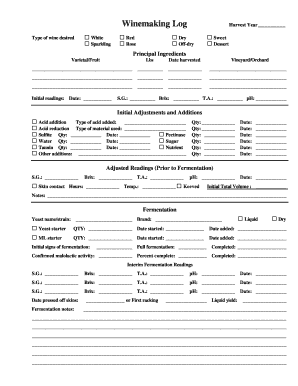
Get Winemaking Log Harvest Year - Nashwood Winery
How it works
-

Open form follow the instructions
-

Easily sign the form with your finger
-

Send filled & signed form or save
How to fill out the Winemaking Log Harvest Year - Nashwood Winery online
The Winemaking Log Harvest Year is an essential document for recording the details of the winemaking process at Nashwood Winery. This guide provides a clear, step-by-step approach for filling out the log online, ensuring that all necessary information is captured accurately.
Follow the steps to complete the Winemaking Log Harvest Year efficiently.
- Press the ‘Get Form’ button to access the Winemaking Log Harvest Year and open it in the online editor.
- Select the type of wine desired by marking the appropriate box for either white, sparkling, red, rose, dry, off-dry, sweet, or dessert.
- Enter the harvest year in the designated field.
- Fill in the principal ingredients section by listing the varietal or fruit, the weight in pounds, and the date harvested for each entry. Ensure all fields are properly filled out for accurate documentation.
- Record the initial readings for specific metrics like specific gravity (S.G.), Brix, total acidity (T.A.), and pH, along with the date of these readings under the initial readings section.
- Document any initial adjustments and additions made to the must, including acid additions, sulfite quantities, water additions, sugar, and nutrients, ensuring to complete the associated quantities and dates.
- Specify adjusted readings before fermentation starts by filling out new values for S.G., Brix, T.A., pH, along with skin contact hours and temperature, if applicable.
- In the fermentation section, provide details such as yeast name/strain, brand, quantities, and dates for starters. Include initial signs of fermentation and final confirmation of completion.
- Record interim fermentation readings at designated intervals for metrics including S.G., Brix, T.A., pH, specifying the date of each reading.
- Outline notes regarding pressing off skins and provide information on liquid yields and fermentation notes.
- Document the rackings post-fermentation by noting down the dates and remaining quantities, alongside any defining appearances.
- For fining and filtration, include specific quantities and dates for any substances used, as well as filtering results and associated observations.
- Fill out the analysis section, entering the S.G., Brix, T.A., pH metrics along with total and free SO2 details and any necessary corrections.
- In the finishing and bottling section, provide information regarding barrel aging, any adjustments made, and final bottling details such as quantity and cost per bottle.
- Finally, summarize your appreciation and notes at the end of the form for comprehensive documentation before submitting.
- Once all necessary fields are completed, save your changes. You can download, print, or share the log as required.
Start completing your Winemaking Log Harvest Year online today for optimal documentation.
This comprehensive winemaking guide explains each step of the production process in detail, from the vineyard to the bottle: Viticulture. Vineyards, terroirs, and grape varieties. Harvesting and sorting. Vinification. Destemming. Treading or pressing. Settling and racking. ... Maturation. Blending. Bottling. Cellaring.