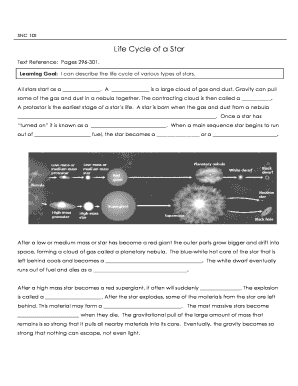
SNC 1DI Life Cycle of a Star Text Reference: Pages 296301. Learning Goal: I can describe the life cycle of various types of stars. All stars start as a . A is a large cloud of gas and dust. Gravity.

How it works
  • Open form

    Open form follow the instructions

  • Easily sign form

    Easily sign the form with your finger

  • Share form

    Send filled & signed form or save

How to use or fill out the Life Cycle Of A Star Worksheet online

The Life Cycle Of A Star Worksheet is designed to help users understand the various stages in the life cycle of stars. This guide will walk you through the process of completing the worksheet online, ensuring clarity and accuracy in your responses.

Follow the steps to complete the worksheet effectively.

  1. Click ‘Get Form’ button to access the Life Cycle Of A Star Worksheet and open it in your preferred editor.
  2. Begin by entering your name at the designated space provided at the beginning of the form.
  3. In the Learning Goal section, reiterate the goal of describing the life cycle of various types of stars to contextualize your responses.
  4. Move to Section One - Sequencing. Here, you will see the stages of a star's life cycle that are out of order. Carefully read each stage and assign the correct number to each stage based on your knowledge.
  5. Proceed to Section Two - Vocabulary. Match each term on the left with its corresponding definition on the right by filling in the blank spaces appropriately.
  6. Once you complete both sections, review your answers for accuracy and ensure all responses are complete.
  7. Finally, save your changes, download, print, or share the worksheet as needed to finalize your submissions.

Complete your Life Cycle Of A Star Worksheet online today to enhance your understanding of stellar evolution.

Get form

Experience a faster way to fill out and sign forms on the web. Access the most extensive library of templates available.

Related content

The Life Cycles of Stars - Imagine the Universe!...

May 7, 2015 — The Life Cycles of Stars. I. Star Birth and Life. Imagine an enormous...

Learn more
Activity: Life Cycle Of a Massive Star - James...

Objective: The NASA/James Webb Space. Telescope Life Cycle bookmark will model the life...

Learn more
Child Passenger Safety Restraint Systems on School...

STAR Instruction Manual . ... Complete the worksheet ... on a gentle cycle. Read and...

Learn more
Questions & Answers

Get answers to your most pressing questions about US Legal Forms API.

Contact support

What is the life cycle of a star explanation for kids?

A star begins its life in a nebula, or area of gas and dust in space. The gas and dust come together to form a protostar, which gets very hot until it turns into a main sequence star. This stage is when nuclear reactions occur and the star glows, and it can last billions of years.

All stars will expand, cool and change colour to become a red giant. What happens next depends on how massive the star is. A smaller star, like the Sun, will gradually cool down and stop glowing. During these changes it will go through the planetary nebula phase, and white dwarf phase.

Stage 6: White Dwarves and Supernovas Depending on the size and solar mass of the star, its life will end in one of two ways: as a white dwarf star or as a supernova explosion.

The formation and life cycle of stars A nebula. A star forms from massive clouds of dust and gas in space, also known as a nebula. ... Protostar. As the mass falls together it gets hot. ... Main sequence star. ... Red giant star. ... White dwarf. ... Supernova. ... Neutron star or black hole.

Massive stars transform into supernovae, neutron stars and black holes while average stars like the sun, end life as a white dwarf surrounded by a disappearing planetary nebula. All stars, irrespective of their size, follow the same 7 stage cycle, they start as a gas cloud and end as a star remnant.

What are the different stages of life cycle of stars? Giant Gas Cloud. Protostar. T-Tauri Phase. Main Sequence. Red Giant. The Fusion of Heavier Elements. Supernovae and Planetary Nebulae.

stars are born in vast clouds of gas and dust. stars spend most of their lives on the main sequence fusing hydrogen gas to helium gas. stars eventually swell up to form a red giant star. stars like the Sun end their lives as planetary nebulae and white dwarfs.

STAGE 1: A Giant Gas Cloud A star begins life as a giant cloud of gas which is generally an accumulation of dust, gas and plasma. Stars form inside relatively dense concentrations of interstellar gas and dust known as molecular clouds. At these temperatures, gases become molecular meaning that atoms bind together.

Get This Form Now!

Use professional pre-built templates to fill in and sign documents online faster. Get access to thousands of forms.

If you believe that this page should be taken down, please follow our DMCA take down process here.

Get Life Cycle Of A Star Worksheet