Loading
Form preview
  • US Legal Forms
  • Form Library
  • More Forms
  • More Uncategorized Forms
  • Modeling Crash Frequency At Highway-railroad Grade ... - Easts - Easts

Get Modeling Crash Frequency At Highway-railroad Grade ... - Easts - Easts

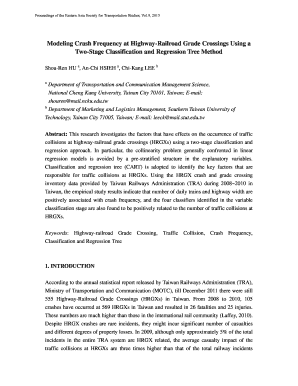
Proceedings of the Eastern Asia Society for Transportation Studies, Vol.9, 2013 Modeling Crash Frequency at Highway-Railroad Grade Crossings Using a Two-Stage Classification and Regression Tree Method.

How it works

  1. Open form

    Open form follow the instructions

  2. Easily sign form

    Easily sign the form with your finger

  3. Share form

    Send filled & signed form or save

How to use or fill out the Modeling Crash Frequency at Highway-Railroad Grade Crossings - EASTS - Easts online

This guide provides a clear and supportive framework for users to effectively fill out the Modeling Crash Frequency form focusing on highway-railroad grade crossings. Follow these steps to ensure accurate submission and contribute to valuable research in transportation safety.

Follow the steps to successfully complete the form.

  1. Click ‘Get Form’ button to access the form and open it in your preferred editing tool.
  2. Begin by entering your contact information in the designated fields. This includes your name, email address, and any relevant affiliation.
  3. Input details about the highway-railroad grade crossing. Provide specifics such as the location, crossing type, and applicable traffic control measures.
  4. Fill out the crash frequency section. Include data related to the number of incidents, types of vehicles involved, and any reported injuries or fatalities.
  5. Complete the variables that reflect environmental conditions. Specify factors like daily traffic volume, weather conditions, and the presence of safety equipment.
  6. Review all information entered for accuracy. Ensure that all necessary fields are completed and that the data is consistent.
  7. Save the changes made to the form. At this stage, you can choose to download a copy for your records or print it out if needed.
  8. Submit the form as per the provided instructions. This may involve uploading the document to a designated portal or emailing it to the relevant authority.

Start contributing to transportation safety research by completing the document online now!

Get form

Experience a faster way to fill out and sign forms on the web. Access the most extensive library of templates available.
Get form

Related content

Study of KDOT Policy on Lane and Shoulder ......
According to the most recent national crash statistics, in 2009 there were ... speed; and...
Learn more
UNC Charlotte Civil & Environmental Engineering...
Apr 13, 2020 — Modeling Pedestrian Injury Severity in Pedestrian-Vehicle Crashes in...
Learn more

Related links form

Medicatiom Permission And Instrections Child Care Home And Centres Good Apple Worksheet Answers Disc Golf Scorecard - Lorain County Metro Parks - Metroparks Mens Life Recovery Application - Rockford Rescue Mission - Rockfordrescuemission

Questions & Answers

Get answers to your most pressing questions about US Legal Forms API.

Contact support

Excess Predicted Average Crash Frequency Using SPFs – This method represents the difference between the observed crash frequency for the site and the predicted crash frequency based on the SPF with information specific to the site.

To accurately calculate this rate, experts typically divide the total number of accidents by the total number of miles traveled by all vehicles within the observed group, then multiply the resulting figure by a constant factor, often 100,000,000 to derive the average crash rate per mile.

(a) Whenever a road user approaches a highway-rail grade crossing under any of the five circumstances enumerated in this subsection, the driver shall stop before the stop line (if present) and not less than 15 feet from the nearest rail of the track, and while so stopped shall listen and look in both directions along ...

The Index of Crash Frequency (ICF) measures the difference between expected and reported number of crashes divided by the standard deviation of the difference in the estimate.

The expected crash frequency is the long-term average crash frequency that would be expected from the specific site and is more statistically reliable as compared with the predicted crash frequency.

The expected crash frequency is the long-term average crash frequency that would be expected from the specific site and is more statistically reliable as compared with the predicted crash frequency.

Highway-railroad grade crossings are intersections where a highway crosses a railroad at-grade. They are also called level crossings in other countries such as Canada, Australia, and the United Kingdom.

An active-railroad crossing is controlled with electric signals. A gate will usually close, lights flash and a sound is made. A passive railroad crossing does not have any lights, sounds, or gates. They are just marked by a railroad crossing sign and a yield or stop sign.

Get This Form Now!

Use professional pre-built templates to fill in and sign documents online faster. Get access to thousands of forms.
Get form
If you believe that this page should be taken down, please follow our DMCA take down processhere.

Industry-leading security and compliance

US Legal Forms protects your data by complying with industry-specific security standards.
  • In businnes since 1997
    25+ years providing professional legal documents.
  • Accredited business
    Guarantees that a business meets BBB accreditation standards in the US and Canada.
  • Secured by Braintree
    Validated Level 1 PCI DSS compliant payment gateway that accepts most major credit and debit card brands from across the globe.
Get Modeling Crash Frequency At Highway-Railroad Grade ... - EASTS - Easts
Get form
  • Adoption
  • Bankruptcy
  • Contractors
  • Divorce
  • Home Sales
  • Employment
  • Identity Theft
  • Incorporation
  • Landlord Tenant
  • Living Trust
  • Name Change
  • Personal Planning
  • Small Business
  • Wills & Estates
  • Packages A-Z
  • Affidavits
  • Bankruptcy
  • Bill of Sale
  • Corporate - LLC
  • Divorce
  • Employment
  • Identity Theft
  • Internet Technology
  • Landlord Tenant
  • Living Wills
  • Name Change
  • Power of Attorney
  • Real Estate
  • Small Estates
  • Wills
  • All Forms
  • Forms A-Z
  • Form Library
  • Legal Hub
  • About Us
  • Help Portal
  • Legal Resources
  • Blog
  • Affiliates
  • Contact Us
  • Delete My Account
  • Site Map
  • Industries
  • Forms in Spanish
  • Localized Forms
  • State-specific Forms
  • Forms Kit
  • Real Estate Handbook
  • All Guides
  • Notarize
  • Incorporation services
  • For Consumers
  • For Small Business
  • For Attorneys
  • USLegal
  • FormsPass
  • pdfFiller
  • signNow
  • altaFlow
  • DocHub
  • Instapage
Form Packages
  • Adoption
  • Bankruptcy
  • Contractors
  • Divorce
  • Home Sales
  • Employment
  • Identity Theft
  • Incorporation
  • Landlord Tenant
  • Living Trust
  • Name Change
  • Personal Planning
  • Small Business
  • Wills & Estates
  • Packages A-Z
Form Categories
  • Affidavits
  • Bankruptcy
  • Bill of Sale
  • Corporate - LLC
  • Divorce
  • Employment
  • Identity Theft
  • Internet Technology
  • Landlord Tenant
  • Living Wills
  • Name Change
  • Power of Attorney
  • Real Estate
  • Small Estates
  • Wills
  • All Forms
  • Forms A-Z
  • Form Library
Customer Service
  • Legal Hub
  • About Us
  • Help Portal
  • Legal Resources
  • Blog
  • Affiliates
  • Contact Us
  • Delete My Account
  • Site Map
  • Industries
  • Forms in Spanish
  • Localized Forms
  • State-specific Forms
  • Forms Kit
Legal Guides
  • Real Estate Handbook
  • All Guides
Prepared for you
  • Notarize
  • Incorporation services
Our Customers
  • For Consumers
  • For Small Business
  • For Attorneys
Our Sites
  • USLegal
  • FormsPass
  • pdfFiller
  • signNow
  • altaFlow
  • DocHub
  • Instapage
Social Media
Call us now toll free:
+1 833 426 79 33
As seen in:
© Copyright 1999-2026 airSlate Legal Forms, Inc. 3720 Flowood Dr, Flowood, Mississippi 39232
  • Your Privacy Choices
  • Terms of Service
  • Privacy Notice
  • Content Takedown Policy
  • Bug Bounty Program