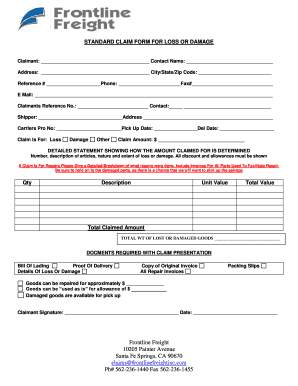
STANDARD CLAIM FORM FOR LOSS OR DAMAGE Claimant: Contact Name: Address: City/State/Zip Code: Reference # Phone: Fax# E Mail: Claimants Reference No.: Contact: Shipper: Address Carriers Pro No: Pick.

How it works
  • Open form

    Open form follow the instructions

  • Easily sign form

    Easily sign the form with your finger

  • Share form

    Send filled & signed form or save

How to fill out the STANDARD CLAIM FORM FOR LOSS OR DAMAGE - Frontline Freight online

Completing the Standard Claim Form for Loss or Damage from Frontline Freight is an essential step in addressing any issues with shipments. This guide provides clear, concise instructions to help users navigate the form effortlessly and submit their claims for loss, damage, or other issues.

Follow the steps to accurately complete the claim form.

  1. Click the ‘Get Form’ button to obtain the form and open it in your designated editor.
  2. In the first section, fill out the claimant's information including your name, address, city, state, and zip code. Ensure the contact name and phone number are accurate for prompt communication.
  3. Enter the reference number and any applicable fax and email information. This section is crucial as it helps in tracking your claim.
  4. Provide your reference number and the contact person for any follow-ups regarding your claim.
  5. Fill in the shipper's name and address. This identifies who is responsible for the shipment.
  6. Document the Carrier's Pro Number, pickup date, and delivery date to maintain a history of the shipment.
  7. Indicate what the claim is for by checking the appropriate boxes: Loss, Damage, or Other.
  8. Enter the claim amount in the specified field, providing a clear statement of the total value you are claiming.
  9. In the detailed statement section, describe the articles, nature, and extent of loss or damage. Include all discounts or allowances, if applicable.
  10. If your claim is for repairs, provide a detailed breakdown of repairs done and attach all relevant invoices.
  11. Total the quantity, description, unit value, and total value of the lost or damaged goods.
  12. Document the total weight of lost or damaged goods and ensure all amounts claimed are correctly tallied.
  13. Check the list of required documents needed for submission, including the bill of lading, proof of delivery, details of loss or damage, and all invoices related to the claim.
  14. Sign and date the claim form to validate your submission.
  15. Save your completed form, then download, print, or share it according to your needs.

Submit your claim by completing the online form now for a swift resolution to your loss or damage issue.

Get form

Experience a faster way to fill out and sign forms on the web. Access the most extensive library of templates available.

Related content

Frontline Ltd. - SEC.gov

If this Form is filed to register additional securities for an offering pursuant to Rule...

Learn more
To protect frontline workers during and after...

Jun 10, 2020 — As the COVID-19 pandemic continues, America's frontline workers are still...

Learn more
Safety Solutions Price List November_2018...

Nov 1, 2018 — Master Lock Company LLC will pre-pay freight charges on all orders...

Learn more
Questions & Answers

Get answers to your most pressing questions about US Legal Forms API.

Contact support

Who pays for damaged freight?

Carrier liability is the term used in the shipping industry to describe that a carrier is responsible for shipment losses, damages and delays.

Carriers cannot decline claims because of a lack of notations on the delivery receipt. However, if no additional evidence can be provided to prove the carrier caused the damage during transit, carriers can deny the claim.

LTL (less than truckload) freight claims must be filed within 9 months of the delivery date. Carriers have 30 days to acknowledge the claim and 120 days from the date of acknowledgment to come to terms.

Only the shipper, the consignee, or a third party who has claim or title to the goods may file a claim. You must file your claim with the origin or destination carrier or with the carrier on whose line the loss or damage occurred, if known.

In most cases, the shipping carriers are responsible for the damaged contents. Still, the customer often considers you, the seller, responsible for the bad experience. The last thing you should do is test their patience with a complicated refund process.

A shipper or consignee initiates a carrier claims process against the transportation service provider contracted to transport freight cargo or parcel shipments under agreed-upon Bill of Lading terms.

In the event of loss or damage, the consignee would file a freight claim against the carrier for (i) damages to cover the loss and (ii) reimbursement of any freight paid. The shipper will not be able to make any claim except as an agent of the consignee.

How to Fight a Freight Claim. Document the damage. ... Keep the freight. ... Carmack Amendment. ... Pay the freight charges. ... Understand your Bill of Lading. ... Timeliness. ... Know the Maximum Freight Claims Liability Amount. ... Profit.

Get This Form Now!

Use professional pre-built templates to fill in and sign documents online faster. Get access to thousands of forms.

If you believe that this page should be taken down, please follow our DMCA take down process here.

Get STANDARD CLAIM FORM FOR LOSS OR DAMAGE - Frontline Freight