We use cookies to improve security, personalize the user experience, enhance our marketing activities (including cooperating with our marketing partners) and for other business use.
Click "here" to read our Cookie Policy. By clicking "Accept" you agree to the use of cookies. Read less
Read more
Accept
Loading
Form preview
  • US Legal Forms
  • Form Library
  • More Forms
  • More Uncategorized Forms
  • Blooms Taxonomy And Costas Levels Of Questioning Prompts And Tasksl Instruction

Get Blooms Taxonomy And Costas Levels Of Questioning Prompts And Tasksl Instruction

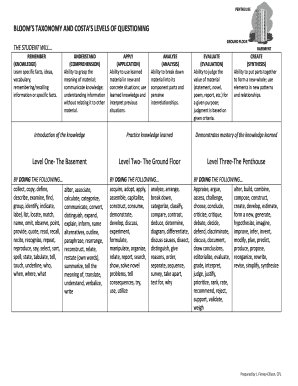
PENTHOUSE BLOOMS TAXONOMY AND COSTAS LEVELS OF QUESTIONING GROUND FLOOR THE STUDENT WILL REMEMBER (KNOWLEDGE) Learn specific facts, ideas, vocabulary; remembering/recalling information or specific.

How it works

  1. Open form

    Open form follow the instructions

  2. Easily sign form

    Easily sign the form with your finger

  3. Share form

    Send filled & signed form or save

How to use or fill out the Blooms Taxonomy And Costas Levels Of Questioning Prompts And Tasks Instruction online

This guide provides a clear and comprehensive overview of how to fill out the Blooms Taxonomy And Costas Levels Of Questioning Prompts And Tasks Instruction form online. Users will gain valuable insights into each section of the form, ensuring they can effectively utilize the prompts and tasks to enhance their questioning techniques.

Follow the steps to fill out the form with ease.

  1. Click ‘Get Form’ button to access the form and open it in your desired online editor.
  2. Begin by reviewing the introduction section of the form. Familiarize yourself with the definitions and purposes of Bloom's Taxonomy and Costa's Levels of Questioning, as this will provide a framework for completing the tasks.
  3. Navigate to the first section labeled 'Remember (Knowledge).' Here, you will outline key facts, ideas, or vocabulary that the students will need to recall. Use examples provided to guide your input.
  4. Proceed to the 'Understand (Comprehension)' section. Describe how the material can be communicated or understood by students. Focus on explaining the material without relating it to other context.
  5. In the 'Apply (Application)' section, provide concrete examples of how the knowledge can be applied in new situations. Include practical scenarios that students might encounter.
  6. Move to the 'Analyze (Analysis)' section. Break down the material and illustrate the interrelationships between concepts. Provide insights on how to dissect the information.
  7. Next, fill out the 'Evaluate (Evaluation)' section. Specify how students can judge the value of different materials for specific purposes. Include criteria for evaluation.
  8. In the final section labeled 'Create (Synthesis),' explain how students can put together different parts to form new ideas. Encourage creative thinking and innovative approaches.
  9. Review all sections for completeness and accuracy. Ensure that each area has been thoroughly addressed with clear and concise language.
  10. Once you have finished filling out the form, you can save your changes, download a copy, print it out, or share it as needed.

Complete your Blooms Taxonomy And Costas Levels Of Questioning Prompts And Tasks Instruction form online today for a comprehensive enhancement of your teaching strategies.

Get form

Experience a faster way to fill out and sign forms on the web. Access the most extensive library of templates available.
Get form

Related content

Writing - ERIC
Developing Minds: A Resource Book for Teaching ... Teacher Behaviors That Enable Student...
Learn more
5.4 Understands the cognitive processes associated...
question at each level of Bloom's taxonomy in ... activities. No evidence that he/she...
Learn more
2017 Book The Data Science Design Manual...
Instead, this book provides a high-level discussion of important design principles....
Learn more

Related links form

Please Click Here For The Dr Phillips Eagle Bb - Central Florida Council Checklist Amp Intake Form Following Eagle Board Of Review BSA Local Council Certification Intake Form - Central Florida Council Politika.org.esn1glocalizacion.doc - Hegoa Ehu

Questions & Answers

Get answers to your most pressing questions about US Legal Forms API.

Contact support

Use the action verbs to inform your learning intentions. There are lots of different graphics that combine all the domains and action verbs into one visual prompt. ... Use Bloom-style questions to prompt deeper thinking. ... Use Bloom's Taxonomy to differentiate your lessons.

Make sure there is one measurable verb in each objective. Each objective needs one verb. ... Ensure that the verbs in the course level objective are at least at the highest Bloom's Taxonomy as the highest lesson level objectives that support it.

The most important use of Bloom's Taxonomy is that is a good heuristic for teachers to understand the varying levels of cognitive, psychomotor, and affective demand that teachers have as outcomes for students. It also helps with assessments in terms of matching your assessment items to the level of your objectives.

In English, there are four types of questions: general or yes/no questions, special questions using wh-words, choice questions, and disjunctive or tag/tail questions. Each of these different types of questions is used commonly in English, and to give the correct answer to each you'll need to be able to be prepared.

Application- Application refers to the ability to use learned material in new and concrete situations. This may include the application of such things as rules, methods, concepts, principles, laws, and theories. Learning outcomes in this area require a higher level of understanding than those of comprehension.

These types of questions test the students' ability to memorize and to recall terms, facts and details without necessarily understanding the concept. Examples of questions: "What is...?"

In Bloom's Taxonomy, there are six levels of skills ranked in order from the most basic to the most complex. ... Subjective assessments (essay responses, experiments, portfolios, performances) tend to measure the higher levels of Bloom's Taxonomy: applying, analyzing, evaluating, and creating.

There are six levels of cognitive learning according to the revised version of Bloom's Taxonomy. Each level is conceptually different. The six levels are remembering, understanding, applying, analyzing, evaluating, and creating.

Bloom's taxonomy is a set of three hierarchical models used to classify educational learning objectives into levels of complexity and specificity. The models organize learning objectives into three different domains: Cognitive, Affective and Sensory/Psychomotor.

Get This Form Now!

Use professional pre-built templates to fill in and sign documents online faster. Get access to thousands of forms.
Get form
If you believe that this page should be taken down, please follow our DMCA take down processhere.

Industry-leading security and compliance

US Legal Forms protects your data by complying with industry-specific security standards.
  • In businnes since 1997
    25+ years providing professional legal documents.
  • Accredited business
    Guarantees that a business meets BBB accreditation standards in the US and Canada.
  • Secured by Braintree
    Validated Level 1 PCI DSS compliant payment gateway that accepts most major credit and debit card brands from across the globe.
Get Blooms Taxonomy And Costas Levels Of Questioning Prompts And Tasksl Instruction
Get form
Form Packages
Adoption
Bankruptcy
Contractors
Divorce
Home Sales
Employment
Identity Theft
Incorporation
Landlord Tenant
Living Trust
Name Change
Personal Planning
Small Business
Wills & Estates
Packages A-Z
Form Categories
Affidavits
Bankruptcy
Bill of Sale
Corporate - LLC
Divorce
Employment
Identity Theft
Internet Technology
Landlord Tenant
Living Wills
Name Change
Power of Attorney
Real Estate
Small Estates
Wills
All Forms
Forms A-Z
Form Library
Customer Service
Terms of Service
Privacy Notice
Legal Hub
Content Takedown Policy
Bug Bounty Program
About Us
Help Portal
Legal Resources
Blog
Affiliates
Contact Us
Delete My Account
Site Map
Industries
Forms in Spanish
Localized Forms
State-specific Forms
Forms Kit
Legal Guides
Real Estate Handbook
All Guides
Prepared for You
Notarize
Incorporation services
Our Customers
For Consumers
For Small Business
For Attorneys
Our Sites
US Legal Forms
USLegal
FormsPass
pdfFiller
signNow
airSlate WorkFlow
DocHub
Instapage
Social Media
Call us now toll free:
+1 833 426 79 33
As seen in:
  • USA Today logo picture
  • CBC News logo picture
  • LA Times logo picture
  • The Washington Post logo picture
  • AP logo picture
  • Forbes logo picture
© Copyright 1997-2025
airSlate Legal Forms, Inc.
3720 Flowood Dr, Flowood, Mississippi 39232
Form Packages
Adoption
Bankruptcy
Contractors
Divorce
Home Sales
Employment
Identity Theft
Incorporation
Landlord Tenant
Living Trust
Name Change
Personal Planning
Small Business
Wills & Estates
Packages A-Z
Form Categories
Affidavits
Bankruptcy
Bill of Sale
Corporate - LLC
Divorce
Employment
Identity Theft
Internet Technology
Landlord Tenant
Living Wills
Name Change
Power of Attorney
Real Estate
Small Estates
Wills
All Forms
Forms A-Z
Form Library
Customer Service
Terms of Service
Privacy Notice
Legal Hub
Content Takedown Policy
Bug Bounty Program
About Us
Help Portal
Legal Resources
Blog
Affiliates
Contact Us
Delete My Account
Site Map
Industries
Forms in Spanish
Localized Forms
State-specific Forms
Forms Kit
Legal Guides
Real Estate Handbook
All Guides
Prepared for You
Notarize
Incorporation services
Our Customers
For Consumers
For Small Business
For Attorneys
Our Sites
US Legal Forms
USLegal
FormsPass
pdfFiller
signNow
airSlate WorkFlow
DocHub
Instapage
Social Media
Call us now toll free:
+1 833 426 79 33
As seen in:
  • USA Today logo picture
  • CBC News logo picture
  • LA Times logo picture
  • The Washington Post logo picture
  • AP logo picture
  • Forbes logo picture
© Copyright 1997-2025
airSlate Legal Forms, Inc.
3720 Flowood Dr, Flowood, Mississippi 39232