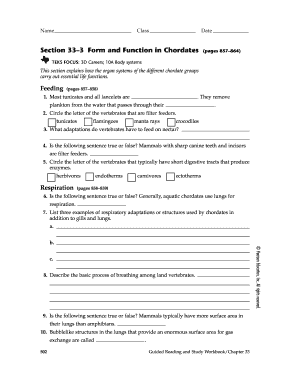
BIOALL IN1StGdtesech33 8/7/03 4 45 PM Page 502 Name Class Section 33 3 Form and Function in Chordates pages 857 864 TEKS FOCUS 3D Careers 10A Body systems This section explains how the organ systems of the different chordate groups carry out essential life functions.
Open form follow the instructions
Easily sign the form with your finger
Send filled & signed form or save
How to fill out the Section 33 3 Form And Function In Chordates online
Filling out the Section 33 3 Form And Function In Chordates is essential for understanding the various organ systems of chordates. This guide provides a clear approach to completing the form online, ensuring users can provide the necessary information efficiently.
Follow the steps to complete the form online.
- Click the ‘Get Form’ button to access the form and open it in your editor.
- Begin by filling in your name in the designated field at the top of the form.
- Next, enter your class information in the appropriate section, ensuring it matches the format requested.
- Record the date by clicking into the date field and selecting the current date from the calendar option.
- Proceed to the main body of the form where you will answer the questions regarding feeding, respiration, circulation, excretion, response, movement, and reproduction, as outlined in the content.
- Be sure to read each question carefully, and provide accurate information based on the chapters detailed in the workbook.
- As you complete each section, make sure to save your progress regularly to avoid any data loss.
- Once you have filled out all sections, review your entries for accuracy and completeness.
- Finally, you can download, print, or share the completed form by selecting the relevant options in your editor.
Start filling out your Section 33 3 Form And Function In Chordates online today!
Experience a faster way to fill out and sign forms on the web. Access the most extensive library of templates available.
Related content
Aug 21, 2014 — 3. The phylogeny of chordates: traditional and recent views ... of the...
Dec 4, 2020 — Chordates Biology - Houston Independent School District Section 33–3...
Sea urchins are typically spiny, globular animals, echinoderms in the class Echinoidea...
Get answers to your most pressing questions about US Legal Forms API.
What is the function of gill slits in invertebrate chordates?
In primitive chordates, these slits are used to filter food particles from the water. In fishes and some amphibians, the slits bear gills and are used for gas exchange. In most land- living chordates, the "gill slits" are present only in embryonic stages; you had pharyngeal slits at one time.
What is the basis of classification of chordates?
Phylum Chordata belongs to the Kingdom Animalia and includes all the vertebrates, i.e., animals with a backbone, and several invertebrates, i.e., organisms without a backbone. They possess a bilaterally symmetrical body and are divided into three different sub-phyla.
What are the three subphyla of chordates and indicate whether they are invertebrates or vertebrates?
Living species of chordates are classified into three major subphyla: Vertebrata, Urochordata, and Cephalochordata. Vertebrates are all chordates that have a backbone. The other two subphyla are invertebrate chordates that lack a backbone. Members of the subphylum Urochordata are tunicates (also called sea squirts).
What are the four embryonic characteristics found in all chordates?
In chordates, four common features appear at some point during development: a notochord, a dorsal hollow nerve cord, pharyngeal slits, and a post-anal tail.
What are three characteristics that set chordates apart from other Phylums?
"The four distinctive characteristics that, taken together, set chordates apart form all other phyla are the notochord; single, dorsal, tubular nerve cord; pharyngeal pouches; and postanal propulsive tail.
What are the 3 primary defining characteristics of chordates?
Animals in the phylum Chordata share four key features: a notochord, a dorsal hollow nerve cord, pharyngeal slits, and a post-anal tail.
How do chordates maintain homeostasis?
Feeding and digestion help maintain homeostasis by providing the body with a continuing supply of needed nutrients. Most tunicates, and all lancelets, are filter feeders. These chordates remove small organisms called plankton from the water that passes through their pharynx.
What are the bases of classifying chordates into three Subphyla?
The prevailing view holds that the phylum Chordata consists of three subphyla: Urochordata (Tunicata), Cephalochordata and Vertebrata (figure 1a). All three groups are characterized by possession of a notochord, a dorsal, hollow neural tube (nerve cord), branchial slits, an endostyle, myotomes and a postanal tail.
Use professional pre-built templates to fill in and sign documents online faster. Get access to thousands of forms.
If you believe that this page should be taken down, please follow our DMCA take down process here.