Loading
Get Avalanche Incident Report: Short Form - Avalanche.org - Avalanche
How it works
-

Open form follow the instructions
-

Easily sign the form with your finger
-

Send filled & signed form or save
How to fill out the Avalanche Incident Report: Short Form - Avalanche.org - Avalanche online
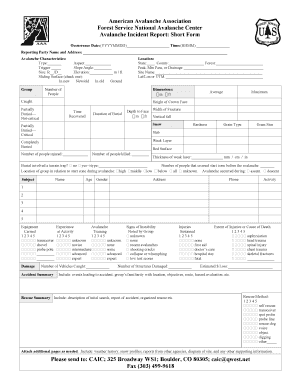
The Avalanche Incident Report: Short Form is an essential tool for documenting avalanche events. This guide will provide you with clear, step-by-step instructions for accurately completing the form to ensure that all necessary information is effectively conveyed.
Follow the steps to complete the form online successfully.
- To begin, click the ‘Get Form’ button to access the Avalanche Incident Report. This will open the form for you to fill out online.
- Start by entering the occurrence date in YYYYMMDD format, followed by the time the incident occurred in HHMM format.
- Fill in your name and address in the Reporting Party section to identify who is completing the report.
- Detail the avalanche characteristics by selecting the type, aspect, trigger, slope angle, size, and elevation of the avalanche.
- In the sliding surface section, check the option that best describes the surface involved in the avalanche.
- Provide location details, including state, county, forest, peak, mountain pass, or drainage, as well as the site name and geographic coordinates (Lat/Lon or UTM).
- Indicate the number of people involved in the incident and document the dimensions of the avalanche, including caught data, height of the crown face, and depth to face.
- Specify the snow characteristics such as weak layer hardness, grain type, and grain size.
- State the number of people injured or killed, and indicate if the burial involved a terrain trap.
- Clarify the location of the group in relation to the start zone and their activity at the time.
- For each individual involved, provide their name, age, and gender, as well as their equipment and experience.
- In the accident summary, describe signs of instability noted, extent of injuries, and damages, including structures affected and estimated loss.
- Compile a rescue summary detailing the initial search and rescue methods utilized.
- If needed, attach additional pages for supplementary information like weather history and other reports.
- Finally, review your entries for accuracy and completeness before submitting the report via the specified email or fax.
Complete your Avalanche Incident Report online today to effectively document and share crucial information.
Related links form
United States classification for avalanche size The size of avalanches are classified using two scales; size relative to destructive force or D-scale and size relative to the avalanche path or R-scale. Both size scales range from 1 to 5 with the D size scale half sizes can be used.