Loading
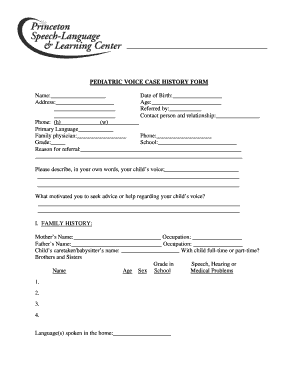
Get Pediatric Voice Case History Form - Psllcnj.com
How it works
-

Open form follow the instructions
-

Easily sign the form with your finger
-

Send filled & signed form or save
How to fill out the Pediatric Voice Case History Form - Psllcnj.com online
Completing the Pediatric Voice Case History Form is an important step in understanding and addressing a child's voice-related issues. This guide will help you through each section of the form, ensuring that you provide comprehensive information that will assist healthcare professionals in their assessment.
Follow the steps to fill out the form effectively.
- Click the ‘Get Form’ button to access the Pediatric Voice Case History Form and open it in your preferred editor.
- Begin by entering your child's details at the top of the form, including their name, date of birth, address, and age. It is essential to provide accurate information in these fields.
- Fill out the referral information by detailing the person or organization that referred your child for assistance.
- In the contact section, provide details about the primary contact person and their relationship to the child, along with their phone numbers for both home and work.
- Indicate the primary language spoken at home and list the family physician's details, including their name and phone number.
- Specify your child's current grade and school, as well as the reason for their referral, providing as much context as possible.
- Describe your child's voice in detail, focusing on any concerns or observations you have noticed that prompted you to seek help.
- In the Family History section, fill in each parent's name and occupation, and provide information about other family members, including siblings, who may have voice or speech problems.
- Carefully outline the history of the voice problem in the designated section, stating when it was first noticed, the circumstances surrounding its onset, and whether it began suddenly or gradually.
- In the Variation of the Problem section, document specific situations where the voice issue is least or most troublesome, noting how your child's voice responds to different emotional states.
- Proceed to the Family and Environmental Information section and answer questions regarding any family history of speech issues, voice use patterns, and environmental stressors like exposure to smoke.
- Complete the Health History and Developmental History sections, noting any past medical issues, hospitalizations, or developmental challenges that may relate to your child’s voice problems.
- After thoroughly filling out all sections, review your entries for accuracy and completeness.
- Finally, save your changes, and download or print the form as needed for submission.
Take the first step towards improving your child's voice health by completing the Pediatric Voice Case History Form online today.
Retain for one year unless there are Distress or Urgency entries. Retain for two years if there are no Distress entries. Logs related to an investigation may not be destroyed without specific authorization.