Loading
Form preview
  • US Legal Forms
  • Other Templates
  • More Forms
  • More Uncategorized Forms
  • Periodontal Risk Assessment Form

Get Periodontal Risk Assessment Form

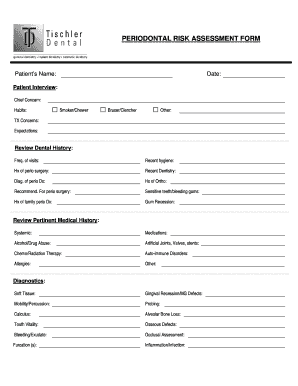
PERIODONTAL RISK ASSESSMENT FORM Patient s Name: Date: Patient Interview: Chief Concern: Habits: Smoker/Chewer Bruxer/Clencher Other:.

How it works

  1. Open form

    Open form follow the instructions

  2. Easily sign form

    Easily sign the form with your finger

  3. Share form

    Send filled & signed form or save

How to fill out the Periodontal Risk Assessment Form online

Filling out the Periodontal Risk Assessment Form online is a crucial step for both dental professionals and patients to assess periodontal health risks. This guide offers clear, step-by-step instructions to help users complete the form accurately and efficiently.

Follow the steps to fill out the Periodontal Risk Assessment Form online.

  1. Click ‘Get Form’ button to obtain the form and open it in the editor.
  2. Begin by entering the patient's name and the current date at the top of the form.
  3. In the patient interview section, list the chief concern and any relevant habits. Indicate if the patient is a smoker or chewer, a bruxer or clencher, or if there are other habits that should be noted.
  4. Next, outline any treatment concerns or expectations the patient may have regarding their periodontal care.
  5. Review the patient's dental history, including the frequency of visits, recent hygiene practices, and history of periodontal surgery or dentistry.
  6. Check for any diagnoses of periodontal disease and document pertinent details about orthodontic history and family history of periodontal disease.
  7. Assess and note any gum recession or sensitivity in teeth and gums.
  8. Review the patient's medical history, documenting existing systemic conditions, medications, and history of alcohol or drug abuse. Include information about artificial joints, chemotherapy, autoimmune disorders, allergies, and other relevant medical details.
  9. Move on to the diagnostics section. Record findings related to soft tissue health, mobility or percussion results, probing depths, calculus buildup, alveolar bone loss, tooth vitality, osseous defects, presence of bleeding or exudate, and occlusal assessment.
  10. Indicate the furcation involvement and any signs of inflammation or infection.
  11. Classify the periodontal case type based on the American Academy of Periodontology categories, ensuring to select the appropriate type from acute to severe cases.
  12. In the general treatment plan, outline any genetic testing, antimicrobial treatments, and specify whether the treatment will take place with a hygienist or dentist.
  13. Detail specific procedures such as adult prophylaxis, laser-assisted treatments, debridement, and occlusal adjustments.
  14. Determine the recare interval and provide any additional comments necessary for clarification.
  15. Finally, ensure you enter the dentist's name and the date of the assessment. Review the entire form for accuracy before completion.
  16. After filling out the form, users can save their changes, download, print, or share the completed document.

Start filling out your Periodontal Risk Assessment Form online today.

Get form

Experience a faster way to fill out and sign forms on the web. Access the most extensive library of templates available.
Get form

Related content

Risk assessment for periodontal disease - NCBI...
As people age, their risk for developing periodontal disease increases. Over half of the...
Learn more
Development and Evaluation of an Interdisciplinary...
PERIODONTAL RISK PREDICTION TOOL USING A MACHINE LEARNING ... assessment of risk for PD...
Learn more
Periodontal Disease - annals.edu.sg
Periodontal Disease as a Risk for PLBW—BK Yeo et al ... intrauterine growth assessment...
Learn more

Related links form

Electrical Permit Application-Rev 62015 - Hales Corners - Halescorners Fines And Fees Report Seatbelt And Child Restraint - MTAS Water Softener Buyback Form - City Of Santa Paula - Ci Santa-paula Ca Download Application - Wild Waves Theme Park

Questions & Answers

Get answers to your most pressing questions about US Legal Forms API.

Contact support

Periodontal disease is diagnosed by your dentist or dental hygienist during a periodontal examination. This type of exam should always be part of your regular dental check-up. A periodontal probe (small dental instrument) is gently used to measure the sulcus (pocket or space) between the tooth and the gums.

Chronic periodontitis results in inflammation within the supporting tissues of the teeth, progressive attachment and bone loss. This is the most frequently occurring form of periodontitis and is characterized by pocket formation and/or recession of the gingiva. It is prevalent in adults, but can occur at any age.

Periodontal disease is broken up into four separate stages: gingivitis, slight periodontal disease, moderate periodontal disease, and advanced periodontal disease.

In order to provide individualized care, a periodontal risk assessment is necessary to determine a patient's risk for disease as well as the likelihood of disease progression and the potential response to treatment. 8. Statement on risk assessment. J Periodontol 2008;79:202.

The disease is still reversible at this stage, and can usually be eliminated by careful daily brushing and flossing. In the more advanced stages of gum disease, called periodontitis, the gums and bone that support the teeth become seriously damaged.

To help combat and reverse periodontal disease, the dentist will remove tartar and plaque from below the gum line. This is known as scaling and root planing. Local anaesthesia is used because it would be painful without it. In addition, your periodontist will prescribe an antibiotic to limit the infection.

The condition you may refer to as gum disease also is called periodontal disease. Periodontal disease is an inflammation of the gums that, if severe, can lead to the loss of the tissues that hold your teeth in place. It is caused by plaque, a sticky film of bacteria that forms constantly on teeth.

Good oral hygiene. Share on Pinterest Regular brushing with a soft brush and fluoride toothpaste can help prevent gum disease. ... Scaling and cleaning. ... Medications. ... Advanced periodontitis.

Measure the pocket depth of the groove between your gums and teeth by placing a dental probe beside your tooth beneath your gumline, usually at several sites throughout your mouth. In a healthy mouth, the pocket depth is usually between 1 and 3 millimeters (mm). Pockets deeper than 4 mm may indicate periodontitis.

A Comprehensive Periodontal Evaluation, or CPE, is a way to assess your periodontal health by examining: Your teeth. Your plaque. Your gums. Your bite.

Get This Form Now!

Use professional pre-built templates to fill in and sign documents online faster. Get access to thousands of forms.
Get form
If you believe that this page should be taken down, please follow our DMCA take down processhere.
Get Periodontal Risk Assessment Form
Get form
  • Adoption
  • Bankruptcy
  • Contractors
  • Divorce
  • Home Sales
  • Employment
  • Identity Theft
  • Incorporation
  • Landlord Tenant
  • Living Trust
  • Name Change
  • Personal Planning
  • Small Business
  • Wills & Estates
  • Packages A-Z
  • Affidavits
  • Bankruptcy
  • Bill of Sale
  • Corporate - LLC
  • Divorce
  • Employment
  • Identity Theft
  • Internet Technology
  • Landlord Tenant
  • Living Wills
  • Name Change
  • Power of Attorney
  • Real Estate
  • Small Estates
  • Wills
  • All Forms
  • Forms A-Z
  • Other Templates
  • Legal Hub
  • About Us
  • Help Portal
  • Legal Resources
  • Blog
  • Affiliates
  • Contact Us
  • Delete My Account
  • Site Map
  • Industries
  • Forms in Spanish
  • Localized Forms
  • State-specific Forms
  • Forms Kit
  • Real Estate Handbook
  • All Guides
  • Notarize
  • Incorporation services
  • For Consumers
  • For Small Business
  • For Attorneys
  • USLegal
  • FormsPass
  • pdfFiller
  • signNow
  • altaFlow
  • DocHub
  • Instapage
Form Packages
  • Adoption
  • Bankruptcy
  • Contractors
  • Divorce
  • Home Sales
  • Employment
  • Identity Theft
  • Incorporation
  • Landlord Tenant
  • Living Trust
  • Name Change
  • Personal Planning
  • Small Business
  • Wills & Estates
  • Packages A-Z
Form Categories
  • Affidavits
  • Bankruptcy
  • Bill of Sale
  • Corporate - LLC
  • Divorce
  • Employment
  • Identity Theft
  • Internet Technology
  • Landlord Tenant
  • Living Wills
  • Name Change
  • Power of Attorney
  • Real Estate
  • Small Estates
  • Wills
  • All Forms
  • Forms A-Z
  • Other Templates
Customer Service
  • Legal Hub
  • About Us
  • Help Portal
  • Legal Resources
  • Blog
  • Affiliates
  • Contact Us
  • Delete My Account
  • Site Map
  • Industries
  • Forms in Spanish
  • Localized Forms
  • State-specific Forms
  • Forms Kit
Legal Guides
  • Real Estate Handbook
  • All Guides
Prepared for you
  • Notarize
  • Incorporation services
Our Customers
  • For Consumers
  • For Small Business
  • For Attorneys
Our Sites
  • USLegal
  • FormsPass
  • pdfFiller
  • signNow
  • altaFlow
  • DocHub
  • Instapage
Social Media
Call us now toll free:
+1 833 426 79 33
As seen in:
© Copyright 1999-2026 airSlate Legal Forms, Inc. 17 Station Street, Ste. 203, Brookline, MA 02445
  • Your Privacy Choices
  • Terms of Service
  • Privacy Notice
  • Content Takedown Policy
  • Bug Bounty Program