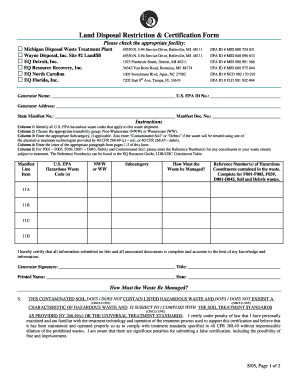
NCE STANDARDS. I certify under penalty of law that I have personally examined and am familiar with the treatment technology and operation of the treatment process used to support this certification. Based on my inquiry of those individuals immediately responsible for obtaining this information, I believe that the treatment process has been operated and maintained properly so as to comply with the treatment standards specified in 40 CFR 268.40 without impermissible dilution of the prohibited wast.
Open form follow the instructions
Easily sign the form with your finger
Send filled & signed form or save
How to use or fill out the Blank Land Disposal Restriction And Certification Form online
Filling out the Blank Land Disposal Restriction And Certification Form online is a crucial step in ensuring compliance with environmental regulations concerning hazardous waste. This guide provides clear, step-by-step instructions to help users complete the form accurately and confidently.
Follow the steps to complete the form effectively:
- Click the ‘Get Form’ button to open the Blank Land Disposal Restriction And Certification Form in your online editor.
- Select the appropriate facility from the provided list. You can choose from options such as Michigan Disposal Waste Treatment Plant or multiple EQ facilities based on your waste management needs.
- Fill in the generator information, including the generator name, U.S. EPA ID number, generator address, and state manifest number. Ensure this information is accurate to avoid delays in processing.
- Complete the manifest document number field to track the specific shipment of waste.
- In Column 1, identify all applicable U.S. EPA hazardous waste codes related to your waste shipment. Ensure that you have the correct codes for effective classification.
- In Column 2, select the appropriate treatability group: Non-Wastewater (NWW) or Wastewater (WW), based on the characteristics of the waste.
- For Column 3, indicate the appropriate subcategory if applicable, and specify if the waste consists of contaminated soil or debris that will undergo alternative treatment.
- In Column 4, enter the letter of the appropriate paragraph from the form that corresponds to how your waste must be treated.
- For Column 5, enter the reference numbers for hazardous constituents in your waste stream that are subject to treatment. This information can be found in the EQ Resource Guide.
- Complete the certification section where the generator must sign, print their name, and provide the title and date. This section confirms the accuracy of all submitted information.
- Review all entries on the form for completeness and accuracy before finalizing.
- Once completed, you may save changes, download, print, or share the filled-out form as needed.
Complete your documents online efficiently and ensure compliance with hazardous waste regulations.
Experience a faster way to fill out and sign forms on the web. Access the most extensive library of templates available.
Related content
May 21, 2020 — In 1984, Congress created the land disposal restrictions (LDR) ... HSWA...
The facility to which the waste will be shipped will provide a copy of the blank...
Table 1 - Effluent Limitations, Monitoring Frequency, and Sample Type for Each Pollutant...
Get answers to your most pressing questions about US Legal Forms API.
What does the land disposal restrictions LDR program do?
The LDR program ensures that wastes are properly treated prior to disposal. This makes hazardous waste less harmful to ground water by reducing the potential for leaching of hazardous constituents and by reducing waste toxicity by destroying or removing harmful constituents.
What is LDR wastewater?
The LDR program identifies treatment standards for hazardous wastes and specifies requirements that generators, transporters, and owners or operators of treatment, storage, and disposal facilities (TSDFs) that manage restricted wastes destined for land disposal must meet.
What is the primary purpose of the land disposal restrictions?
The LDR program ensures that wastes are properly treated prior to disposal. This makes hazardous waste less harmful to ground water by reducing the potential for leaching of hazardous constituents and by reducing waste toxicity by destroying or removing harmful constituents.
What does LDR stand for in hazardous waste?
Posted on 8/23/2016 by Joel Gregier. If your site generates hazardous wastes, you will likely deal with Land Disposal Restrictions (LDRs) at some point. In a nutshell, hazardous waste may not be placed in a landfill or surface impoundment until it has been treated to make it safer for the environment.
What does the land disposal restrictions LDR restrict?
The LDR program ensures that hazardous waste cannot be placed on the land until the waste meets specific treatment standards to reduce the mobility or toxicity of the hazardous constituents in the waste. This training module presents an overview of the land disposal restrictions program.
What was the major drive behind creating the land disposal restrictions LDR program in 1984?
One major impetus for the program was the prevention of the pollution of groundwater, usually through leaching of hazardous contaminants into water supplies. LDR provisions focus on eliminating this possibility by proper treatment of hazardous or toxic constituents in waste before land disposal.
Use professional pre-built templates to fill in and sign documents online faster. Get access to thousands of forms.
If you believe that this page should be taken down, please follow our DMCA take down process here.