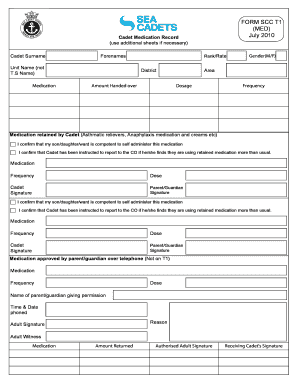
FORM SCC T1 (MED) July 2010 Cadet Medication Record (use additional sheets if necessary) Cadet Surname Forenames Unit Name (not T.S Name) Medication Rank/Rate District Amount Handed over Gender(M/F).

How it works
  • Open form

    Open form follow the instructions

  • Easily sign form

    Easily sign the form with your finger

  • Share form

    Send filled & signed form or save

How to fill out the FORM SCC T1 (MED) July 2010 online

This guide provides clear and detailed instructions on how to complete the FORM SCC T1 (MED) July 2010, which is essential for recording cadet medication information. Whether you are a parent, guardian, or authorized adult, following these steps will help ensure that the form is filled out accurately and efficiently.

Follow the steps to successfully complete the form online.

  1. Use the ‘Get Form’ button to obtain the form and open it in the online editor.
  2. Fill in the cadet’s surname, forenames, and unit name (excluding T.S. Name) in the designated fields.
  3. Record the medication details including the name, dosage, frequency, and amount handed over in the respective sections.
  4. Indicate the cadet's rank or rate, gender, and district in the appropriate fields.
  5. Confirm whether the cadet retains medication such as asthmatic relievers or anaphylaxis medication and have the cadet and parent/guardian sign off on the competency for self-administration.
  6. Provide any additional medication records as required, ensuring to include dosage and frequency for each medication listed.
  7. If necessary, include information regarding medications approved by the parent/guardian over the phone, including the name of the adult and the time and date of the phone call.
  8. Have the required signatures from the authorized adult, parent/guardian, and the cadet where indicated on the form.
  9. Once all sections are completed, review the form for accuracy before saving changes, downloading, printing, or sharing the form.

Complete your FORM SCC T1 (MED) July 2010 online now to ensure proper medication management for cadets.

Get form

Experience a faster way to fill out and sign forms on the web. Access the most extensive library of templates available.

Related content

Evaluation of the Definitions of “High-Risk”...

Sep 17, 2014 — ... squamous cell carcinoma (cSCC) has metastasized beyond the skin...

Learn more
SCC Catalog - Southeast Community College

SCC Programs of Study Chart | Page 1 | SCC College Catalog | 2016-2017. 2016-2017 ... AAS:...

Learn more
- Wikipedia

, sold under the brand name among others, is a medication used to treat ... In July 2005...

Learn more
Questions & Answers

Get answers to your most pressing questions about US Legal Forms API.

Contact support

How long can you live with stage 1 squamous cell carcinoma?

In general, the squamous cell carcinoma survival rate is very high—when detected early, the five-year survival rate is 99 percent. Even if squamous cell carcinoma has spread to nearby lymph nodes, the cancer may be effectively treated through a combination of surgery and radiation treatment.

Grade 1 cancer cells look more like normal cells under a microscope and grow and spread more slowly than grade 2 and 3 cancer cells. Stage IB squamous cell carcinoma of the esophagus. Cancer has spread into the mucosa layer, thin muscle layer, or submucosa layer of the esophagus wall.

Stage 2 squamous cell carcinoma: In stage 2, the cancer is larger than 2 centimeters across, and has not spread to nearby organs or lymph nodes, or a tumor of any size with 2 or more high risk features.

Squamous cell carcinoma of the skin is usually not life-threatening, though it can be aggressive. Untreated, squamous cell carcinoma of the skin can grow large or spread to other parts of your body, causing serious complications.

What does SCC look like? SCCs can appear as scaly red patches, open sores, rough, thickened or wart-like skin, or raised growths with a central depression. At times, SCCs may crust over, itch or bleed.

Treating squamous cell carcinoma Once squamous cell carcinoma has spread beyond the skin, though, less than half of people live five years, even with aggressive treatment.

Flexible endoscopy with biopsy is the primary method for diagnosis of esophageal cancer. Computed tomography (CT) of the chest and abdomen is an optional test for staging of early-stage esophageal cancer, and a recommended test for staging of locoregionalized esophageal cancer.

Squamous Cell Carcinoma Early Stages At first, cancer cells appear as flat patches in the skin, often with a rough, scaly, reddish, or brown surface. These abnormal cells slowly grow in sun-exposed areas.

Get This Form Now!

Use professional pre-built templates to fill in and sign documents online faster. Get access to thousands of forms.

If you believe that this page should be taken down, please follow our DMCA take down process here.

Get FORM SCC T1 (MED) July 2010